
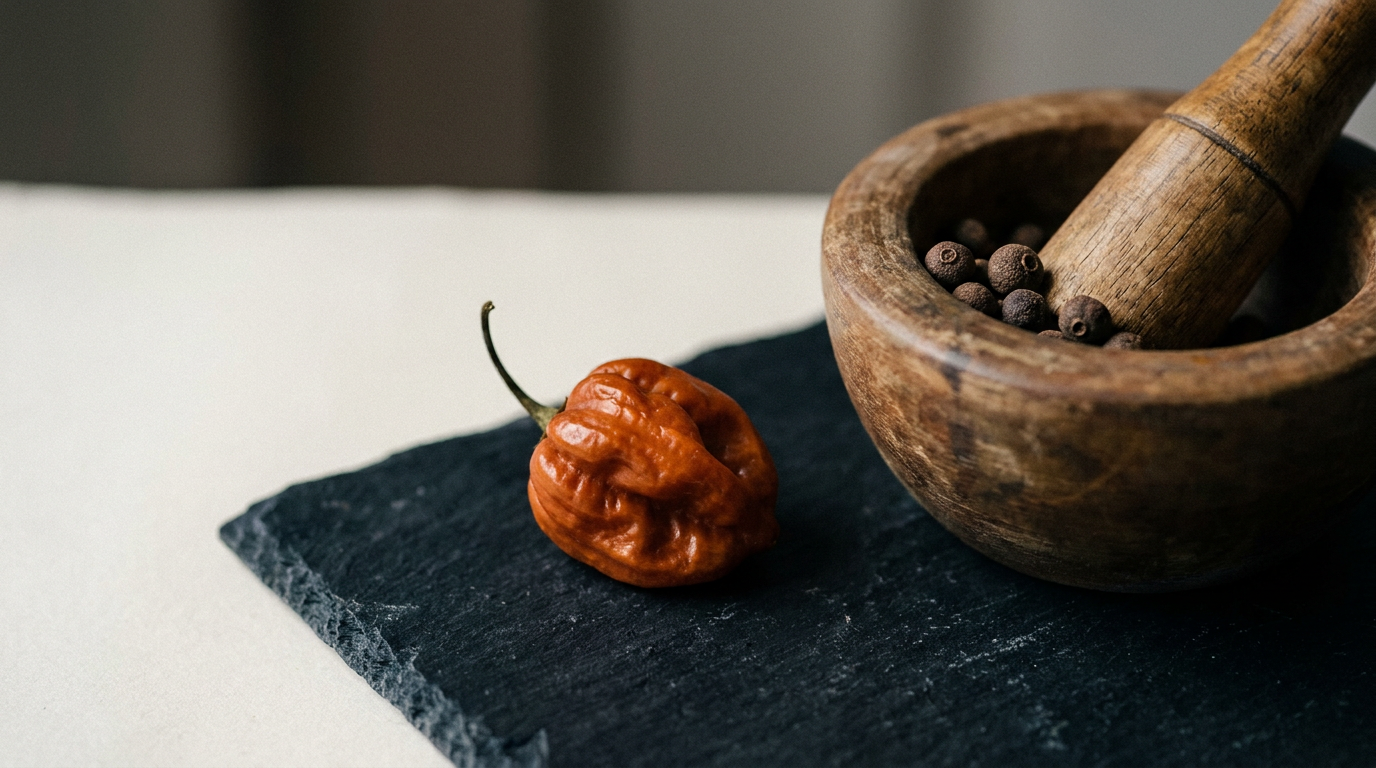
The Scotch bonnet (Capsicum chinense) is a cultivar of chili pepper native to the Caribbean, celebrated for delivering intense heat (100,000 to 350,000 Scoville Heat Units) alongside a distinctive sweet, apricot-like aroma. Often confused with the habanero, its squat, lobed shape and high concentration of volatile esters set it apart both botanically and across Caribbean foodways.
To understand the pepper, consult our reference entry for the Scotch bonnet, but consider here what happens inside the pot when fire meets aroma.
The taxonomist's error and the Amazonian pod
In 1776, the Austrian botanist Nikolaus Joseph von Jacquin surveyed the plant specimens arriving in Vienna from the Americas. He mistakenly catalogued this fiery, broad-leafed nightshade as Capsicum chinense, under the impression it originated in China [1]. The plant had nothing to do with East Asia. Its wild relatives were domesticated in the western Amazon basin thousands of years earlier.
By the time European botanists misnamed it, indigenous Taíno, Arawak, and Carib communities had cultivated distinct varieties across the Caribbean islands for generations. The variety known as the Scotch bonnet earned its English vernacular from its squashed, four-lobed silhouette, which resembles a Scotsman’s tam-o'-shanter cap. In Jamaica, Barbados, and Guyana, the plant diversified under selective cultivation, favoured for two qualities that rarely peak together in European-bred cultivars: high heat and an intense, stone-fruit sweetness.
The volatile chemistry of stone fruit
The heat of a pepper is rarely its most interesting feature. Most cultivated hot chilies belong to Capsicum annuum—the species encompassing jalapeños, poblanos, and bell peppers. C. annuum volatile profiles are dominated by alkylmethoxypyrazines, the compounds responsible for green, vegetal, cut-grass aromas.
Capsicum chinense, by contrast, expresses an entirely different aromatic machinery. Scotch bonnets synthesise a dense profile of aliphatic esters, particularly ethyl 3-methylbutanoate and hexyl esters, alongside long-chain aldehydes [2]. These are the identical volatile compounds that give ripe apricots, mangoes, and apples their aroma. When you slice through a fresh Scotch bonnet, your olfactory receptors register fruit before the trigeminal nerve registers pain. The capsaicinoids (chiefly capsaicin and dihydrocapsaicin) stimulate the TRPV1 heat receptors in the mouth, but the esters bypass that pathway entirely, travelling retro-nasally to produce a sensation of complex sweetness without sugar [3].
Scotch Bonnet versus Habanero
Commercial grocers often treat the Scotch bonnet and the orange habanero as interchangeable commodities. While both belong to C. chinense and share similar baseline Scoville metrics, they perform differently in composition and cooking.
| Trait | Scotch Bonnet | Common Orange Habanero |
| :--- | :--- | :--- |
| Botanical designation | Capsicum chinense | Capsicum chinense |
| Typical shape | Flattened, lobed, indented bottom | Tapered, lantern-shaped, pointed tip |
| Scoville rating (SHU) | 100,000 – 350,000 | 100,000 – 350,000 |
| Aromatic dominance | Apricot, ripe peach, cherry | Floral, lime zest, sharp herbaceousness |
| Pericarp thickness | Moderately fleshy, slightly succulent | Thin, taut skin |
| Traditional role | Steamed whole in stews; jerk marinades | Fresh salsas, acid-heavy table sauces |
Where the habanero is crisp and floral, the Scotch bonnet possesses an unctuous, heavier fruit body that withstands extended simmer times.
The physics of the unbroken pod
Capsaicin is not distributed evenly through a chili pepper. The seeds contain negligible capsaicin; instead, the compound is synthesised and stored in the glandular cells of the placenta—the pale, spongy tissue running down the interior of the pepper [4]. The outer flesh (pericarp) contains far lower concentrations, while housing the majority of the volatile aromatic esters.
This physiological partition explains one of the most widespread cooking techniques in Caribbean domestic cookery: dropping a whole, unpierced Scotch bonnet into a boiling pot of rice and peas, callaloo, or goat stew.
When floated intact in simmering liquid, the pepper acts as an internal pressure chamber. Water-insoluble capsaicin remains trapped within the placenta behind the hydrophobic, waxy cuticle of the skin. The lighter volatile esters, however, are released through the epidermal pores or diffused slowly through the heated skin into the steam and fat at the surface of the pot. The cook extracts perfume without releasing the caustic placenta.
The cardinal rule of this technique is structural: do not pierce the skin. The moment a fork tears the pericarp, thermal convection currents draw liquid into the internal cavity. The water dissolves capsaicin-containing resins and floods the pot, converting a delicately scented dish into pure capsaicin fire.
In applications like Jamaican jerk marinade, the approach inverts. The pepper is minced or crushed alongside scallions, pimento (allspice berries), and thyme. Here, mechanical shear breaks open the placental cells intentionally. The lipophilic capsaicin dissolves into the cooking fat and the natural oils of the crushed allspice, producing an even, prolonged burn anchored by the fruitiness of the fractured skin.
Frequently asked questions
### Why is capsaicin not in the seeds?
Capsaicinoids are produced in the placental septum that holds the seeds, not inside the seeds themselves. Seeds taste hot only because they sit in immediate physical contact with the capsaicin-secreting glands of the placenta during development.
### Can I substitute a habanero for a Scotch bonnet in stews?
Yes, from a heat perspective, because both range between 100,000 and 350,000 SHU. However, habaneros carry a lighter, citrus-forward aroma, whereas Scotch bonnets introduce a rich, stone-fruit profile essential for traditional jerk and braised dishes.
### How do you preserve Scotch bonnets without losing their fruit flavour?
Freezing whole pods inside airtight containers preserves their volatile esters far better than pickling or hot-air drying. Thermal drying drives off the delicate low-boiling-point esters, flattening the fruit profile into generic chili heat.
Sources & citations
- Jacquin, N.J. (1776). Hortus Botanicus Vindobonensis. Vienna: Kaliwoda. https://www.biodiversitylibrary.org/item/8977
- Pino, J. et al. (2007). Volatile compounds of Capsicum chinense L. cv. habanero. Food Chemistry, 104(4), 1682–1686. https://doi.org/10.1016/j.foodchem.2007.03.011
- Caterina, M.J. et al. (1997). The capsaicin receptor: a heat-activated ion channel in the pain pathway. Nature, 389(6653), 816–824. https://doi.org/10.1038/39807
- Stewart, C. et al. (2005). The Pun1 gene for pungency in Capsicum encodes a putative acyltransferase. The Plant Journal, 42(5), 675–688. https://doi.org/10.1111/j.1365-313X.2005.02410.x