
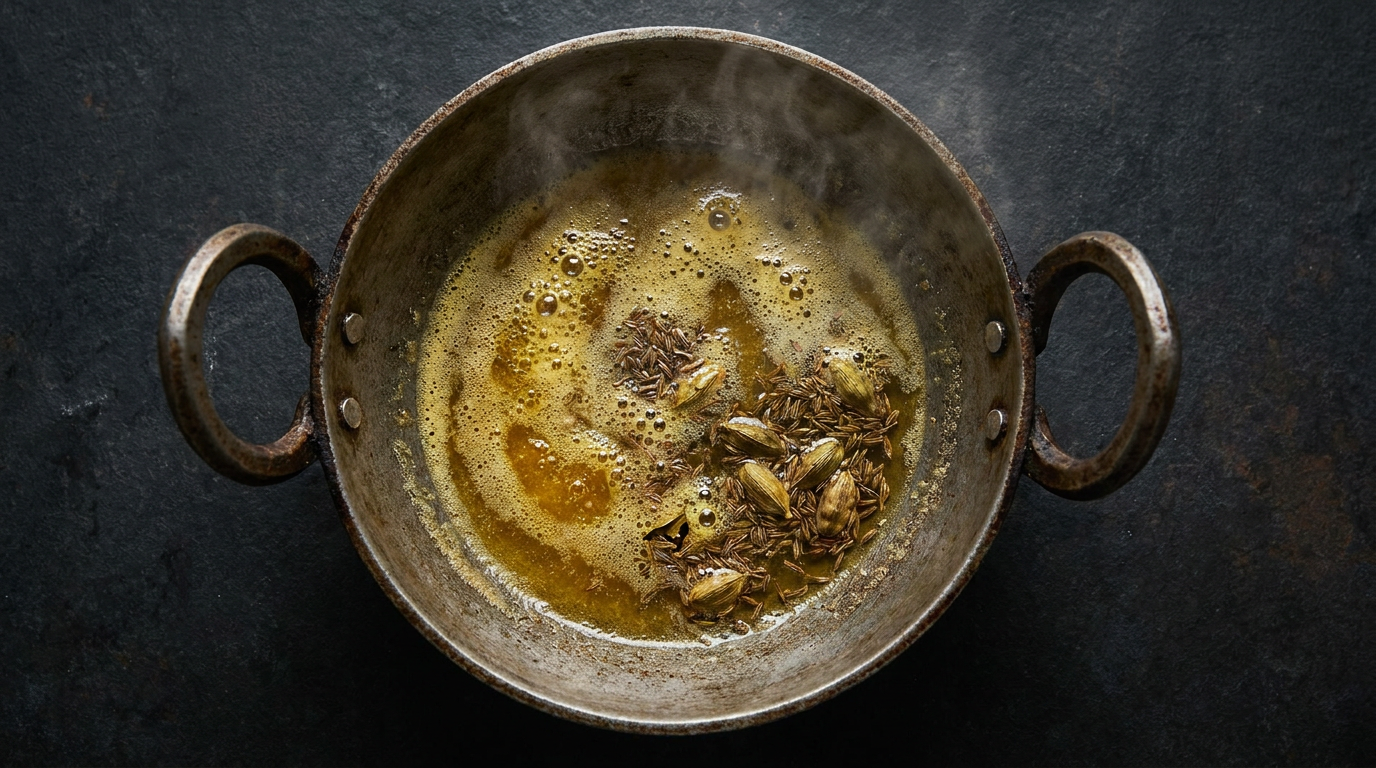
Bhuna begins with whole spices hitting hot ghee at 130 to 180°C. In the first 90 seconds, moisture inside the seed rapidly vaporises, fracturing the pericarp and releasing lipophilic essential oils—such as cuminaldehyde, eugenol, and cineole—directly into the fat. Simmering water cannot achieve this; fat-soluble volatiles require lipid extraction and Maillard browning to develop complex, non-volatile aromatic compounds [1].
The colonial flattening of the frying pan
British colonial cookery did something curious to South Asian technique: it boiled everything. Nineteenth-century household manuals, written by colonial administrators and domestic arbiters such as Flora Annie Steel, routinely instructed cooks to combine pre-ground "curry powders" with stock, flour, and meat, stewing the mixture until soft [2]. The Victorian palate understood braising, boiling, and flour-roux thickening. It did not understand lipid-mediated thermal extraction.
In classical subcontinental cooking, bhunao (often Anglicised to the noun "bhuna") is the process of frying wet pastes, aromatics, and spices in hot fat until the moisture leaves and the fat separates. Before that paste enters the pan, however, comes the initial blooming of khada masala—whole spices like cumin seed (Cuminum cyminum), green cardamom (Elettaria cardamomum), cloves (Syzygium aromaticum), and cassia bark.
Treating these whole seeds as passive garnishes or boiling them in liquid yields little flavour. Spices are protective plant structures evolved to lock chemical defences inside waxy coats, lignified fibres, and internal oil glands. Water at 100°C is incapable of dissolving them properly. Hot clarified butterfat is another proposition entirely.
The physics of the first ninety seconds
The chemical drama of blooming whole spices unfolds in three brief, overlapping stages:
### Seconds 0 to 30: The micro-steam explosion
Whole spices are dried, but they are not desiccated; they typically contain 8 to 12 percent residual water. When dropped into ghee held at 150–170°C, the external heat immediately turns that internal water into high-pressure steam. Because the seed's outer layer (the pericarp or testa) resists expansion, pressure builds until the wall ruptures. This is why cumin seeds fizz and mustard seeds pop violently. The breach creates microscopic fissures that allow hot fat to flood the seed's internal secretory canals.
### Seconds 30 to 60: Lipid solubilisation
The majority of desirable aromatic molecules in spices—terpenes, phenols, aldehydes, and esters—are hydrophobic. They do not dissolve in water; they dissolve in lipids. Ghee functions here not merely as a cooking medium or a source of flavour, but as a solvent [1]. Eugenol from cloves, cuminaldehyde from cumin, and 1,8-cineole from black cardamom dissolve directly into the liquid triglycerides. Because ghee is clarified milk fat devoid of water and milk solids, it can sit at these elevated temperatures without sputtering or scorch-foaming, capturing volatile top-notes before they escape into the kitchen hood.
### Seconds 60 to 90: Pyrazines and the Maillard threshold
Whole spices contain plant sugars and trace amino acids. As moisture drops near zero at the spice surface, thermal conditions allow non-enzymatic browning to begin. Alkylpyrazines, which produce roasted, nutty, and savoury notes, form rapidly above 130°C [3]. Meanwhile, heavier aromatics rearrange. For instance, the raw, harsh greenness of fresh cumin seed softens as volatile hydrocarbons flash off, leaving behind richer, toasted aromatic fractions.
Water versus fat extraction
To understand why British "curry powder stewing" failed so comprehensively, compare the physical behaviour of whole spices in liquid:
| Extraction Property | Boiling Water (Stewing) | Hot Ghee (Bhuna / Blooming) |
| :--- | :--- | :--- |
| Operating Temperature | 100°C maximum | 140°C to 180°C |
| Primary Solvent | Polar (water) | Non-polar (triglycerides) |
| Cell Wall Rupture | Slow softening of cellulose | Rapid steam fracture (vesicle burst) |
| Aromatic Capture | Hydrophilic tannins leach; oils float to top | Hydrophobic volatiles dissolve into lipid base |
| Maillard Reactions | Absent (inhibited by free water) | Active (forms savoury pyrazines) |
| Flavour Profile | Bitter, muddy, raw vegetable notes | Nutty, layered, aromatic, rounded |
The threshold before carbon
Ninety seconds is an outer boundary, not a target to exceed. Beyond 90 seconds in fat above 160°C, heat destroys more flavour than it creates. Monoterpenes evaporate entirely. Phenolic compounds oxidise into bitter, harsh degradation products. The sugars within the seeds char, depositing acrid polycyclic compounds that no amount of subsequent onion paste can conceal.
The cook's cue to halt this initial extraction is sensory: the cumin seeds darken from straw-yellow to reddish-brown, the cardamom pods puff with trapped steam, and the aggressive raw spice smell turns suddenly warm and rounded. At that precise second, you introduce the wet paste—onions, ginger, garlic, or tomatoes. The water in the paste instantly drops the pan's temperature below 100°C, stopping the browning and locking the dissolved essential oils securely inside the fat emulsion.
Technique is not a sentimental ritual. It is thermodynamics applied to botanical anatomy.
Frequently asked questions
### What oil works best if I do not have ghee?
Neutral oils with high smoke points and low flavour profiles work well, such as refined rapeseed or groundnut oil. Mustard oil is traditionally used in eastern and northern India, though it must first be heated to its smoking point to volatilise raw allyl isothiocyanate before spices are introduced. Butter cannot substitute for ghee here; its milk solids will burn at 120°C, long before whole spices can properly bloom.
### Can ground spices be bloomed the same way?
No. Ground spices have already lost their protective structures, and their vast surface-area-to-volume ratio means they burn within three to five seconds in fat at 160°C. Ground spices belong either in fat at a much lower temperature (under 120°C) or added directly to the wet, simmering onion base where ambient moisture protects them from scorching.
### How do I know if the ghee is at the right temperature?
Drop a single cumin seed into the pan. If it sinks to the bottom without movement, the fat is too cold and will merely soak the spice. If it turns black in three seconds, the fat is too hot. If the seed sinks briefly, rises within two seconds accompanied by fine bubbles, and smells toasted rather than charred, the fat is between 150°C and 170°C.
Sources & citations
- Reineccius, G. (2006). Flavor Chemistry and Technology (2nd ed.). CRC Press, pp. 245–252.
- Collingham, E. (2006). Curry: A Tale of Cooks and Conquerors. Oxford University Press, pp. 129–135.
- McGorrin, K. M. (2011). Key Aroma Compounds in Heated Foods: Mechanisms of Formation. ACS Symposium Series, 1058, 23–45.
- Peter, K. V. (2012). Handbook of Herbs and Spices (Vol. 2). Woodhead Publishing, pp. 11–28.