
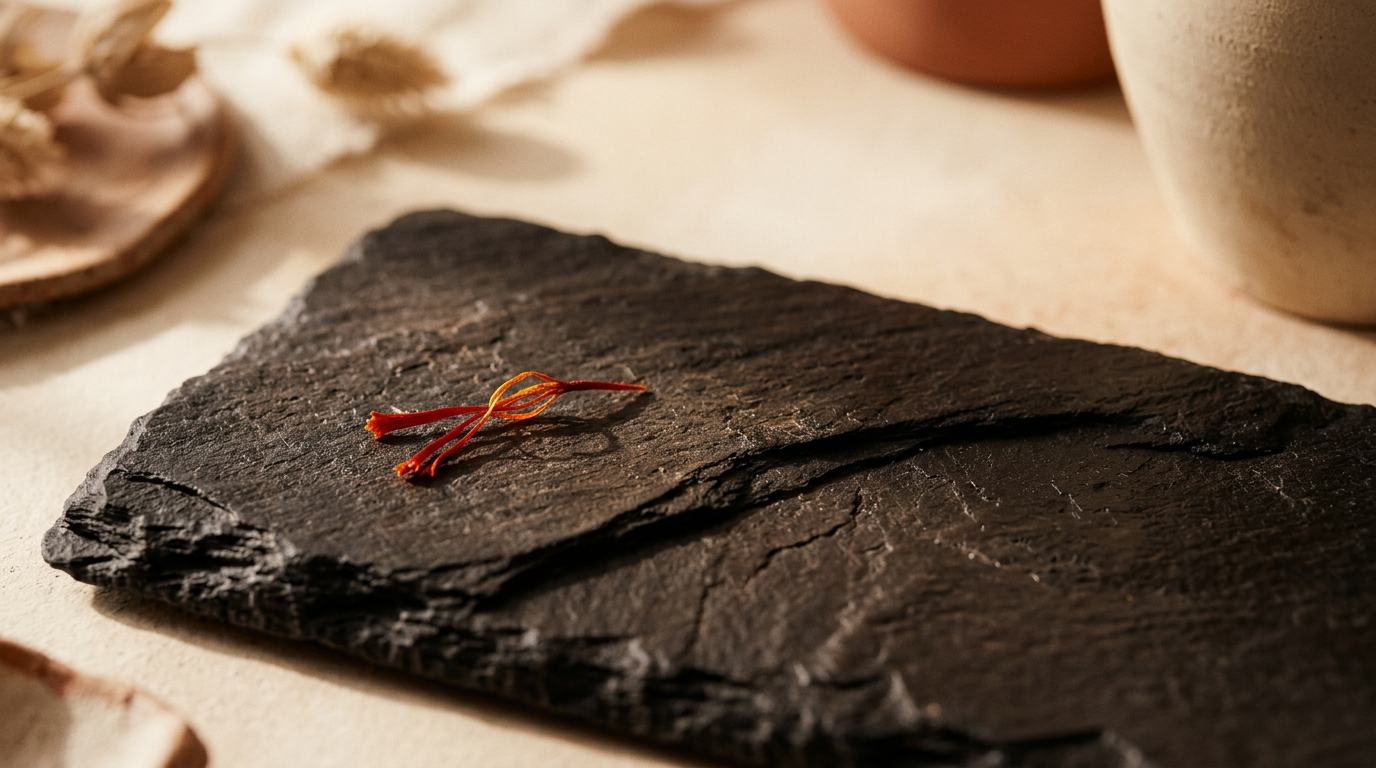
The saffron carbon footprint is an invisible cost in every precious strand, with air freight emissions often dwarfing those of the spice's careful cultivation. Shipping this delicate cargo by air from its origin to markets in the US, UK, and UAE can account for over 90% of its total transport emissions. However, smarter logistics can dramatically reduce this impact without compromising quality.
Saffron is the definition of a high-value, low-weight product. It takes roughly 150,000 crocus flowers to produce a single kilogram of dried stigmas [1]. This intensive labor, combined with its delicacy, makes it the world’s most expensive spice. For decades, the default logic has been to protect this investment by shipping it as quickly as possible: by air.
It’s a decision that makes sense on a simple spreadsheet. But it comes at a steep environmental cost. Let’s look at the numbers for a small, 10kg shipment traveling from Herat, Afghanistan to three of our key communities.
The Climate Cost of Speed
Air freight is fast, but it is extraordinarily carbon-intensive compared to ocean shipping. The difference is not subtle; it's a profound gap that changes the entire climate story of an ingredient.
| Transport Mode | Route (approx. km) | Emissions (kg CO2e) per 10kg | Notes |
| :------------- | :-------------------------- | :-------------------------- | :----------------------------------------- |
| Air Freight | Herat (AFG) to London (UK) | ~7,700km via Dubai | ~125 kg CO2e | A week's worth of driving a car. |
| Sea Freight | Herat to Karachi (sea port) | ~9,000km via sea | ~2.5 kg CO2e | The equivalent of charging your phone. |
Emissions are estimates based on standard international conversion factors [2].
As the table shows, flying that tiny parcel—barely the weight of a well-fed housecat—generates fifty times more carbon than sending it by sea. A single one-ounce shipment to a chef in the US carries a disproportionate climate penalty. For a shopper in London hunting for a few grams to make a perfect saffron risotto, the hidden emissions dwarf the spice itself. The entire industry has accepted this as the unavoidable cost of doing business. We decided to question that assumption.
Rethinking the Journey from the Ground Up
The challenge is that sea freight is slow and notoriously humid, two sworn enemies of delicate saffron. The conventional wisdom says it’s impossible. But impossible is often just a synonym for ‘no one’s built the right system yet.’
We spent two years building that system. Instead of flying dozens of small, inefficient packages directly from farms to their final destinations, we consolidated our entire harvest. We worked with our farming partners in Afghanistan on new hermetic packaging protocols to protect the stigmas from any moisture ingress. Then, we did something radical: we moved the entire season's harvest in a single, climate-controlled container by sea.
Our destination: the port of Jebel Ali in the [UAE](/region/gulf). This isn't just a random port; it's one of the world's most advanced logistics hubs, situated perfectly between our growers in the East and our customers in the West. By shipping in bulk via ocean freight to our own dedicated facility there, we slashed the main-leg transport emissions for every single gram of saffron by over 95%.
From our Gulf hub, we fulfill orders locally and regionally. It’s a model that respects the inherent value of the spice by refusing to burn carbon frivolously to move it. This is the real, and often unmeasured, part of the saffron carbon footprint.
More Than a Spice, It's a System
This isn't just about saffron. It's a proof of concept for a more thoughtful, climate-aware supply chain for all high-value agricultural goods. It requires patience, deep logistical expertise, and a willingness to invest upfront in a system that pays climate dividends for years to come.
When a product is grown with such care—hand-picked at dawn, dried by artisans, protected by generations of knowledge—it feels like a profound failure to then load it onto the most polluting form of transport available. The true measure of a spice's quality isn't just its color, aroma, or lab-certified crocin content [3]. It's also the integrity of its journey from the farmer's hand to your kitchen. By tackling the saffron carbon footprint, we're honoring the land and the labor behind it.
---
Frequently Asked Questions
1. Why is saffron so expensive?
Saffron's high cost comes from its labor-intensive harvest. Each saffron crocus produces only three tiny stigmas (threads), which must be hand-picked at dawn before the flower wilts. It takes approximately 150,000 flowers to yield just one kilogram of dried saffron [1].
2. Does shipping saffron by sea affect its quality?
If done improperly, yes. Humidity and long transit times can degrade saffron's delicate aroma and flavor compounds. Our solution involves a multi-layered system of hermetically sealed packaging at the source and climate-controlled containers to ensure the saffron arrives in perfect condition, which we verify through third-party lab testing.
3. What exactly is a "carbon footprint"?
A carbon footprint is the total amount of greenhouse gases (including carbon dioxide and methane) that are generated by our actions. In this case, it refers to the emissions produced by growing, processing, and transporting the saffron from the farm to the consumer [4].
4. How can I reduce the climate impact of my food choices?
Supporting brands with transparent supply chains is a great start. Look for companies that discuss their sourcing and logistics openly. Reducing food waste, eating seasonally, and prioritizing foods that travel by land or sea rather than air can also make a significant difference.
Sources & citations
[1] Encyclopaedia Britannica. (2023). Saffron. https://www.britannica.com/plant/saffron
[2] UK Government, Department for Business, Energy & Industrial Strategy. (2022). Greenhouse gas reporting: conversion factors 2022. https://www.gov.uk/government/publications/greenhouse-gas-reporting-conversion-factors-2022
[3] Mousavi, B., & Bathaie, S. Z. (2011). Historical uses and properties of saffron (Crocus sativus). Avicenna journal of phytomedicine, 1(1), 1–6. https://www.ncbi.nlm.nih.gov/pmc/articles/PMC3937172/
[4] The New York Times. (2023). Climate Change: What Is a Carbon Footprint? https://www.nytimes.com/guides/year-of-living-better/how-to-reduce-your-carbon-footprint