
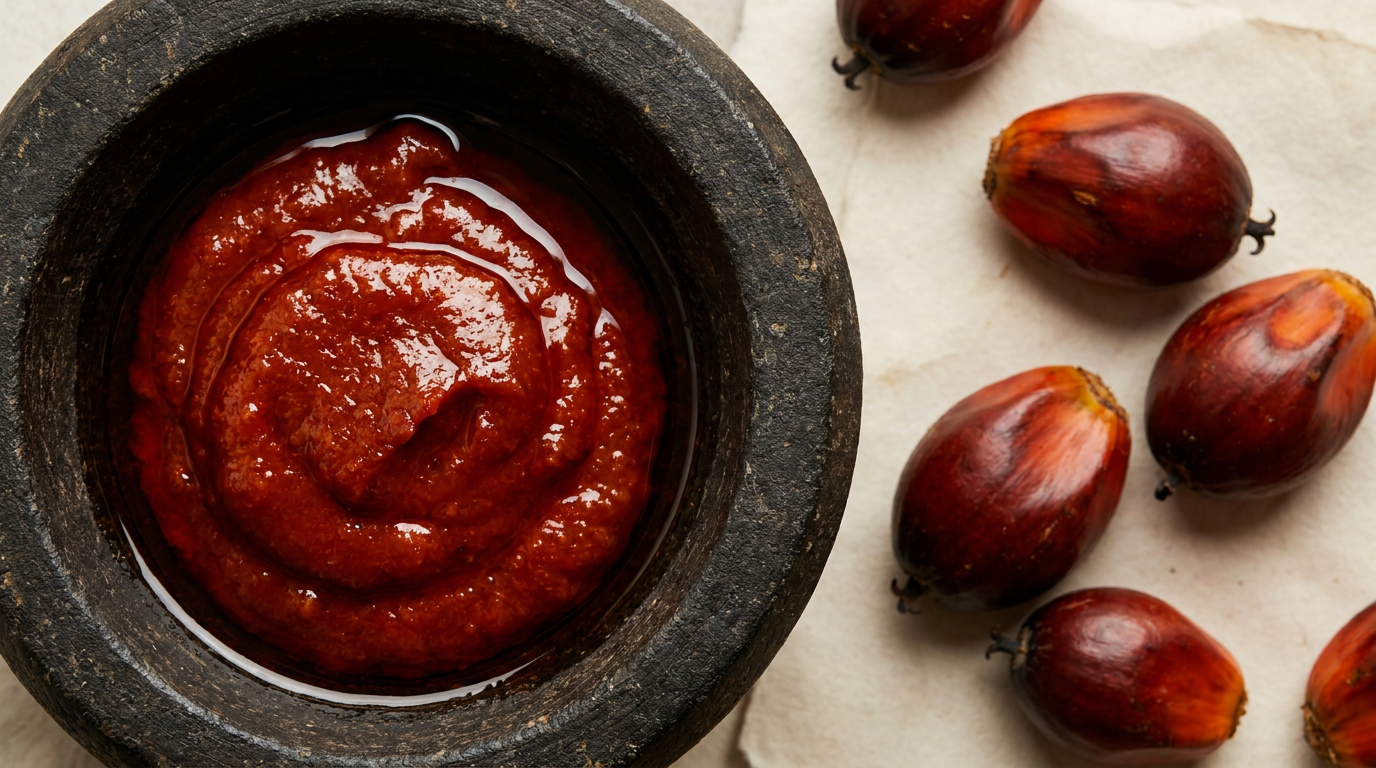
Red palm oil is an unrefined culinary fat extracted from the fleshy mesocarp of the oil palm fruit (Elaeis guineensis). Distinguished by its vivid ruby-orange colour, the oil owes its hue to exceptionally high concentrations of alpha- and beta-carotenes alongside fat-soluble tocotrienols. Unlike industrial refined palm oil, virgin red palm oil retains its potent carotenoid load, earthy aroma, and balanced fatty acid architecture.
To talk about palm oil in contemporary food writing is usually to talk about global commodity supply chains, deforestation, and industrial food manufacturing. Those are vital discussions, but they routinely erase what the ingredient actually is when treated as food rather than industrial feedstock. Long before European traders turned Elaeis guineensis into a high-yield commodity, communities across coastal West and Central Africa were boiling and pressing the oily drupes of the palm for daily sustenance, preservation, and flavour [1].
The mesocarp versus the kernel
The oil palm produces a fruit with two distinct sources of fat. The inner stone yields palm kernel oil: a pale, brittle fat composed largely of saturated lauric and myristic acids, chemically closer to coconut oil than to the flesh surrounding it. The outer fibrous mesocarp yields red palm oil.
In traditional processing, the fruit bunches are steamed or boiled to soften the pulp and inactivate endogenous lipases. Without prompt thermal deactivation, plant enzymes rapidly hydrolyse triglycerides into free fatty acids, turning the oil rancid within hours [2]. The softened pulp is pounded and pressed with water, separating the red lipid phase from the fibrous solids.
What comes out is not a neutral cooking medium. It is an unctuous, thick-bodied fat that solidifies at temperate room temperatures and melts around 30 to 38 degrees Celsius, depending on its exact ratio of solid and liquid fractions.
The pigment problem
The most striking property of virgin palm oil is its colour. At roughly 500 to 700 parts per million, its carotenoid concentration outstrips that of carrots by factor of fifteen [3]. These pigments are dominated by beta-carotene and alpha-carotene, the identical hydrocarbon molecules responsible for the colour of squashes and autumnal leaves.
Industrial refiners view these carotenoids as impurities. When palm oil is destined for commercial margarine or frying shortening, it undergoes refining, bleaching, and deodorising (RBD). The oil is heated under vacuum to over 240 degrees Celsius and passed through activated bleaching earth. Thermal degradation destroys the carotenes, leaving behind a colourless, odourless, and shelf-stable triglyceride bulk.
| Oil Variant | Source Tissue | Carotenoid Content | Predominant Fatty Acids | Culinary State |
| :--- | :--- | :--- | :--- | :--- |
| Virgin Red Palm Oil | Mesocarp (fruit flesh) | 500–700 ppm (Intense orange) | Palmitic (~44%), Oleic (~40%) | Semi-solid at 20°C; viscous, savoury |
| Refined Palm Oil (RBD) | Mesocarp (fruit flesh) | Undetectable (<5 ppm) | Palmitic (~44%), Oleic (~40%) | Liquid to semi-solid; neutral, clear |
| Palm Kernel Oil | Endosperm (seed kernel) | Negligible | Lauric (~48%), Myristic (~16%) | Solid at room temp; waxy, sharp melt |
Stripping the colour also strips the flavour. Unrefined red palm oil has an assertive, slightly floral aroma with a distinct savoury brassiness that reminds some tasters of boiled carrots, pumpkin skin, or crushed marigolds. In dishes like Nigerian banga soup, Senegalese soupou kandia, or Afro-Bahian moqueca, that flavour is not an incidental byproduct. It is the architectural spine of the broth.
The heat paradox in the pot
Cooking with unrefined red palm oil requires understanding how carotenoids react to temperature. Carotenes are heat-sensitive polyunsaturated hydrocarbons. If you pour red palm oil into an empty, roaring pan to sear a steak, you will watch the ruby oil fade to pale yellow within sixty seconds as the conjugated double bonds in the carotenes thermally oxidise and cleave [3]. Along with the pigment, you lose the tocotrienols, a potent variant of Vitamin E that acts as the oil’s built-in antioxidant defence [4].
West African cooks avoid this through culinary technique. In stews and soups, red palm oil is frequently introduced into a simmering water-rich base rather than subjected to dry, scorching heat. The presence of water caps the liquid phase temperature near 100 degrees Celsius, preserving the carotene structure and preventing thermal destruction of the nutrients.
Alternatively, when the oil is deliberately "bleached" by controlled heating in certain regional preparations, it is done gently to alter the aromatic profile from vegetal to nutty, stopping well short of the scorching temperatures used in industrial processing.
Lipid composition and stability
Nutritionally and structurally, red palm oil occupies an unusual middle ground. Its fatty acid composition splits almost evenly down the middle: roughly 50% saturated fats (principally palmitic acid), 40% monounsaturated fats (principally oleic acid), and 10% polyunsaturated linoleic acid [1].
This balance explains its stability. Unlike high-polyunsaturated seed oils (such as sunflower, soy, or corn), red palm oil is far less prone to rapid oxidation when stored. The saturated palmitic acid forms a crystal network at cooler temperatures, while the monounsaturated oleic acid keeps the fat pliable. It does not behave like liquid olive oil, nor does it behave like solid tallow. It sits squarely between them, offering body and emulsifying power without requiring industrial hydrogenation.
When we understand red palm oil through its chemical composition rather than its industrial reputation, it ceases to be an anonymous bulk ingredient. It is a regional, pigment-rich culinary fat that rewards precise thermal handling in the kitchen.
Frequently asked questions
### Does cooking with red palm oil turn food orange?
Yes. The dense concentration of carotenes readily binds to other fats and starches in the pan, tinting ingredients from pale gold to intense vermilion. In traditional stews, this vivid hue is an intentional aesthetic and cultural hallmark of the dish.
### Is red palm oil the same as palm kernel oil?
No. Red palm oil comes from the outer fleshy mesocarp of the palm fruit and contains about 50% saturated fat with abundant oleic acid and carotenes. Palm kernel oil is pressed from the inner seed, contains over 80% saturated fat (mostly lauric acid), is pale yellow or white, and contains virtually no carotenoids.
### Can you substitute olive oil for red palm oil in recipes?
Technically you can use olive oil to cook the ingredients, but the result will taste and look entirely different. Red palm oil provides a heavy, coating mouthfeel, a distinctive vegetal-nutty flavour, and an orange hue that olive oil cannot replicate. Where unavailable, cooks sometimes blend neutral oil with annatto or paprika for colour, though this misses the characteristic savoury notes.
### What is the smoke point of unrefined red palm oil?
Virgin red palm oil has a smoke point of approximately 150 to 160 degrees Celsius (around 300 to 320 degrees Fahrenheit). Because high heat destroys its carotenes and produces acrid volatiles, it is best suited for low to medium heat, gentle sautéing, or incorporation into water-based stews rather than deep-fat frying.
Sources & citations
- Edem, D.O. (2002). Palm oil: Biochemical, physiological, nutritional, hematological, and toxicological aspects: A review. Plant Foods for Human Nutrition, 57(3), 319–341.
- FAO/WHO Codex Alimentarius. (1999). Standard for Named Vegetable Oils (CXS 210-1999). Food and Agriculture Organization of the United Nations.
- Ping, F.W. & Choo, Y.M. (2000). Carotenoids in red palm oil: properties and applications. ASEAN Food Journal, 12(4), 185–194.
- Sundram, K., Sambanthamurthi, R., & Tan, Y.A. (2003). Palm fruit chemistry and nutrition. Asia Pacific Journal of Clinical Nutrition, 12(3), 355–362.