
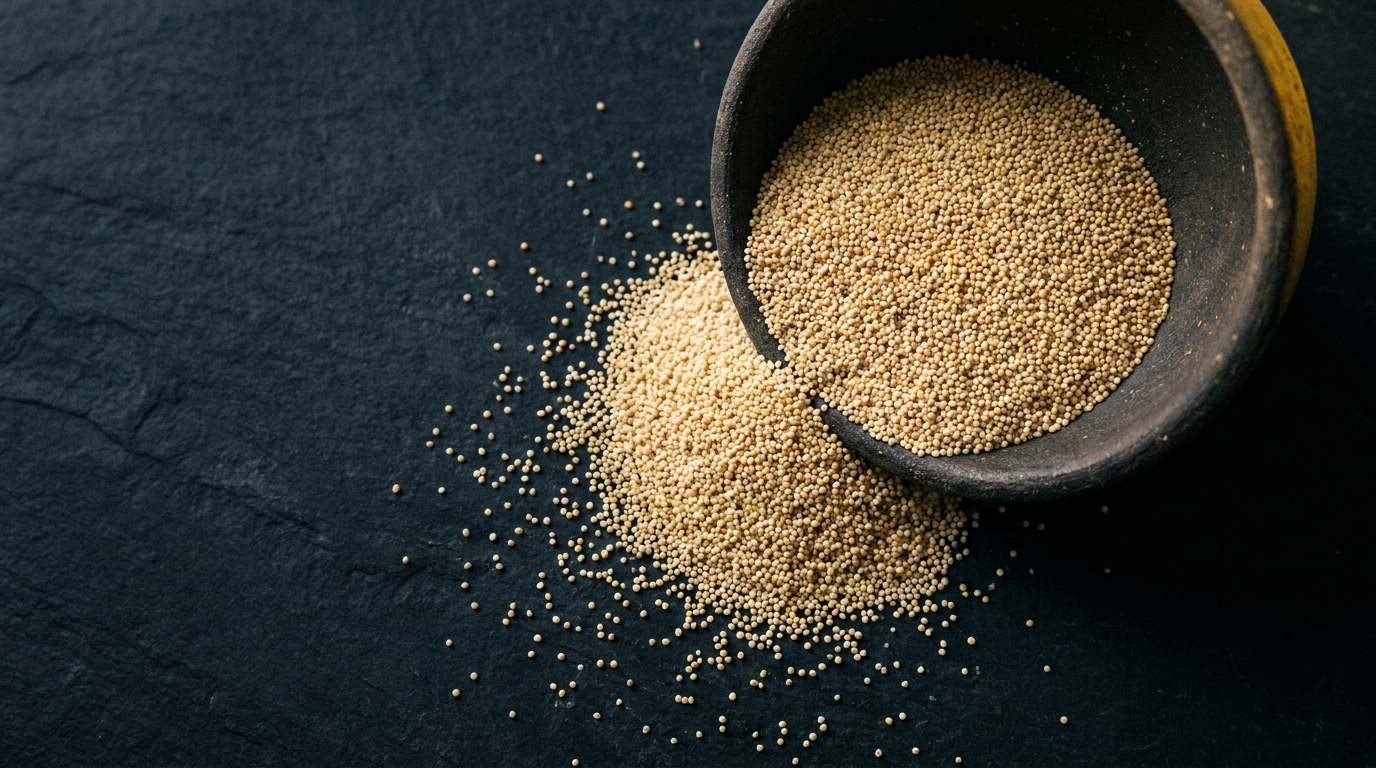
Fonio (Digitaria exilis) is an ancient, gluten-free West African grain belonging to the millet family, known for its resilience in arid soils and rapid maturation in as few as sixty days. Exceptionally rich in sulphur-rich amino acids like methionine and cystine, it serves both as an essential subsistence crop during lean seasons and a versatile, quick-cooking cereal.
For centuries across the Sahel, fonio held an unglamorous label among European observers: 'hungry rice' [1]. The title missed the botanical reality entirely. Farmers along the arid strip running from Senegal through Guinea to northern Nigeria did not sow fonio because they lacked imagination; they grew it because it solves an agronomic problem that ruins slower cereals.
The Agronomy of Urgency
Fonio belongs to the genus Digitaria, the same botanical grouping that includes common crabgrass. That ancestry gives it a profound survival advantage. While pearl millet and sorghum demand three to five months of consistent soil moisture, extra-early fonio landraces mature in just six to eight weeks [1].
This speed functions as biological insurance. In the Sahelian belt, the period between planting the main staple crops and harvesting them is traditionally known as the hungry season. Granaries from the previous year empty out just as hard field labour begins. Fonio bridges that exact physiological gap. It does this by deploying the C4 photosynthetic pathway, which concentrates carbon dioxide around the enzyme RuBisCO, minimising water loss through transpiration in high heat [2].
Furthermore, the crop tolerates poor, acidic soils with high aluminium toxicity where maize and conventional wheat fail to yield [1]. It requires little to no synthetic fertiliser, sending down a fine, fibrous root system that stabilises topsoil against the drying wind off the desert.
The Methionine Discrepancy
Most modern cereal marketing relies on broad assertions of 'nutritional density'. Fonio’s nutritional interest lies somewhere far more specific: its amino acid profile.
Cereal grains like wheat, rice, and maize typically suffer from a consistent nutritional bottleneck: they are limited in sulphur-containing amino acids, predominantly methionine and cystine. Methionine is essential; the human body cannot synthesise it, relying on it to build proteins, absorb zinc, and maintain connective tissue. Legumes, while rich in lysine, fall short on sulphur amino acids.
| Cereal / Grain | Maturation Period | Gluten Content | Notable Limiting Amino Acid | Methionine + Cysteine (g / 16g N) |
| :--- | :--- | :--- | :--- | :--- |
| White Fonio (D. exilis) | 60–90 days | Zero (Non-gluten) | Lysine | 4.0–4.6 |
| Polished White Rice | 105–150 days | Zero | Lysine | 2.5–3.2 |
| Hard Red Wheat | 110–130 days | High (Gliadin/Glutenin) | Lysine | 3.0–3.5 |
| Quinoa | 90–120 days | Zero | Leucine (mild) | 2.9–3.2 |
Fonio reverses the standard grain baseline. Its levels of methionine and cystine are nearly double those found in wheat or white rice [2, 3]. For communities reliant predominantly on plant-based starch, this biochemical quirk makes fonio an exceptional partner to pulses. The two complete each other on a molecular level without need for livestock fortification.
Its starch structure presents another documented practical advantage. Fonio possesses a comparatively high amylose-to-amylopectin ratio and a significant proportion of resistant starch [3]. The linear amylose chains pack together tightly, resisting rapid enzymatic hydrolysis by alpha-amylase in the human digestive tract. The practical result is a lower glycaemic response than polished rice or conventional couscous, making it metabolised steadily rather than delivering a steep glucose peak.
The Mechanics of Decortication
If fonio is drought-resilient and chemically exceptional, why did it fall out of global commercial supply chains during the twentieth century? The answer is mechanical.
A single fonio grain measures roughly 1 to 1.5 millimetres across. Surrounding each caryopsis is a tenacious, multi-layered silica husk that protects the seed from insects and scorching sun. Historically, processing required hours of mortar-and-pestle pestling by hand, followed by repeated washing and sun-drying to separate the sand from the seed [1, 4]. A woman might work for two hours to produce two kilograms of clean grain.
Under colonial French regimes in West Africa, this labor overhead led administrators to discourage fonio in favour of Asian paddy rice, which yielded more immediate volume per mechanical processing line. It was only in the late 1990s, when the Senegalese engineer Sanoussi Diakité invented a rotary mechanical dehuller capable of processing five kilograms of fonio in eight minutes without crushing the tiny kernel, that urban consumption became realistically viable at scale [4].
Behaviour in the Pot
In the kitchen, fonio behaves unlike either rice or semolina. Because of its tiny grain size, water absorption is near-instantaneous.
When boiled or steamed, the starch granules gelatinise between 65°C and 72°C. With a 1:2 grain-to-water ratio by volume, fonio hydrates fully in three to four minutes. The resulting grains stay distinct if kept unbothered, carrying a mild, nutty aroma driven by trace volatile aldehydes and pyrazines formed during post-harvest drying. Over-stirring during hydration, however, shears the swollen amylose networks and yields a thick, cohesive porridge akin to tori or West African swallows. Neither preparation is an error; both are functions of knowing how quickly a 1mm grain yields to heat.
Frequently Asked Questions
### Is fonio naturally gluten-free?
Yes. Fonio belongs to the Poaceae family but does not express the prolamins (such as alpha-gliadin) responsible for eliciting celiac immune responses. It can be safely consumed by individuals with celiac disease or non-celiac gluten sensitivity, provided it is processed in a facility free from wheat contamination.
### How does fonio compare to couscous?
Couscous is manufactured from rolled durum wheat semolina; it contains gluten and cooks via the rehydration of pre-steamed wheat pasta. Fonio is an intact, unrefined whole cereal grain. It cooks just as quickly as instant couscous (under five minutes) and has a similar granular texture, but it carries a higher micronutrient content, no gluten, and a lower glycaemic impact.
### Can fonio be used as a baking flour?
Because fonio lacks a gluten network, fonio flour cannot trap gas bubbles produced by yeast in the same manner as bread wheat. It functions exceptionally well in flatbreads, pancakes, shortbreads, or as a 20% to 30% composite flour mixed with higher-starch or gluten-containing flours to add nutty flavour and moisture retention.
### What does fonio taste like?
Fonio is flavour-neutral with a delicate, nutty, earthy backbone. It lacks the bitter saponin coating found on raw quinoa, meaning it does not require vigorous washing prior to cooking to remove astringent compounds.
Sources & citations
- National Research Council. (1996). Lost Crops of Africa: Volume I: Grains. Washington, DC: The National Academies Press. https://doi.org/10.17226/2305.
- Cruz, J. F., Béavogui, F., & Dramé, D. (2011). Le Fonio (Digitaria exilis). Quae / CTA, Versailles.
- Jideani, I. A. (1999). Traditional and possible technological uses of Digitaria exilis (fonio) and Digitaria iburua (iburu) grains. Plant Foods for Human Nutrition, 54(4), 363–374.
- Vodouhè, S. R., Dansi, A., Avohou, H. T., et al. (2003). Plant genetic resources and food security in West Africa: the case of fonio (Digitaria exilis). Genet Resour Crop Evol, 50, 485–493.