
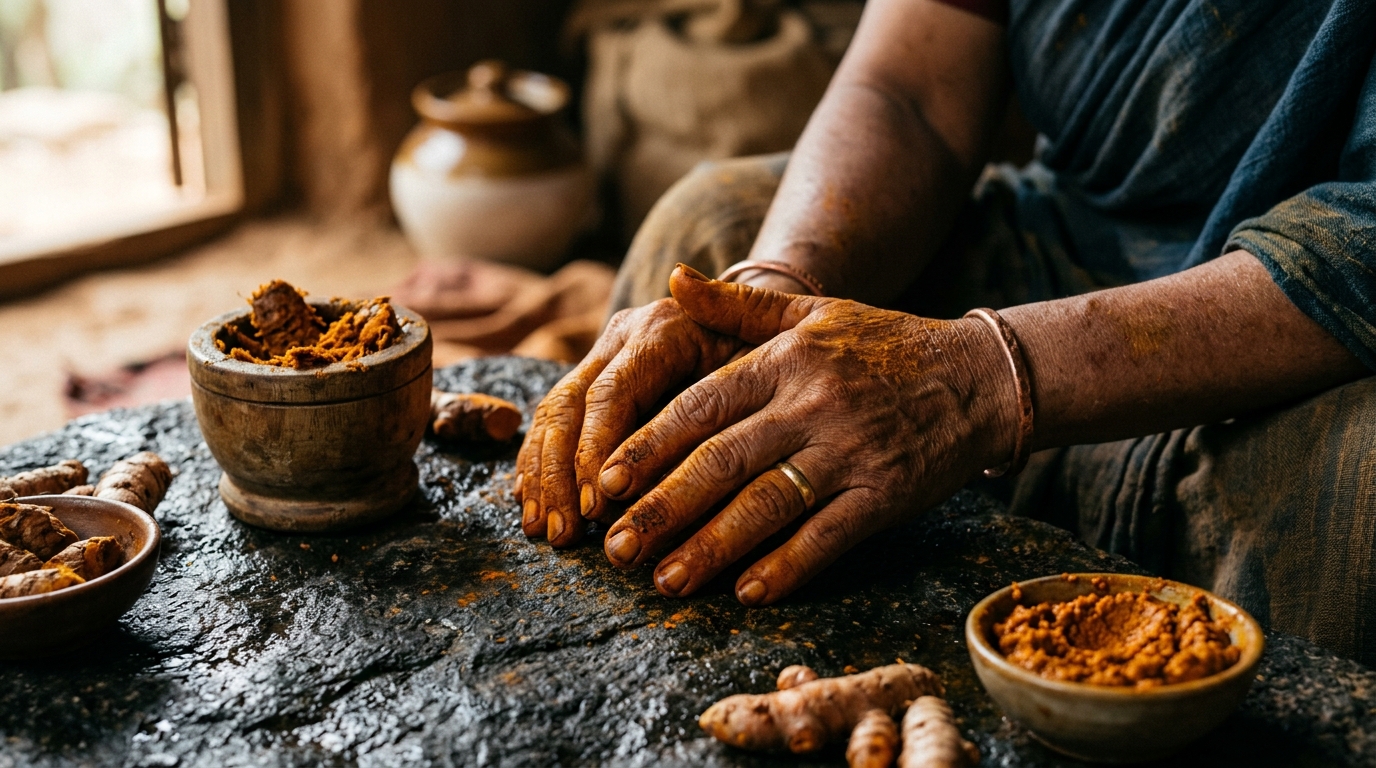
We need to talk about turmeric. Not the golden lattes or the endless supplement capsules, but the spice itself. For most of the world, turmeric is simply 'yellow.' It’s an inexpensive, industrially-milled powder valued more for its ability to stain curry a familiar hue than for its fiery, earthy flavor or potent chemistry. This is commodity turmeric, and it’s a ghost—a pale imitation of what this rhizome can and should be.
This race to the bottom for the cheapest yellow powder is a direct legacy of a colonial mindset that prized bulk over biodiversity. When the global spice trade industrialized, it flattened the rich tapestry of indigenous agriculture into uniform, tradeable goods. Nuance, terroir, and generations of farmer wisdom were irrelevant. Price was king. In this system, a truly exceptional turmeric, one with a story rooted in the hills of Northeast India, was almost lost entirely.
The Lakadong Exception
Deep in the Jaintia Hills of Meghalaya, a state in Northeast India, grows a variety of turmeric called Lakadong. It is, to put it simply, a different spice altogether. While standard commodity turmeric contains an average of 2-3% curcumin—the much-hyped bioactive compound—Lakadong consistently clocks in between 7-12% [1]. This isn't its only virtue. It possesses a penetrating floral and earthy aroma and a deep, bright flavor that the commodity stuff can only dream of.
For generations, Lakadong turmeric was the pride of the indigenous farming communities in Meghalaya, particularly the women who have been the custodians of its seed rhizomes. It was their medicine, their treasured spice, and a cornerstone of their culture. But it was also harder to grow and yielded less than the blander commercial varieties. When faced with a global market that paid the same low price for any yellow powder, growing Lakadong became economically untenable. Why pour heart and labor into a superior crop if the world refused to see, taste, or pay for the difference?
Farmers began abandoning it for easier, higher-yield crops. The unique genetic heirloom that produced this powerhouse spice was pushed to the brink of extinction, preserved only by a handful of stubborn families who refused to let it disappear [2].
The Curcumin Myth
Parallel to Lakadong's decline, the Western wellness industry discovered turmeric. But in its typical reductionist fashion, it didn't discover turmeric; it discovered curcumin. The narrative became dangerously simple: curcumin is the 'active ingredient,' and more is always better. This myopic focus on a single molecule has two toxic side effects.
First, it ignores the plant's beautiful complexity. Turmeric contains over 200 compounds, including aromatic turmerones, which not only contribute to its incredible flavor but also have their own significant biological activities and may even increase the bioavailability of curcumin [3]. This is the 'entourage effect'—the idea that the whole plant is more powerful than the sum of its isolated parts. By reducing turmeric to a single percentage on a supplement bottle, we dishonor the plant and the ancient wisdom that always revered it as a whole food.
Second, the curcumin obsession plays directly into the hands of the commodity machine. It creates a market where low-grade turmeric powder can be 'fortified' with synthetic curcumin from a lab and marketed as 'high-potency.' This fraudulent practice further devalues the real agricultural work of growing high-curcumin varieties naturally, making it even harder for farmers like those in Meghalaya to compete.
Reclaiming the Gold
The story of Lakadong is, thankfully, one of revival. Recognizing the crisis, the Government of Meghalaya and local entrepreneurs began a concerted effort to save it. The 'Lakadong Mission' was launched to provide farmers with resources, organic certification support, and, most importantly, to build a market that would pay a premium for this premium spice [4].
By connecting farmers directly to discerning buyers, they bypassed the exploitative commodity chain. Farmers are now guaranteed a significantly higher price for their Lakadong crop, making its cultivation a viable and dignified livelihood once more. Today, the revival is led by thousands of farmers, predominantly women, who are reclaiming their agricultural heritage and economic sovereignty [2].
For us—as eaters, founders, and investors—the story of Lakadong is a powerful lesson. The price gap between a $2 jar of anonymous yellow dust and a $10 jar of single-origin Lakadong isn't 'expensive.' It's the true cost of quality, biodiversity, and justice. It is the cost of paying a farmer a fair wage for her stewardship of the land and her preservation of an heirloom.
Choosing Lakadong is about more than a higher curcumin percentage. It is a vote for a different kind of food system—one that values flavor over filler, biodiversity over monoculture, and people over profit. It’s a choice to taste the story in the soil, and to ensure that stories like this one don't just survive, but thrive.
Sources & citations
- Purkayastha, M. D., et al. (2012). Molecular characterization of 'Lakadong'—a unique high curcumin content turmeric (Curcuma longa L.) cultivar of Meghalaya. National Centre for Biotechnology Information, PubMed. https://pubmed.ncbi.nlm.nih.gov/22841498/
- Zizira. (n.d.). The Story of Lakadong Turmeric. Zizira, a food-focused enterprise in Meghalaya. https://www.zizira.com/pages/the-story-of-lakadong-turmeric
- Aggarwal, B. B., & Harikumar, K. B. (2009). Potential therapeutic effects of curcumin, the anti-inflammatory agent, against neurodegenerative, cardiovascular, pulmonary, metabolic, autoimmune and neoplastic diseases. The International Journal of Biochemistry & Cell Biology. https://www.sciencedirect.com/science/article/pii/S135727250800164X
- Directorate of Horticulture, Government of Meghalaya. (n.d.). Mission Lakadong. https://doh.meghalaya.gov.in/mission_lakadong.html