
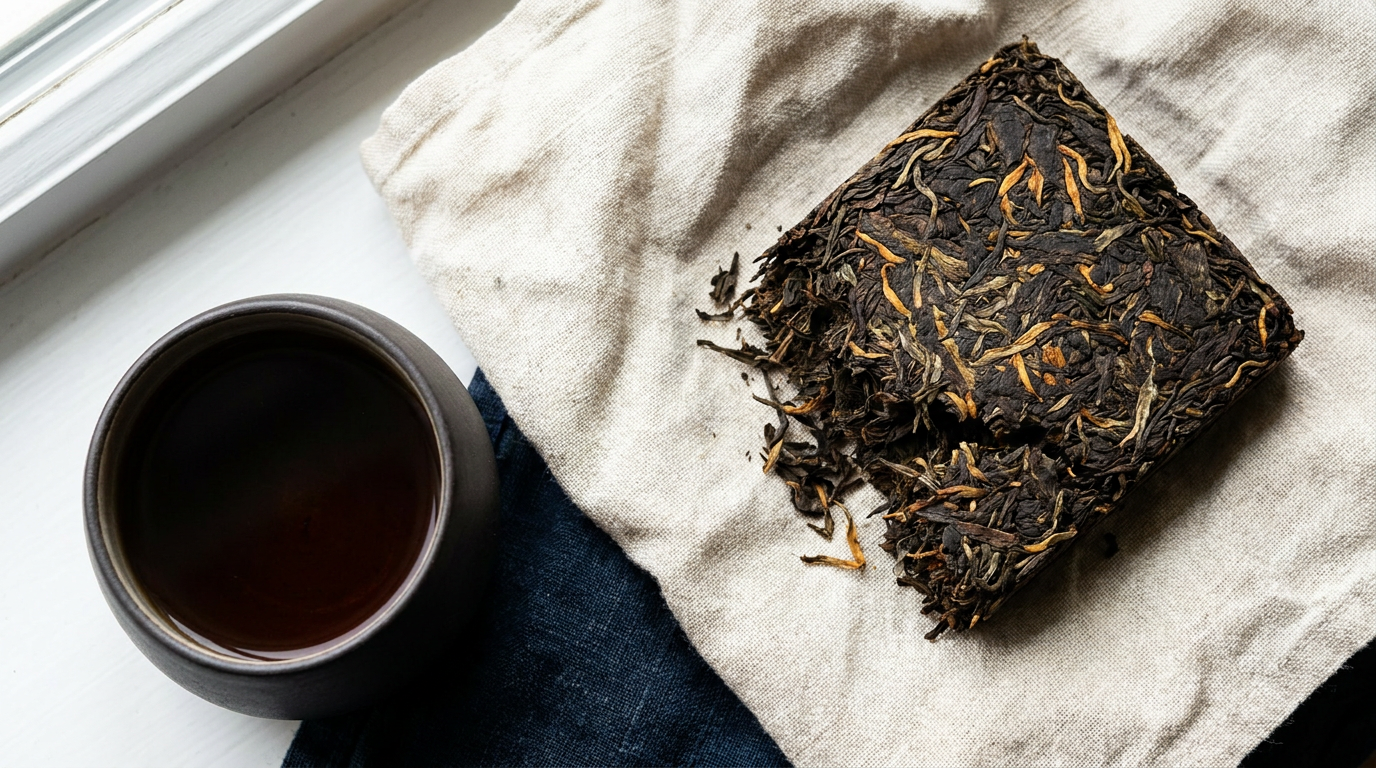
Pu-erh is a post-fermented tea produced from Camellia sinensis var. assamica in Yunnan, China, that matures over decades through solid-state microbial fermentation rather than simple enzymatic oxidation. Driven by fungal and bacterial communities including Aspergillus species, this process converts bitter catechins into complex theabrownins, creating an evolving sensory profile and bioactive compounds studied for their effects on lipid metabolism.
To call pu-erh "the wine of teas" is a polite commercial metaphor that obscures what is actually happening on the shelf. Fine wine in a sealed bottle is an anaerobic chemical system. Its tannins polymerise, its acids soften, and volatile esters rearrange in the dark without the help of living organisms. Once bottled, the yeast is dead.
Pu-erh is quite the opposite. A compressed cake of raw pu-erh (sheng) is not an inert vessel waiting out the years; it is an active ecological niche. It ages because a consortium of airborne fungi, yeasts, and bacteria slowly digest the leaves under ambient humidity and oxygen. If wine is aged by chemistry, pu-erh is aged by livestock.
Oxidation is not fermentation
Tea terminology has spent a century confusing two different biological mechanisms. Black tea is routinely described on commercial packaging as "fully fermented". It is not. Black tea undergoes enzymatic oxidation: when the leaf is rolled or bruised, polyphenol oxidase (an enzyme native to the plant tissue) meets atmospheric oxygen and converts colourless catechins into reddish-brown theaflavins and thearubigins. Microbes play no deliberate role in making standard black tea.
Pu-erh belongs to the category of heicha (dark tea), where the plant's own enzymes are deliberately deactivated early. Harvested leaves are pan-fried in large woks—a step called shaqing, or "killing the green". This denatures the plant's polyphenol oxidase, halting enzymatic browning. What follows is post-fermentation, carried out by external microflora [1].
There are two distinct paths this takes:
- Sheng (Raw) Pu-erh: Compressed into cakes and aged slowly over ten, twenty, or forty years. The microbial succession begins with epiphytic moulds and gradually shifts as moisture and acidity evolve.
- Shou (Ripe) Pu-erh: Invented in the early 1970s at the Kunming and Menghai tea factories to replicate decades of natural aging in weeks. Massive piles of leaf are wetted, covered with thermal tarpaulins, and left to undergo thermophilic solid-state fermentation—a controlled composting process called wo dui (wet piling).
| Attribute | Sheng (Raw) Pu-erh | Shou (Ripe) Pu-erh |
| :--- | :--- | :--- |
| Primary driver | Ambient slow succession (Aspergillus, yeasts, actinobacteria) | Accelerated thermophilic pile fermentation (Aspergillus luchuensis) |
| Production timeline | 5 to 30+ years for mature profile | 45 to 60 days of wet piling |
| Dominant polyphenols | High residual catechins early; gradual conversion | Rapidly dominated by high-molecular-weight theabrownins |
| Astringency | Intense and bitter when young; smooth when aged | Low to nonexistent; immediate dark, earthy density |
| Liquor colour | Pale gold turning to amber, then deep ruby | Dark mahogany to opaque ink |
The microbial engine of the brick
In both methods, the workhorse of the transformation is filamentous fungi, predominantly species within the Aspergillus genus (notably Aspergillus luchuensis and A. niger variants), alongside yeasts such as Blastobotrys adeninivorans [1].
As these colonies colonise the damp leaf matrix, they secrete extracellular enzymes: cellulases, pectinases, and polyphenol oxidases of microbial origin. These enzymes cleave the large, mouth-drying ester catechins—chiefly epigallocatechin gallate (EGCG)—that make fresh assamica leaves aggressively bitter.
Over time, monomeric catechins fall by as much as 80 percent. In their place, gallic acid concentrations spike, and polyphenols polymerise into gargantuan, water-soluble pigments called theabrownins [2]. The tea loses its biting tannic grip. In return, it gains that idiosyncratic, forest-floor earthiness, dark amber depth, and lingering sweetness (huigan) prized by collectors.
What lipid metabolism trials actually show
In traditional Chinese dietary culture, pu-erh has long been prescribed alongside heavy, fatty meals to "cut the grease". Over the past fifteen years, metabolic researchers have tried to figure out whether that custom rests on measurable pharmacology or wishful thinking.
It turns out there is real mechanism here, though it does not work like a miracle diet pill.
The most convincing research centres on theabrownins and bile acid pathways. In a landmark 2019 study published in Nature Communications, researchers demonstrated that pu-erh theabrownins alter the gut microbiota in animal models, suppressing species that produce bile salt hydrolase (BSH) [2]. When BSH is inhibited, conjugated bile acids accumulate in the ileum, which downregulates the intestinal FXR–FGF15 signalling pathway. The liver responds by pulling circulating cholesterol out of the bloodstream to synthesise fresh bile acids, driving down serum total cholesterol and triglycerides [2].
Laboratory work also confirms that pu-erh extracts inhibit pancreatic lipase, the enzyme responsible for breaking down dietary triglycerides into absorbable fatty acids in the gut [3]. If the enzyme is partially blocked, fewer lipids cross the intestinal wall.
Human clinical trials paint a modest, consistent picture. A double-blind, placebo-controlled trial evaluating fermented pu-erh extract in individuals with metabolic syndrome found statistically significant reductions in LDL cholesterol and small reductions in body mass index over twenty weeks [4]. However, these are clinical adjustments—marginal shifts of 5 to 10 percent in blood lipid markers—not a license to consume deep-fried pork knuckle with impunity. The tea modifies lipid handling in the liver and gut; it does not erase calories.
Storage is not cellarage
Because of the wine comparison, Western buyers often stash pu-erh in wine fridges or dry basements. Both are mistakes.
A wine fridge is too cold and airtight. A dry domestic cupboard (below 50 percent relative humidity) halts the fungi entirely, desiccating the cake into dormancy. Conversely, humidity above 80 percent without ventilation encourages mycotoxin-producing moulds like Aspergillus flavus, ruining the tea.
To mature, raw pu-erh needs airflow, moderate ambient temperature (20–28°C), and relative humidity around 60 to 70 percent. It needs to breathe because the microbes inside it are breathing. Treat it like a wheel of farmhouse cheese, not a vintage Bordeaux, and the tea will reward you for decades.
Frequently asked questions
### Can pu-erh tea spoil or expire?
Because of its low water activity once pressed, pu-erh does not have a formal expiration date if stored cleanly. It can, however, spoil if subjected to high humidity (above 80% RH) in stagnant air, which encourages toxic, non-target moulds. It can also absorb ambient kitchen odours if left near spices or cooking grease.
### Does pu-erh contain statins?
Early laboratory papers suggested pu-erh contains lovastatin, a natural HMG-CoA reductase inhibitor produced by certain fungi. Later, rigorous testing revealed that statin levels in commercially produced, clean pu-erh are either undetectable or present only in negligible microgram traces. Its lipid-modulating effects stem primarily from theabrownins and bile acid regulation, not pharmaceutical statins.
### Which is better for digestion, raw (sheng) or ripe (shou)?
For immediate drinking alongside or after heavy meals, ripe (shou) pu-erh is generally gentler on the stomach. The high concentration of theabrownins and low astringency make it less irritating to gastric mucosa than young raw pu-erh, which remains high in unoxidised, stomach-stimulating catechins.
Sources & citations
- Zhao, M., et al. (2015). Microbial diversity and flavor formation in Yunnan Pu-erh tea. Annals of Microbiology, 65(3), 1321–1330.
- Huang, F., et al. (2019). Theabrownin from Pu-erh tea attenuates hypercholesterolemia via modulation of gut microbiota and bile acid metabolism. Nature Communications, 10, Article 4971. https://doi.org/10.1038/s41467-019-12896-x
- Hou, Y., et al. (2009). Pu-erh tea aqueous extract inhibits pancreatic lipase in vitro and hyperlipidemia in mice. Phytotherapy Research, 23(5), 702–709.
- Jensen, G. S., et al. (2016). Reduction of body fat and improved lipid profile in a randomized, double-blind, placebo-controlled study with fermented tea extract. Nutrition Research, 36(12), 1364–1372.