
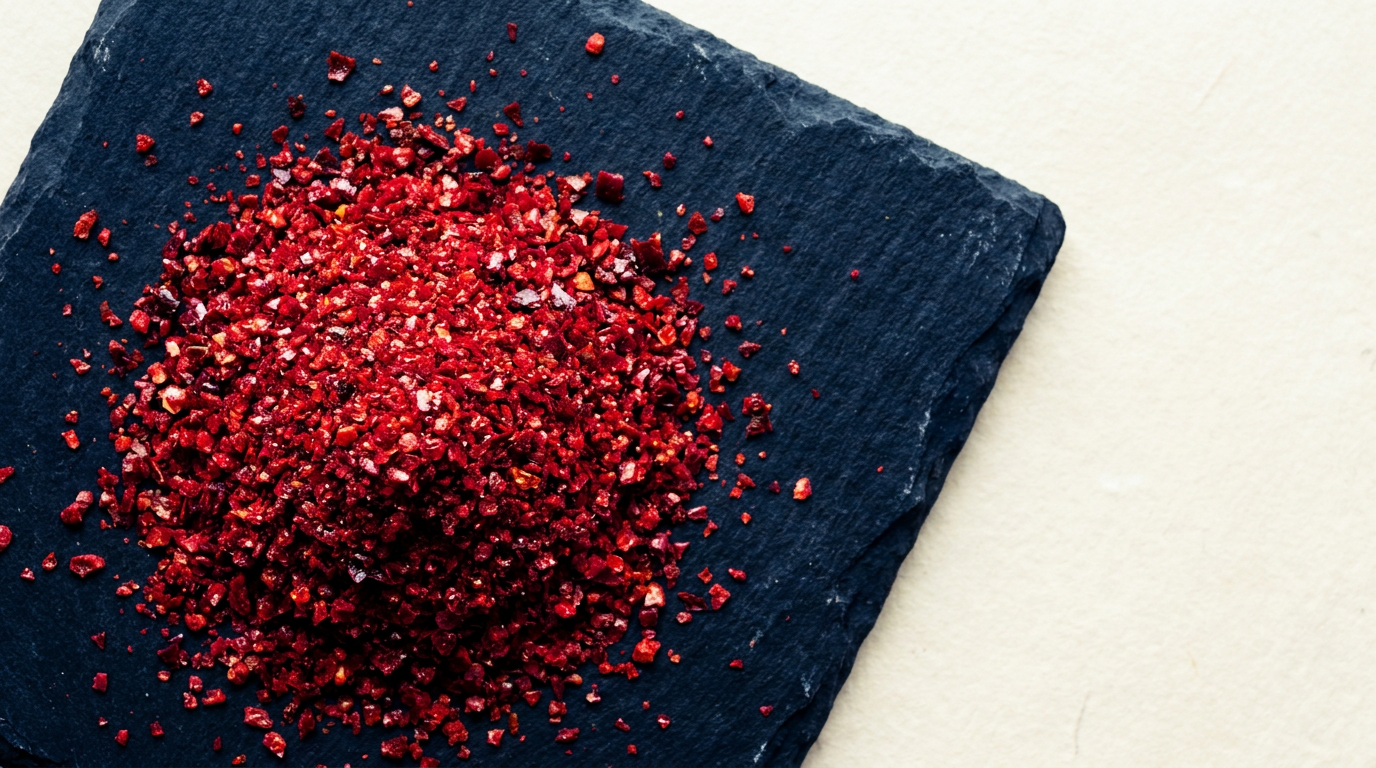
Gochugaru is the coarsely ground, deseeded dried pepper flake milled from Korean cultivars of Capsicum annuum. Distinct from cayenne, it delivers moderate heat—typically 1,500 to 10,000 Scoville Heat Units—paired with high natural sugar content and deep fruitiness. It provides the vivid red colour, fermentable sugars, and gentle thermal persistence that anchor modern kimchi, stews, and Korean braises.
The late arrival that remade a cuisine
A persistent myth treats red chili as an ancient pillar of Korean cooking. In fact, Capsicum annuum reached the Korean peninsula in the late sixteenth or early seventeenth century, introduced via maritime trade routes likely passing through Japan or China [1]. Early historical texts, including the Jibong Yuseol published in 1614, record the fruit under names like namman-gwangye (southern barbarian pepper). Prior to its integration, Korean cooks relied on black pepper, garlic, ginger, and chopi (Zanthoxylum piperitum, a relative of Sichuan pepper) to generate warmth.
Over the subsequent two centuries, Korean farmers selected cultivars that prioritised thick pericarps, intense red pigmentation, high free sugars, and subdued heat. By the mid-eighteenth century, records such as the Jeungbo Sallim Gyeongje confirm chili paste and chili-seasoned vegetables had become household staples [1]. The ingredient did not simply add spice to an existing diet; it fundamentally altered how food was preserved.
Sugar, capsaicin, and the palate
The culinary utility of gochugaru lies in its specific chemical balance. Most cooks outside Korea treat dried chili as a blunt heat delivery system. Gochugaru operates differently because of its low pungency-to-solid ratio.
| Attribute | Gochugaru (Capsicum annuum) | Cayenne pepper (Capsicum annuum) |
| :--- | :--- | :--- |
| Scoville Heat Units (SHU) | 1,500 – 10,000 | 30,000 – 50,000 |
| Free Sugar Content (Dry Weight) | 10% – 15% | 3% – 6% |
| Capsaicin-to-Dihydrocapsaicin Ratio | Roughly 1:1 to 1.5:1 | Typically 2:1 or higher |
| Processing Style | Flaked; usually deseeded | Finely pulverised; whole fruit and seeds |
| Dominant Flavour Profile | Sweet, fruity, lightly smoky, warm | Sharp, pungent, immediate burn |
Capsaicin and dihydrocapsaicin account for the vast majority of capsaicinoids in red peppers [2]. Cayenne features a high capsaicin concentration that hits the anterior tongue and roof of the mouth with immediate intensity. Gochugaru contains a milder total capsaicinoid concentration, allowing its significant volume of free sugars—predominantly glucose and fructose—to register alongside the heat [2].
Because the heat is low, cooks can use gochugaru in volume. A single pot of soondubu jjigae or a batch of baechu kimchi often requires several heaped tablespoons. If you substituted cayenne at that volume, the food would be inedible; if you reduced cayenne to match the heat level, you would lose the colour, mouthfeel, and sweetness that gochugaru contributes.
The role of taeyangcho
The method of dehydration determines how a pepper tastes and ages. Commercial Korean chili peppers follow two main post-harvest pathways: hot-air mechanical drying (geoncho) or sun-drying (taeyangcho).
Mechanical drying exposes freshly harvested chillies to forced air at temperatures between 55°C and 65°C for 24 to 48 hours. It is cheap, rapid, and eliminates weather risk, but heat can degrade heat-sensitive carotenoids—chiefly capsanthin and capsorubin—leaving the flakes slightly brown and dulling their aroma [3].
Taeyangcho relies on natural sunlight, usually managed inside plastic hoop greenhouses to control humidity and protect the pods from rain. The process takes up to two weeks. Prolonged, low-temperature solar drying preserves the brilliant ruby capsanthin pigments and prevents the caramelisation or scorching of delicate surface sugars [3]. Flakes milled from genuine sun-dried peppers exhibit a translucent, bright red appearance and a cleaner, less bitter finish. Commercial processors frequently compromise with a hybrid process: an initial 24-hour run through a forced-air kiln to drive off surface moisture and deter mold, followed by several days under the sun.
Korean millers also separate the inner placenta and seeds before milling. Chili seeds contain minimal capsaicin but yield pale, tan particles and bitter oils that spoil the uniform scarlet colour of broths and pastes. Flakes sold with whole seeds ground in are noticeably paler and harsher.
Fuel for fermentation
In kimchi making, gochugaru does far more than flavour the cabbage. Its chemical makeup supports the microbial ecology of cold fermentation.
During lactic acid fermentation, Leuconostoc mesenteroides and later Lactobacillus plantarum convert simple carbohydrates into lactic acid, acetic acid, and carbon dioxide [4]. The sugars naturally present in the pepper pericarp provide supplemental fuel for these bacteria during the early anaerobic phase. Concurrently, the polyphenols and capsaicinoids in the pepper act as mild antimicrobials, slowing the proliferation of putrefactive, non-acid-tolerant bacteria without inhibiting lactic acid producers [4]. It protects the ferment while deepening its flavour.
Frequently asked questions
### Can I substitute red pepper flakes or cayenne for gochugaru?
Not without altering the texture and balance of the dish. Standard supermarket red pepper flakes include seeds, taste woodier, and lack gochugaru's high sugar content. Cayenne has roughly ten times the capsaicin concentration of gochugaru. Using cayenne to achieve the deep red colour of a Korean broth will make the dish excessively hot long before you reach the correct appearance and flavour.
### What does the label 'taeyangcho' mean on a bag?
Taeyangcho denotes chili peppers that were sun-dried rather than rapidly cured in high-heat mechanical kilns. The designation indicates better colour preservation, higher intact capsanthin levels, and a rounder, naturally sweeter profile.
### What is the difference between coarse and fine gochugaru?
Coarse flakes (guk-yong) look like small flakes and are used for making kimchi, seasoned side dishes (banchan), and stews. Fine powder (gochujang-yong) has a texture like flour; it is used for making gochujang paste and in clear broths or sauces where visible flakes would spoil the texture.
### How should gochugaru be stored?
Due to its high sugar content and residual moisture, gochugaru oxidises and moulds more readily than standard dried spices. Store it in an airtight container in the freezer or refrigerator. Exposure to light and room temperature quickly turns the bright scarlet flakes a dull, oxidised brown.
Sources & citations
- Park, D. Y., et al. (2014). Historical overview of the origin of Korean chili pepper and kimchi. Journal of Ethnic Foods, 1(1), 16–21.
- Ku, K. H., et al. (2009). Physicochemical properties and sensory characteristics of Korean red pepper powder. Korean Journal of Food Preservation, 16(5), 724–731.
- Shin, H. J., et al. (2012). Quality characteristics of red pepper powder dried under various conditions. Korean Journal of Food Science and Technology, 44(2), 177–183.
- Cheigh, H. S., & Park, K. Y. (1994). Biochemical, microbiological, and nutritional aspects of kimchi (Korean fermented vegetable products). Critical Reviews in Food Science and Nutrition, 34(2), 175–203.