
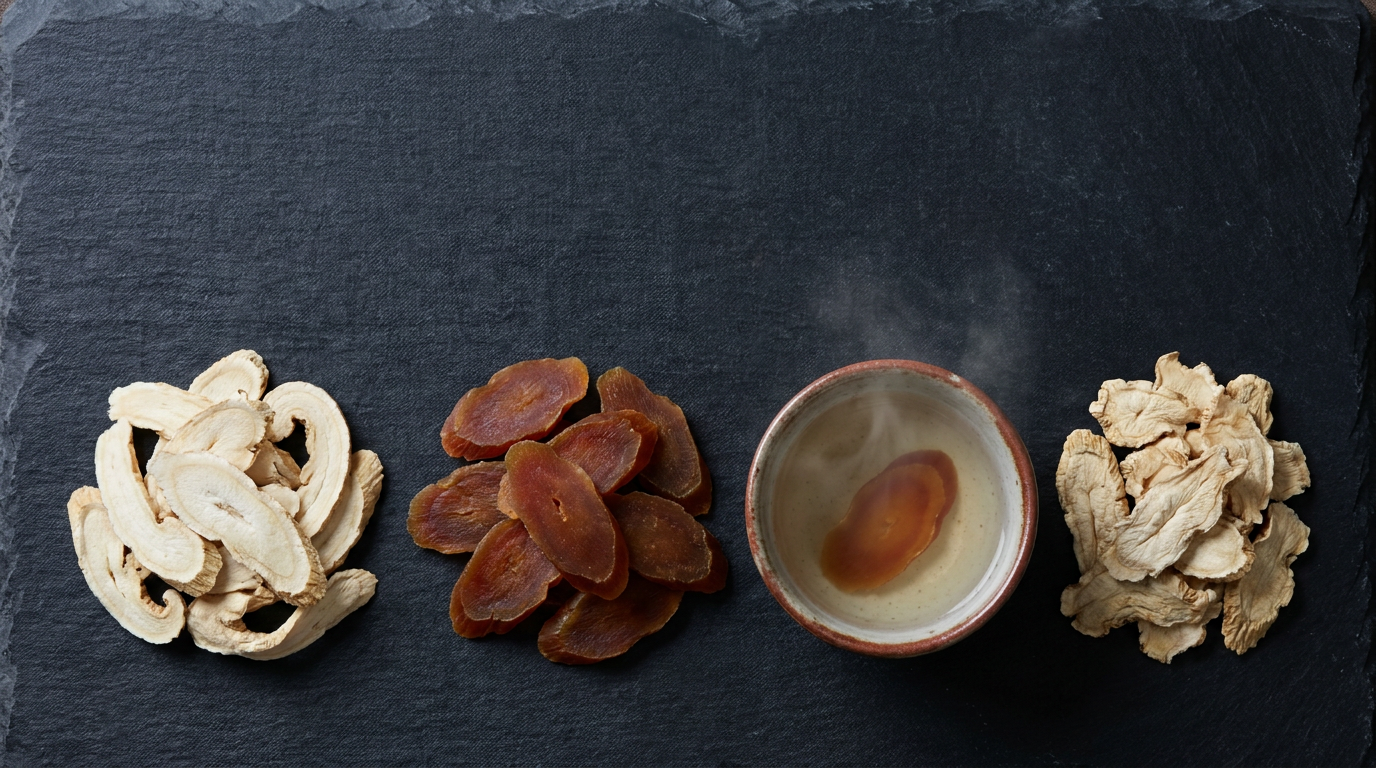
Ginseng in a cup of tea is shaped by species and processing, which dictate its chemical makeup. White ginseng is dried raw Asian root (Panax ginseng), red ginseng is steamed before drying, and American ginseng (Panax quinquefolius) is an entirely distinct species. These methods alter ginsenoside profiles, meaning each variety produces measurably different effects in hot water.
Drop dried root into boiling water and you expect something restorative. The beverage aisle calls ginseng an adaptogen, an umbrella term coined by Soviet pharmacologists in the 1940s to describe substances that purportedly help organisms resist broad biological stress [1]. Yet plants do not synthesise compounds to fulfil regulatory categories or beverage slogans. They make secondary metabolites to deter herbivores, resist fungal infection, and survive winter. In ginseng, these compounds are primarily dammarane-type triterpene saponins called ginsenosides.
How those ginsenosides behave in your cup depends on botany and the application of heat.
The chemistry of the steam
All true ginsengs belong to the genus Panax. The division between white and red ginseng is not botanical; it is culinary and pharmaceutical processing applied to Panax ginseng.
White ginseng is simply the fresh root, harvested after four to six years, peeled, and sun-dried or air-dried. It retains the native ginsenosides present in the fresh plant, dominated by compounds such as Rb1, Rg1, and Re. It yields a pale, earthy, distinctly bitter infusion with a dry, wood-bark finish.
Red ginseng undergoes intensive thermal processing. The unpeeled roots are steamed at temperatures around 100°C for several hours before dehydration [2]. This heat treatment initiates non-enzymatic deglycosylation: glucose moieties strip away from the larger native saponin molecules, converting polar ginsenosides like Rb1 into less polar, smaller compounds, particularly Rg3, Rh2, and compound K. Maillard reactions also turn the root a deep caramelised amber, providing the infusion with a sweeter, toasted note alongside the medicinal bitterness.
In pharmacokinetics, smaller molecules often cross biological membranes more effectively than large glycosides. Steaming effectively runs a chemical breakdown that human digestion would otherwise have to attempt on its own.
American ginseng is not just Asian ginseng grown across the Atlantic
Then there is Panax quinquefolius, native to the deciduous forests of eastern North America, especially the cool hills of Wisconsin and Ontario. It is a separate species, not a transplant of Asian stock.
Traditional Chinese Medicine observed the functional difference long before liquid chromatography existed, classifying Asian ginseng (Ren Shen) as warming and stimulating, and American ginseng (Xi Yang Shen) as cooling and yin-nourishing. Phytochemical analysis explains why these two roots do not drink or act the same way [3].
| Attribute | White Ginseng (P. ginseng) | Red Ginseng (P. ginseng) | American Ginseng (P. quinquefolius) |
| :--- | :--- | :--- | :--- |
| Processing | Peeled, sun-dried raw | Unpeeled, steamed, then dried | Harvested, washed, dried raw |
| Key Ginsenosides | High Rb1, balanced Rg1 | Enriched in Rg3, Rh1, Rh2 | High Rb1, trace to zero Rg1 |
| Rg1 to Rb1 Ratio | Moderate (~0.3 to 1.0) | Variable; transformed Rg isomers | Very low (<0.1) |
| Flavour in Cup | Sharp, grassy, light bitterness | Toasted, earthy, deep bittersweet | Sweet finish, herbaceous, mild bitter |
| Primary Documented Effect | Mild central stimulant [2] | Vascular & immune markers [2] | Glycaemic regulation [4] |
The ratio of the ginsenoside Rg1 to Rb1 forms the functional dividing line. Rg1 shows central nervous system excitation and blood pressure stimulation in experimental models. Rb1, conversely, shows central nervous system sedation, tranquilising effects, and blood pressure reduction [3]. American ginseng contains almost no Rg1 relative to its dense concentration of Rb1. A cup of American ginseng tea is chemically quiet; red ginseng tea is chemically demanding.
The extraction problem in boiling water
Ginsenosides are saponins. They possess a hydrophobic steroid backbone bonded to hydrophilic sugar units. Because of this structure, they do not dissolve instantly like caffeine or the catechins in green tea.
If you drop a few paper-thin slices of dried root into a mug and pull them out after three minutes, you have mostly extracted surface sugars and trace volatile aromatics. Studies assessing ginsenoside extraction into water show that recovering a meaningful yield requires extended decoction: simmering slices gently between 80°C and 90°C for thirty to sixty minutes [5]. Rapid-brew ginseng teabags generally supply a hint of bitterness rather than the doses tested in clinical literature.
Sifting the adaptogen claim
Marketing copy credits ginseng with sweeping claims: it purports to balance cortisol, boost focus, settle anxiety, and restore vitality simultaneously. Clinical human trials paint a much narrower, more measured picture.
American ginseng has reasonable evidence showing it attenuates postprandial blood glucose spikes in adults with and without type 2 diabetes when consumed shortly before or during a carbohydrate-dense meal [4]. Asian red ginseng repeatedly demonstrates modest improvements in vascular endothelial function and subjective fatigue markers in clinical trials, but these studies use concentrated standardised extracts, not diluted infusions [2].
Treating ginseng as an intelligent herb that intuitively fixes whatever is out of balance obscures real pharmacological activity. It has actual chemical actions, which also means it has actual boundaries and drug interactions, notably with blood thinners like warfarin and certain antidiabetic therapies [3].
If you brew ginseng, choose the root to match your intent. Reach for American ginseng if you want a calmer, faintly sweet infusion to accompany food. Use red ginseng if you want the robust, toasted bite of heat-altered saponins for late morning focus. Simmer the slices thoroughly rather than treating them like quick-steep tea leaves, and leave the marketing myths on the shelf.
Frequently asked questions
### Can I make ginseng tea by just steeping slices in boiling water?
You can, but you will extract very little of the root's active ginsenosides. Saponins require time and consistent heat to dissolve into water. For an effective infusion, gently simmer root slices on a stove for 30 to 45 minutes rather than steeping them in a mug.
### Is red ginseng naturally red when harvested?
No. Fresh Asian ginseng is off-white or pale beige. The red colour develops during post-harvest processing, where the unpeeled root is exposed to high-heat steaming and then dried, causing chemical reactions that darken the tissue.
### Which ginseng variety is best for evening drinking?
American ginseng (Panax quinquefolius) is better suited to late afternoons or evenings. It possesses a high concentration of the calming ginsenoside Rb1 and negligible levels of the stimulating Rg1, unlike red or white Asian ginseng.
Sources & citations
- Brekhman, I.I. and Dardymov, I.V. (1969). 'New Substances of Plant Origin which Increase Nonspecific Resistance', Annual Review of Pharmacology, 9(1), pp. 419–430. doi:10.1146/annurev.pa.09.040169.002223.
- Kim, J.H. (2018). 'Pharmacological and medical applications of Panax ginseng and ginsenosides: a review for use in cardiovascular diseases', Journal of Ginseng Research, 42(3), pp. 264–269. doi:10.1016/j.jgr.2017.10.001.
- Qi, L.W., Wang, C.Z. and Yuan, C.S. (2011). 'Ginsenosides from American ginseng: chemical and pharmacological diversity', Phytochemistry, 72(8), pp. 689–699. doi:10.1016/j.phytochem.2011.02.012.
- Vuksan, V., et al. (2000). 'American ginseng (Panax quinquefolius L) reduces postprandial glycemia in nondiabetic subjects and subjects with type 2 diabetes mellitus', Archives of Internal Medicine, 160(7), pp. 1009–1013. doi:10.1001/archinte.160.7.1009.
- Sun, C., et al. (2011). 'Extraction and determination of ginsenosides in ginseng root by subcritical water extraction', Separation and Purification Technology, 78(2), pp. 240–246. doi:10.1016/j.seppur.2011.02.013.