
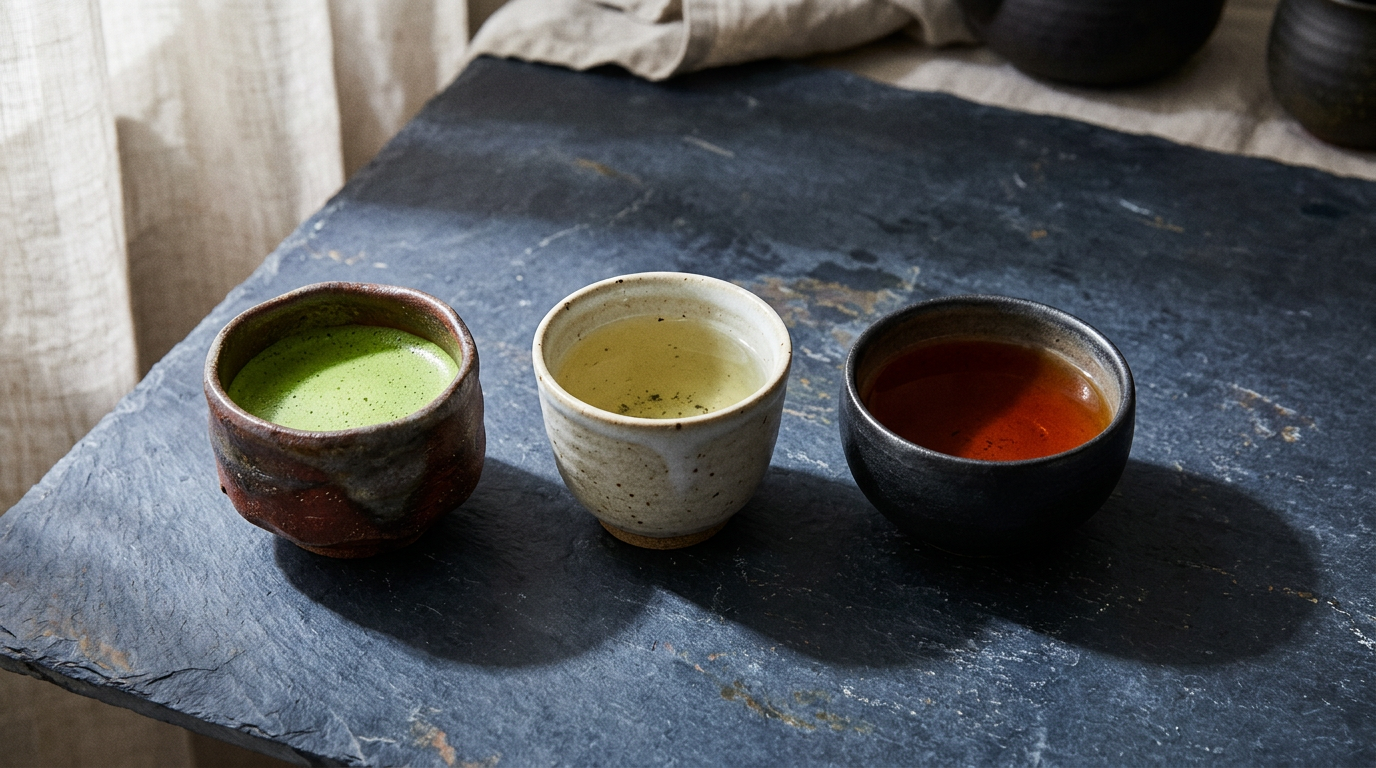
Matcha, sencha, and hojicha all originate from the Camellia sinensis plant, yet they offer distinct experiences. Matcha is a vibrant, powdered tea from shade-grown leaves, rich in L-theanine for calm focus. Sencha is a steamed, whole-leaf tea offering a classic grassy taste and high antioxidant levels. Hojicha is roasted, resulting in a nutty, low-caffeine brew ideal for evenings. Their differences lie not in the seed, but in the craft.
It’s a simple fact that often gets lost in the noise of wellness marketing: all true tea—black, green, oolong, white—is born from a single evergreen species, Camellia sinensis [1]. The stunning diversity we see in the tea aisle is a testament to human ingenuity. It’s a story of how specific agricultural and processing choices can coax entirely different chemical and sensory profiles from the very same leaves. Nowhere is this more apparent than in the Japanese green tea trio of matcha, sencha, and hojicha.
They represent three distinct philosophies of cultivation and craft, resulting in three unique beverages tailored for different moments of the day.
Matcha: The Shade-Grown Powerhouse
Matcha’s vivid, almost electric green color isn’t an accident; it’s the direct result of a painstaking growing process called tencha. About 20–30 days before harvest, the tea bushes are covered with screens to block direct sunlight. Starved of sun, the plants go into overdrive producing chlorophyll, which floods the leaves with green pigment. More importantly, this shading process significantly boosts the production of amino acids, particularly L-theanine [2].
L-theanine is the molecule behind matcha’s celebrated paradox: a state of “calm alertness.” It promotes alpha brain waves, which are associated with relaxed focus, and it can temper the jittery effects of caffeine [3]. After harvesting, the leaves are steamed, dried, and meticulously deveined and destemmed. Only the finest, softest leaf tissue, the tencha, is stone-ground into the fine powder we know as matcha.
When you drink matcha, you are consuming the entire leaf, not just an infusion. This makes it a uniquely potent source of the plant’s full spectrum of compounds, from caffeine and L-theanine to antioxidants. It’s a brew for moments that demand high focus and quiet energy.
Sencha: The Sun-Kissed Standard
If matcha is the specialized ceremonial brew, sencha is Japan’s democratic, everyday staple. Unlike matcha, sencha bushes are grown in full sun, which encourages the leaves to produce more catechins, a class of antioxidant polyphenols. The most famous of these is epigallocatechin gallate, or EGCG.
After harvesting, the leaves are immediately steamed to halt oxidation. This critical step preserves their green color and locks in the fresh, grassy, and slightly savory (umami) flavor profile that defines sencha. The leaves are then rolled into their characteristic needle-like shape and dried. When you brew sencha, you are creating an infusion, steeping these rolled leaves in hot water to extract their flavor and compounds.
Sencha offers a more classic green tea experience: a bright, brisk flavor with a pleasant astringency and a moderate caffeine kick. It’s the perfect afternoon cup, a straightforward and deeply refreshing expression of the sun-fed tea leaf.
Hojicha: The Roasting Revelation
Sometimes, the most interesting innovations are born from a desire for comfort and utility. Hojicha is a green tea—typically made from later-harvest sencha or other parts like stems and twigs—that is roasted over charcoal or sand at high temperatures. This final step radically transforms it.
Roasting does two crucial things. First, it breaks down a significant portion of the caffeine and the catechins (which are responsible for bitterness and astringency). This makes hojicha exceptionally gentle on the stomach and low in caffeine, suitable for drinking any time of day, even in the evening [4]. Second, the heat triggers the Maillard reaction, the same chemical process that browns toast and sears steak. This creates a completely new flavor profile: the grassy notes of green tea vanish, replaced by warm, nutty, and toasty aromas.
Its reddish-brown liquor and comforting flavor make hojicha feel like a different beverage entirely. It’s a brilliant example of how a simple, elemental process like roasting can create a new category of experience from a familiar ingredient.
A Tale of Three Teas
To choose the right tea is to understand its purpose. This is the wisdom embedded in centuries of craft.
| Feature | Matcha | Sencha | Hojicha |
| :--- | :--- | :--- | :--- |
| Process | Shaded, steamed, stone-ground | Sun-grown, steamed, rolled | Sun-grown, roasted |
| Form | Fine powder (whole leaf) | Whole leaf infusion | Roasted leaf/stem infusion |
| Color | Vibrant, deep green | Pale green to yellow-green | Reddish-brown |
| Flavor | Rich, umami, creamy, vegetal | Grassy, fresh, savory, astringent | Toasty, nutty, caramel-like |
| Key Compound | L-theanine | EGCG (Catechins) | Pyrazines (from roasting) |
| Caffeine | High | Medium | Low |
| Best For | Morning energy, calm focus | All-day refreshment, antioxidant boost | Evening relaxation, caffeine sensitivity |
### FAQ
1. Is one tea “healthier” than the others?
Each tea has a different strength. Matcha provides the highest concentration of L-theanine and overall nutrients because you consume the whole leaf. Sencha is particularly rich in sun-induced antioxidants like EGCG. Hojicha is very low in caffeine and gentle on the system, which is a health benefit for many. The “healthiest” choice depends entirely on your personal goals and time of day.
2. Why is ceremonial grade matcha so expensive?
The cost reflects the labor-intensive process. The shading, careful hand-picking of the youngest leaves, meticulous destemming and deveining, and the slow, precise art of stone-grinding all contribute to the final price. It takes about an hour to grind just 30-40 grams of high-quality matcha.
3. Can I make matcha by grinding up sencha leaves?
No. Matcha is made from a specific type of leaf called tencha that has been shaded and processed differently. Grinding sencha would result in a gritty, bitter powder with a completely different chemical and flavor profile.
4. Does water temperature matter when brewing?
Absolutely. Green teas are sensitive to high temperatures, which can scorch the leaves and release excess tannins, making the brew bitter. A general rule is to use cooler water for higher quality teas. For sencha, aim for around 160-175°F (70-80°C). For hojicha, you can use hotter water, around 195°F (90°C), as it's more robust. Matcha is typically whisked with water around 175°F (80°C).
Sources & citations
[1] Royal Botanic Gardens, Kew. "Camellia sinensis (L.) Kuntze." Plants of the World Online. https://powo.science.kew.org/taxon/urn:lsid:ipni.org:names:282129-2
[2] Unno, Keiko, et al. "Stress-Reducing Function of Matcha Green Tea in Animal Experiments and Clinical Trials." Nutrients, vol. 11, no. 10, 2019, p. 2288. https://www.ncbi.nlm.nih.gov/pmc/articles/PMC6836118/
[3] Hidese, Shinsuke, et al. "Effects of L-Theanine Administration on Stress-Related Symptoms and Cognitive Functions in Healthy Adults: A Randomized Controlled Trial." Nutrients, vol. 11, no. 10, 2019, p. 2362. https://www.pubmed.ncbi.nlm.nih.gov/31623400/
[4] Lee, Liang-Yuan, et al. "Effect of Roasting on the Taste, Quality, and Bioactive Compounds of a Specialty Tea." Journal of Food Science, vol. 86, no. 1, 2021, pp. 244-255. https://onlinelibrary.wiley.com/journal/17503841