
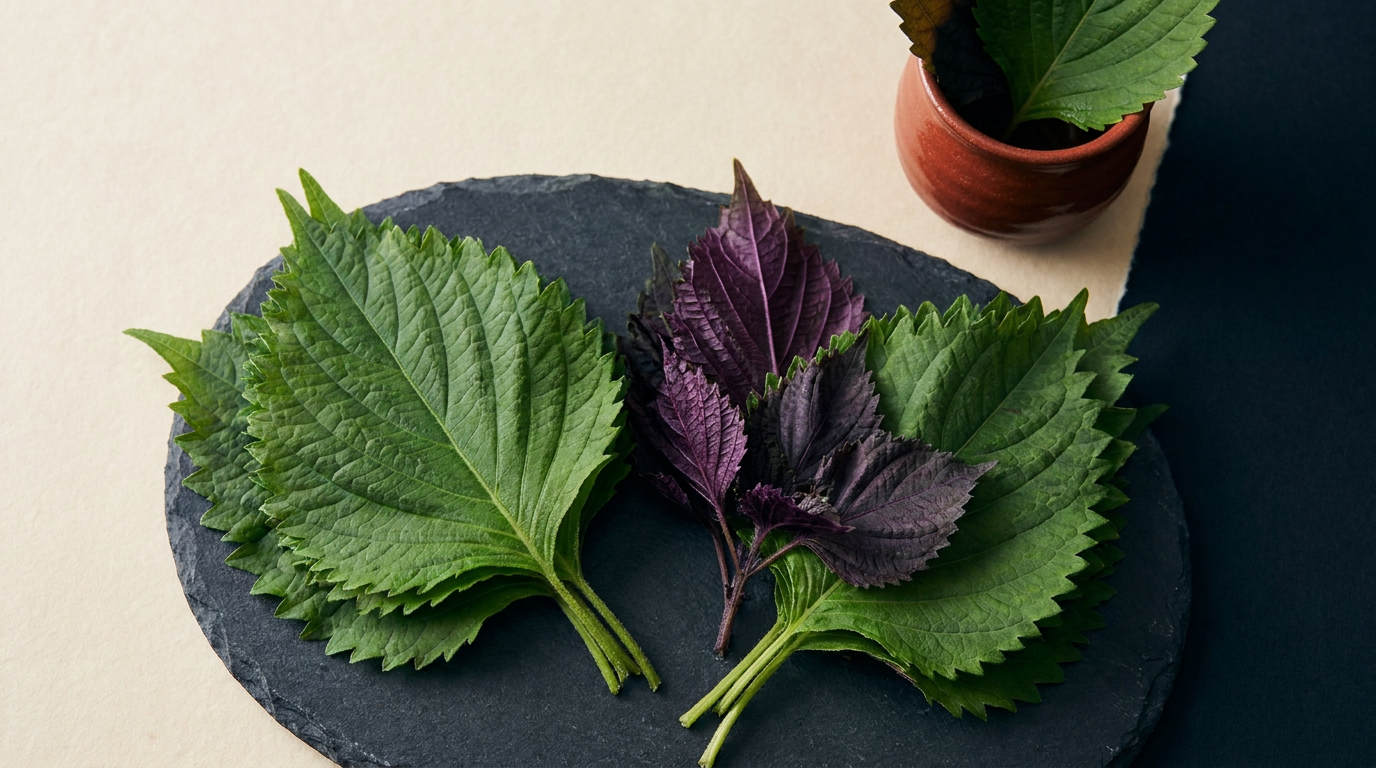
Perilla is a mint-family herb divided primarily into two culinary varieties: Korean kkaennip (Perilla frutescens var. frutescens) and Japanese shiso (Perilla frutescens var. crispa). Though frequently conflated or mislabelled as sesame leaves, they differ markedly in morphology, chemical composition, and flavour. Korean perilla delivers a nutty, aniseed-like earthiness, while Japanese shiso provides a sharp, citrus-tinged freshness dominated by perillaldehyde [1].
The mistranslation that refuses to die
If you buy a plastic flat-pack of broad, spade-shaped, serrated green leaves in an East Asian grocer in London or Manchester, there is a high probability the English sticker reads "sesame leaves". It is a botanical falsehood that has persisted for decades through commercial packaging and restaurant menus.
True sesame (Sesamum indicum) belongs to the family Pedaliaceae. Its leaves are bitter, tough, and grown for seed oil, not table consumption. Perilla belongs to Lamiaceae, the mint family, sitting alongside basil, sage, and lemon balm [2]. The confusion originated because the Korean name for the herb, kkaennip, translates literally as "sesame leaf"—a linguistic shortcut arising because Korean agricultural traditions distinguish between chamkkae (true sesame) and deulkkae (wild or field perilla). Both produce oil-rich seeds, but their culinary leaves belong to entirely different plant orders.
Treating them as interchangeable is not a minor semantic issue. It leads home cooks to believe they are tasting sesame foliage when they are actually tasting a volatile-rich member of the mint genus.
Perillaldehyde versus perillaketone
The split between Japanese shiso and Korean kkaennip is chemical before it is cultural. While both belong to Perilla frutescens, centuries of selective cultivation have driven their volatile oil profiles along separate pathways [1], [3].
Japanese green shiso (ao-jiso) is defined by perillaldehyde. This monoterpene accounts for over 50 per cent of its essential oil profile, delivering a sharp, pungent profile that shares volatile compounds with cumin and citrus peel, underpinned by a cooling menthol edge. Red shiso (aka-jiso), heavily pigmented with cyanidin-derived anthocyanins, contains similar volatiles paired with high concentrations of rosmarinic acid, used historically as both a natural preservative and a vibrant textile or pickle dye [3].
Korean perilla leaves run in an entirely different sensory direction. Perillaldehyde is virtually absent in standard cultivated kkaennip. Instead, the primary aromatic volatiles include perillene, egomaketone, and caryophyllene, giving the leaf an aroma closer to aniseed, damp wood, and toasted hazelnut, without the citric pierce of its Japanese counterpart [1], [4].
| Trait | Korean Perilla (Kkaennip) | Japanese Shiso (Ao-jiso / Aka-jiso) |
| :--- | :--- | :--- |
| Botanical variety | P. frutescens var. frutescens | P. frutescens var. crispa |
| Dominant volatile | Perillene, caryophyllene, perilla ketone | Perillaldehyde, limonene |
| Leaf texture | Broad, thick, sturdy serration | Delicate, deeply ruffled, thin |
| Primary aroma notes | Anise, toasted nut, damp wood, mint | Citrus peel, cinnamon-cumin, sharp herb |
| Traditional role | Ssam wraps, jangajji (soy pickles), braises | Raw fish garnish, umeboshi dyeing, tempura |
How chemistry dictates the kitchen
Because the structural leaves of Korean perilla are thick and fibrous, they hold up to heat and fermentation. Layered with garlic, soy sauce, toasted perilla oil, and gochugaru, kkaennip jangajji softens into a leathery, deeply savoury preserve that can sit in brine for months without disintegrating. Fresh, the leaf functions as a robust wrap (ssam) for fatty cuts of grilled pork belly (samgyeopsal). Its woodsy, aniseed volatiles slice through animal fat without overpowering the scorched meat.
Drop Japanese green shiso into a hot braise and you will ruin it. The leaf is delicate, paper-thin, and its characteristic perillaldehyde degrades under prolonged heat, leaving behind a muddy bitterness. Shiso behaves best raw, shaved thin across cold soba, laid whole under slices of fatty tuna, or fried quickly in a lace-thin tempura batter where the heat sets the surface before the aromatics cook away.
In Western kitchens, perilla is increasingly treated as a novelty salad green. This works reasonably well with very young, tender kkaennip dressed in a neutral oil and rice vinegar, where the nuttiness works like an assertive wild rocket. But tossing mature Japanese shiso haphazardly into a mesclun mix is rarely successful; the high perillaldehyde concentration will bully lighter lettuces, tasting medicinal to anyone expecting a mild herb.
Frequently asked questions
### Is perilla leaf the same as sesame leaf?
No. The English label "sesame leaf" is a mistranslation of the Korean term kkaennip. True sesame (Sesamum indicum) produces bitter leaves rarely eaten fresh. Perilla (Perilla frutescens) belongs to the mint family.
### Can you substitute Japanese shiso for Korean perilla?
They are rarely swappable in traditional dishes. Japanese shiso is fragile, citrus-driven, and volatile-heavy; Korean perilla is earthier, broader, and sturdier. Using shiso in a slow soy pickle will reduce the leaves to pulp, while using Korean perilla alongside delicate sashimi can overwhelm the fish with anise notes.
### Why does red shiso turn pickled liquids pink?
Red shiso (aka-jiso) contains high concentrations of perillanin, an anthocyanin pigment. When perillanin encounters the acetic or citric acids in vinegar or ume plum brine, its molecular structure shifts, turning the liquid a brilliant magenta-red [3].
### How should fresh perilla leaves be stored?
Store them upright like cut flowers, stems submerged in a centimetre of water in a jar, covered loosely with a reusable bag in the refrigerator. Both varieties lose their aromatic volatiles quickly once the leaf edges blacken from excess humidity or cold damage.
Sources & citations
- Ito, M. (2008). 'Studies on Perilla: Chemical varieties and medicinal uses', Biological and Pharmaceutical Bulletin, 31(7), pp. 1290–1295.
- Royal Botanic Gardens, Kew. (2024). 'Perilla frutescens (L.) Britton', Plants of the World Online. Available at: https://powo.science.kew.org/taxon/urn:lsid:ipni.org:names:453896-1
- Yoshida, K., Kondo, T., Kameda, K. and Goto, T. (1990). 'Structure of anthocyanin pigments in red perilla', Phytochemistry, 29(7), pp. 2307–2310.
- Lee, J., Lee, S. and Chung, H. (2015). 'Volatile compounds of perilla (Perilla frutescens) leaves harvested at different growth stages', Food Science and Biotechnology, 24(5), pp. 1601–1608.