
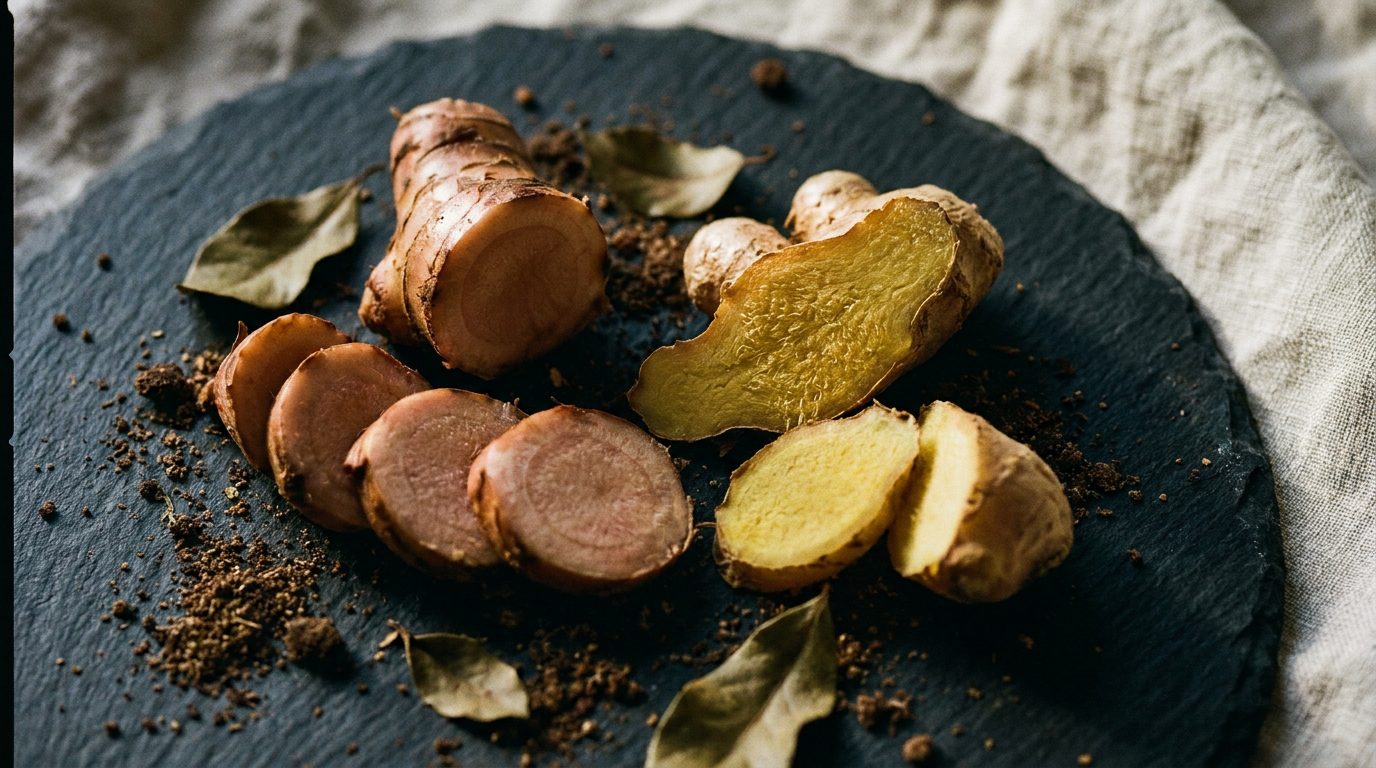
Galangal and ginger both belong to the Zingiberaceae family, but they are chemically distinct rhizomes with entirely different culinary functions. While ginger derives its heat from gingerols and shogaols, producing a warm, citrus-peppery burn, galangal is dominated by 1,8-cineole, methyl cinnamate, and the flavonoid galangin, yielding a camphoraceous, pine-like sharpness that does not soften with heat.
English-language recipe books have spent decades treating galangal as an inconvenient substitute for ginger, or vice versa. Supermarkets often label Alpinia galanga as "Thai ginger" or "blue ginger", suggesting a regional quirk rather than a distinct plant. It is lazy taxonomy, and it ruins dinner.
To swap them in a broth or curry paste is not like trading yellow onions for shallots. It is closer to trading peppermint for horseradish. Both will wake you up, but the machinery behind the sensation is operating on entirely different pathways.
The architecture of pungency
The heat of fresh common ginger (Zingiber officinale) comes primarily from gingerols, a group of pungent phenolic compounds [1]. When ginger is dried, these gingerols undergo dehydration to form shogaols, which register on the human tongue as twice as hot. When cooked, gingerols degrade into zingerone, which is rounder, sweeter, and distinctly less aggressive.
Ginger's essential oil profile is loaded with sesquiterpenes, chiefly zingiberene and beta-sesquiphellandrene, alongside citral, which supplies the familiar lemon top-note. The physiological reaction to ginger is vascular: it warms the oral mucosa through transient receptor potential (TRPV1) channels, stimulating saliva and producing a clean, mouth-coating radiance.
Galangal does something else entirely.
Greater galangal (Alpinia galanga) owes its biting aroma to 1,8-cineole (the dominant volatile in eucalyptus), methyl cinnamate (a sweet, woody phenylpropanoid found in basil and cinnamon), and camphor [2]. Its specific sting does not come from gingerol, but largely from 1'-acetoxychavicol acetate (ACA), a pungent phenylpropanoid ester with a dry, sharp, almost numbing profile [3].
Then there is galangin.
Galangin and the bitter backbone
Galangin (3,5,7-trihydroxyflavone) is a natural flavonol found in abundance in Alpinia officinarum (lesser galangal) and Alpinia galanga [3]. In pharmacology, galangin attracts research for its enzymatic inhibition and anti-inflammatory pathways in cell models [3]. In the kitchen, its presence matters because it gives galangal its structural astringency.
Unlike ginger, which softens into sweetness when simmered for two hours with pork or poultry, galangal maintains its resinous, bitter spine. It cuts through saturated animal fats and rich coconut cream precisely because cineole and galangin refuse to yield to braising heat. If you substitute ordinary ginger into a southern Thai coconut soup like tom kha, the dish collapses into confectionary sweet-warmth. Galangal is there to provide the alpine, medicinal counterweight.
Under the knife
The physical difference between the two rhizomes tells you everything about their cellular structure.
Ginger rhizomes possess thin skins that surrender to the edge of a teaspoon. The interior is juicy, crisp, and fibrous along distinct grain lines, easy to grate fine into an emulsifying pulp.
Galangal is wood. The skin is pale, ringed with reddish-brown nodes, and tough enough to turn the edge of a cheap chef's knife. Its flesh is dense, pale cream, and virtually impossible to grate on a microplane without producing dry sawdust. Traditional cooks do not grate galangal; they slice it into coins to be bruised and extracted in a simmer, or they hammer it down with a heavy granite mortar and pestle until the dense cell walls rupture into a smooth curry paste.
| Attribute | Ginger (Zingiber officinale) | Greater Galangal (Alpinia galanga) |
| :--- | :--- | :--- |
| Primary Pungent Chemistry | Gingerols, shogaols, zingerone | 1'-Acetoxychavicol acetate (ACA), galangin |
| Dominant Volatiles | Zingiberene, citral, camphene | 1,8-Cineole, methyl cinnamate, camphor |
| Sensory Direction | Warm, citrus-peppery, sweetening | Pine, eucalyptus, resinous, astringent |
| Physical Texture | Moist, crisp, easily grated | Hard, fibrous, woody, dense |
| Culinary Behaviour | Softens and sweetens with prolonged heat | Retains rigid bite and aromatic camphor |
Lesser versus greater
To make matters slightly more complicated, the trade recognises two distinct plants as galangal.
Greater galangal (Alpinia galanga) is the rhizome common to Southeast Asian markets, Indonesia, and Thailand. It has lighter skin, subtle pinkish shoots, and the signature pine-cineole profile essential to rendang and samlar kakou.
Lesser galangal (Alpinia officinarum), native to southern China and prized historically in medieval European and Middle Eastern pantries, is smaller, reddish-brown, and fiercely pungent. Its galangin concentration is higher, and its flavour profile tilts toward bitter medicine, cardamomic heat, and ginger-peppery intensity [3]. Using lesser galangal in place of greater galangal requires caution: it will overwhelm a delicate broth with astringency.
Cooking requires understanding what a plant is doing chemically inside a pot. Ginger warms, balances acid, and rounds off edges. Galangal slices through grease, delivers camphor, and stands its ground.
Frequently asked questions
### Can I substitute ginger for galangal if I add lemon zest?
No. While lemon zest provides citral, which is already present in ginger, it does nothing to introduce 1,8-cineole or methyl cinnamate. The substitution produces a citrus-ginger profile that lacks the resinous, pine-camphor backbone required by traditional Indonesian, Malaysian, and Thai dishes.
### Can I eat the galangal slices left in my soup?
Typically, no. In soups such as tom yum, galangal is sliced into thin rounds simply to extract its volatile oils and water-soluble flavours during simmering. The rhizome remains dense, woody, and unpleasantly fibrous even after an hour of boiling. Treat the slices as you would bay leaves: leave them in the bowl or discard them before serving.
### Does dried or powdered galangal work as well as fresh?
Dried galangal loses much of its volatile terpene profile, particularly the bright cineole notes, leaving behind a predominantly woody, bitter character. While powdered galangal has historic uses in spice blends and herbal preparations, fresh or frozen whole rhizomes should be preferred for curry pastes and broths.
Sources & citations
- Semwal, R.B., et al. (2015). Gingerols and shogaols: Important nutraceutical principles from ginger. Phytochemistry, 117, 554-568. https://doi.org/10.1016/j.phytochem.2015.07.012
- Ravindran, P.N., & Babu, K.N. (2005). Ginger: The Genus Zingiber. CRC Press.
- Chouni, A., & Paul, S. (2018). A Review on Phytochemical and Pharmacological Potential of Alpinia galanga. Pharmacognosy Journal, 10(1), 9-15. https://doi.org/10.5530/pj.2018.1.2