
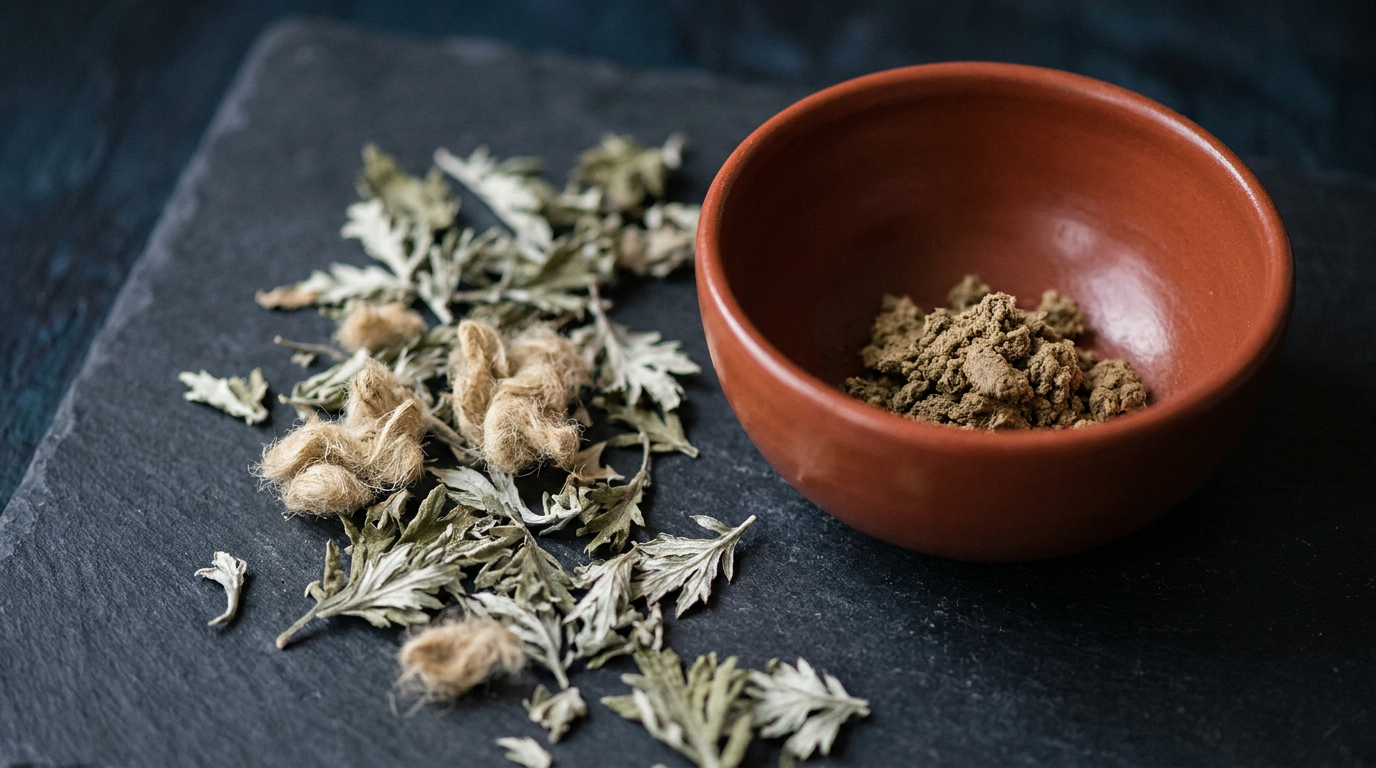
Mugwort refers to several aromatic species of the genus Artemisia, prized across East Asia for external therapeutic use. In Japanese bathhouses, Artemisia princeps (yomogi) steeps in hot water to release volatile terpenes that soothe skin, whilst traditional Chinese medicine compresses aged Artemisia argyi into moxa sticks, burning them near acupuncture points to deliver localized thermal stimulation and transdermal aromatic compounds.
Few plants have been asked to do quite as much varied physical labour as the Artemisia genus. In Europe, Artemisia absinthium gave wormwood its bitter bite and absinthe its pale green haze. In modern pharmacology, Artemisia annua supplied artemisinin, the sesquiterpene lactone that transformed global malaria therapy and earned Youyou Tu a Nobel Prize in 2015 [1]. Yet across East Asia, the plant's most enduring cultural footprint is not swallowed as a pill or a tincture. It is applied to the outside of the body.
Take two distinct rituals: the dried bundle of Artemisia princeps bobbing in a steaming cedar tub in a Japanese sentō, and the dense, smouldering cylinder of Artemisia argyi held millimetres above an ankle in a Chinese acupuncture clinic. They look entirely unrelated. One is a gentle soak, the other an exercise in thermal proximity. Both, however, rely on the peculiar chemistry of mugwort's volatile oils and how human skin registers heat.
The chemistry of the fuzz
If you turn over a fresh leaf of Artemisia argyi or A. princeps, the underside is silvery-white, coated in dense, woolly trichomes. These hairs are not merely protective insulation against insects; they house glandular structures packed with essential oils. When dried leaves are pounded and sifted repeatedly, the brittle green leaf matter falls away, leaving behind a pale, fibrous mass known as moxa wool or ai rong [2].
This wool burns with a distinct, slow consistency. It produces a uniform, low-temperature combustion that does not flare up violently, making it ideal for controlled heat delivery. But moxibustion is not simply an awkward substitute for an electric heating pad. As the wool smoulders, it volatilises a cocktail of cineole (eucalyptol), camphor, borneol and thujone [2].
Topically, cineole and camphor act as mild counter-irritants. They stimulate cutaneous thermal receptors—specifically TRPV3 and TRPM8 ion channels—creating local vasodilation [3]. Blood vessels near the surface dilate, increasing microcirculation without requiring chemical burns. The physical heat from the ember provides infrared radiation that penetrates tissue, while the released vapours settle onto the lipid barrier of the skin.
| Species | Common name | Primary topical use | Key active volatiles |
| :--- | :--- | :--- | :--- |
| Artemisia princeps | Yomogi / Japanese mugwort | Onsen bath infusions, herbal compresses | 1,8-cineole, borneol, caryophyllene |
| Artemisia argyi | Chinese mugwort / Gaiyou | Moxibustion (moxa sticks, cones) | 1,8-cineole, camphor, borneol, thujone |
| Artemisia annua | Sweet wormwood | Antimalarial extraction, topical washes | Artemisinin, artemisia ketone, germacrene D |
From the bath to the meridian
In Japan, Artemisia princeps—yomogi—straddles the line between pantry and bathhouse. In spring, tender shoots are pounded into glutinous rice for kusa mochi, lending a grassy, tannic astringency and a moss-green hue. In the bath (yomogi-yu), mature summer leaves are dried, packed into coarse cotton bags, and steeped directly into water kept at 41 to 43 degrees Celsius.
Hot water acts as a gentle solvent for mugwort’s water-soluble flavonoids and extracts a fraction of the lighter volatile terpenes. The mechanism here is uncomplicated: the hot water induces hydrostatic pressure and systemic peripheral vasodilation, while the aromatic cineole and borneol provide sensory and mild topical soothing. Japanese public baths have offered seasonal yomogi soaks for centuries, particularly in late spring, ostensibly to ease chilblains and rough skin left behind by dry winters [4].
Moxibustion takes the application in an entirely different direction. Practitioners of traditional Chinese medicine position burning sticks of aged A. argyi over specific points, holding them steady until the patient reports deep, penetrating warmth. Clinical research into moxibustion demonstrates measurable increases in local blood flow and changes in inflammatory markers around the targeted site [5]. The combustion produces near- and far-infrared radiation, matching the absorption spectrum of human soft tissue remarkably well.
There is, however, a mundane catch: the smoke. Burning moxa wool produces particulate matter and combustion gases that can irritate the respiratory tracts of both practitioner and patient. In modern hospital settings across East Asia, smokeless moxa—pre-charred sticks resembling charcoal—is increasingly common, though traditionalists complain that charred moxa lacks the rich volatile oil profile of raw, aged wool. In doing so, they inadvertently admit what pharmacology suggests: the aromatic chemistry matters as much as the heat.
Reading the plant without the mysticism
It is tempting to romanticise mugwort as an ancient panacea or dismiss its external uses as simple placebo dressed up in fragrant smoke. The reality sits squarely in the middle. Mugwort is an effective delivery vehicle for aromatic mono- and sesquiterpenes precisely because it is fibrous, oily, and readily available across temperate riverbanks and hillsides.
You do not need an esoteric diagnosis to understand why a yomogi bath feels restorative. Heat widens blood vessels; aromatic terpenes ease surface tension and mildly desensitise sensory nerves. Moxa sticks achieve a concentrated version of the same phenomenon using radiant thermal energy. The Artemisia genus proved indispensable to human medicine not through supernatural alignment, but because its glandular hairs manufacture some of the most versatile surface-active molecules in the plant kingdom.
Frequently asked questions
### Can any mugwort species be used for topical applications?
While several Artemisia species share similar terpenes, A. argyi and A. princeps are favoured in East Asia for their high trichome density and specific volatile profiles. Common European mugwort (Artemisia vulgaris) has comparable properties, but its chemical profile varies significantly by geography and soil.
### Is moxibustion safe to try at home?
Indirect moxibustion, where a moxa stick is held several centimetres away from the skin, carries low risk if handled carefully, though burns can occur if the ember gets too close. Adequate ventilation is essential to avoid inhaling the dense, aromatic smoke generated during burning.
### What is the difference between Artemisia annua and culinary mugwort?
Artemisia annua (sweet wormwood) produces artemisinin, a critical antimalarial compound, and has a more fern-like leaf structure. Culinary mugworts, such as Artemisia princeps (yomogi) or Artemisia vulgaris, contain significantly lower or negligible artemisinin levels and are instead chosen for their volatile flavour compounds and culinary texture.
Sources & citations
- Tu, Y. (2011). The discovery of artemisinin (qinghaosu) and gifts from Chinese medicine. Nature Medicine, 17(10), 1217–1220. https://doi.org/10.1038/nm.2471
- Huang, L. et al. (2012). Chemical composition and biological properties of volatile oil from Artemisia argyi. Journal of Medicinal Plants Research, 6(34), 4872–4878.
- Vriens, J., Nilius, B., & Voets, T. (2014). Peripheral thermosensation in mammals. Nature Reviews Neuroscience, 15(9), 573–589. https://doi.org/10.1038/nrn3784
- Ministry of Agriculture, Forestry and Fisheries (Japan). (2020). Yomogi: Traditional uses in culinary and bathing cultures. MAFF Food Culture Archive.
- Xu, J. et al. (2014). Moxibustion for primary dysmenorrhea: a systematic review and meta-analysis of randomized controlled trials. PLOS ONE, 9(6), e99323. https://doi.org/10.1371/journal.pone.0099323