
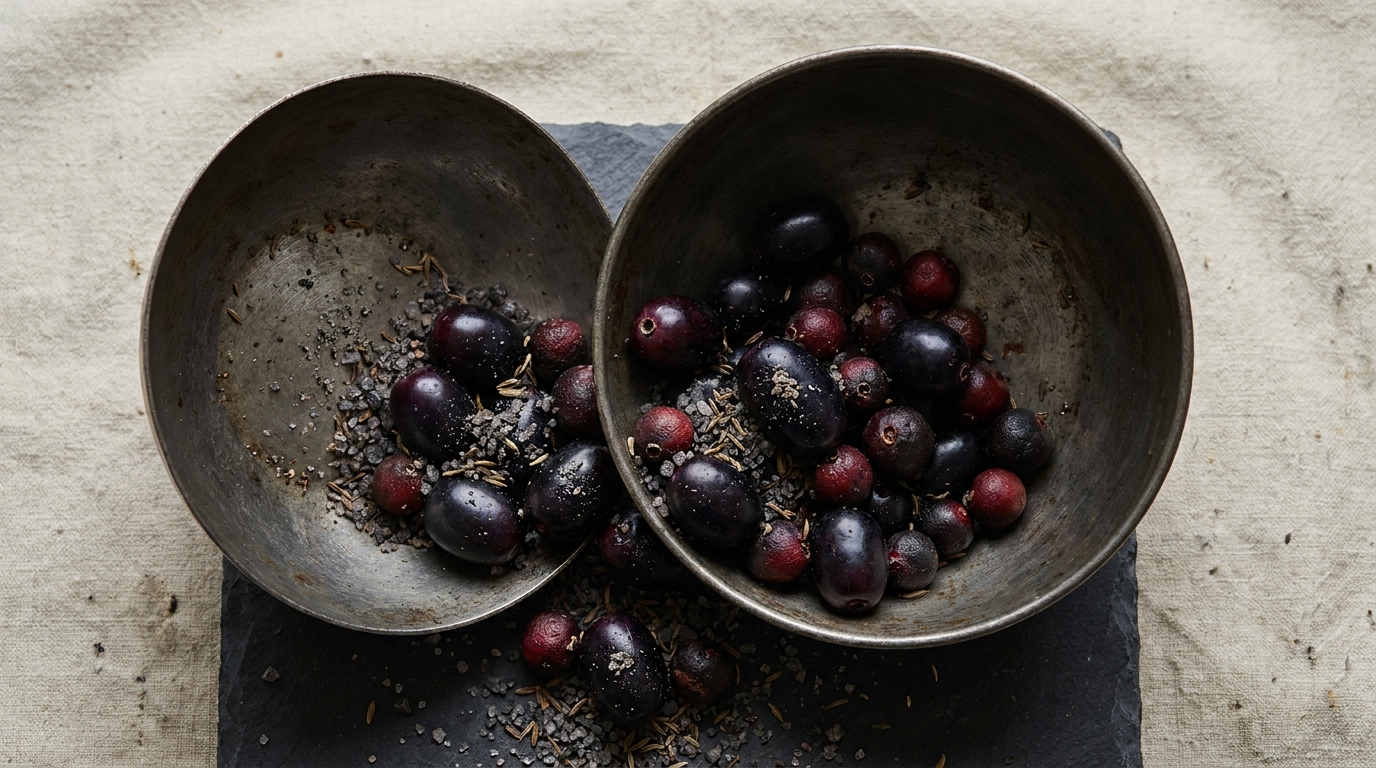
Jamun, phalsa, and karonda are indigenous South Asian fruits whose intense astringency, fragile skins, and rapid post-harvest respiration have locked them out of modern industrial supply chains. In sidelining them for shelf-stable, uniform cultivars, commercial agriculture traded away dense concentrations of anthocyanins, triterpenoids, and functional organic acids that regulate glucose metabolism, gut motility, and sensory complexity.
Supermarkets do not stock what tastes best. They stock what rots slowest.
To build a fruit section capable of sitting under cold fluorescent tubes for twelve days, commercial horticulture systematically bred out three traits: high astringency, paper-thin skins, and rapid respiration rates. In doing so, it selected for uniform sweetness and thick cellulose rinds. The casual casualties of this logistics-first breeding programme were the wild and semi-cultivated summer fruits of the subtropics—species that deliver a distinct medicinal tartness and an extraordinary density of secondary plant metabolites.
Jamun and the machinery of astringency
Jamun (Syzygium cumini), also known as the black plum or Java plum, stains the tongue deep violet. That pigment is not cosmetic. It is driven by delphinidin, petunidin, and malvidin diglucosides—water-soluble vacuolar pigments belonging to the anthocyanin family [1].
What makes jamun distinctive on the palate is its aggressive astringency. Astringency is not a basic taste detected by taste buds; it is a tactile sensation produced when salivary proteins, particularly proline-rich proteins, precipitate out of solution after binding with polyphenols and condensed tannins. Modern supermarket fruit breeders view astringency as a defect to be eliminated. In human physiology, however, those same condensed tannins and ellagitannins exert an inhibitory effect on alpha-amylase and alpha-glucosidase, enzymes responsible for cleaving complex carbohydrates into glucose in the small intestine [1]. Traditional Indian medicine long leaned on jamun seeds and flesh for managing metabolic disorders, a practice that pharmacology now understands through this precise mechanism of delayed intestinal carbohydrate absorption.
Phalsa: the forty-eight-hour drupe
If jamun resists the supermarket through its medicinal tartness, phalsa (Grewia asiatica) resists it through sheer physical fragility. The fruit is a tiny drupe, barely a centimetre wide, that ripens to a dark purplish-red in the peak heat of May and June across northern and central India.
Phalsa has an effective post-harvest life of roughly forty-eight hours [2]. Its respiration rate is exceptionally high, and its skin offers almost zero mechanical protection against bruising. Because it cannot survive refrigerated transport across continents—or even across three state borders without turning into fermented mush—it has never been industrialised.
Yet biochemically, phalsa is a remarkable fruit. It contains high concentrations of cyanidin 3-glucoside alongside significant levels of potassium, phosphorus, and organic acids, predominantly citric acid [2]. In traditional regional diets, it was never treated as dessert. It was prepared as a pressed, strained extract drunk to mitigate acute thermal stress. The high potassium-to-sodium ratio and rapid electrolyte replenishment provided a physiological rationale that predated modern isotonic sports drinks by centuries.
Karonda: the berry reduced to a fake cherry
Karonda (Carissa carandas) suffered a different indignity. Instead of being abandoned, it was degraded.
The berry grows wild on spiny shrubs across the arid zones of the subcontinent. In its unripe state, it is white with a bright pink blush, hard, aggressively sour, and brimming with sticky latex. Ripe, it turns a deep, inky purple. Karonda is exceptionally rich in pectin, ascorbic acid, and triterpenoids like lupeol and carissone [3]. Because of its high pectin and natural acid matrix, it provides an exceptional natural set for preserves and pickles.
Commercial food manufacturing discovered that if you de-seed unripe karonda, boil out its natural astringent tannins, bleach it in sulphur dioxide, and soak it in synthetic red food dye and heavy sugar syrup, it becomes a cheap substitute for candied glacé cherries. Millions of people consume karonda every year inside mass-produced fruitcakes, ice creams, and paan, entirely unaware that the rubbery red cube they are chewing is an ancient medicinal fruit stripped of its native chemistry.
| Fruit | Botanical Name | Primary Functional Compounds | Post-Harvest Shelf Life | Traditional Preparation |
| :--- | :--- | :--- | :--- | :--- |
| Jamun | Syzygium cumini | Anthocyanins, ellagitannins, jamboline | 3–5 days (ambient) | Shaken fresh with black salt (kala namak) |
| Phalsa | Grewia asiatica | Cyanidin 3-glucoside, citric acid, potassium | 24–48 hours | Lightly crushed, cold-pressed sherbet |
| Karonda | Carissa carandas | Pectin, lupeol, carissone, ascorbic acid | 4–7 days | Salt-cured pickle with mustard oil and fenugreek |
The street cart's sensory chemistry
There is a standard way street vendors serve these fruits across Delhi, Lahore, and Lucknow: shaken vigorously in an aluminium bowl with roasted cumin (bhuna jeera) and black salt (kala namak).
This is not casual seasoning. It is sensory biochemistry. Sodium chloride and the trace sulphur compounds in kala namak suppress our perception of bitterness and blunt extreme astringency by altering how tannins interact with salivary proteins [4]. Meanwhile, the warm, earthy aldehydes of toasted cumin bridge the sharp, volatile acids of the fruit. The combination triggers intense salivation, counteracting the drying, protein-precipitating effect of the tannins.
When we let fragile, astringent fruits drop out of cultivation, we do not just lose old flavours. We discard the plant compounds our digestive systems co-evolved with, in exchange for a supermarket shelf full of uniform, transportable sugar.
Frequently Asked Questions
### Why do jamun and phalsa make your mouth feel dry?
That dry, puckering sensation is astringency, not bitterness. It occurs because tannins and polyphenols bind to the lubricating proline-rich proteins in your saliva, causing them to precipitate out and temporarily increasing friction in the oral cavity [4].
### Can jamun seed powder replace clinical blood sugar medication?
No. While lab models and human trials demonstrate that compounds in jamun seed extract inhibit alpha-amylase and alpha-glucosidase to moderate glucose absorption [1], this is a supportive dietary mechanism, not a replacement for prescribed diabetes management.
### Why isn't phalsa cultivated commercially for export?
Phalsa has one of the highest post-harvest respiration rates among subtropical drupes and an exceptionally fragile epidermis. It typically begins to ferment within 24 to 48 hours of picking without cold-chain infrastructure, making long-distance cargo transit commercially unviable [2].
### What is genuine karonda supposed to taste like?
Unripe karonda is sharply acidic, crisp, and slightly resinous, requiring salt, oil, or sugar to balance. Fully ripe karonda is tart-sweet with a mild berry finish, vastly different from the bleached, syrupy "tutti-frutti" garnishes made from it.
Sources & citations
- Shrikanta, A., Kumar, A., & Govindaswamy, V. (2015). Resveratrol content and antioxidant capacity of Syzygium cumini (L.) Skeels. Journal of Food Science and Technology, 52(10), 6798–6804.
- Yadav, A. K. (1999). Phalsa: A potential fruit crop for the arid zone. In J. Janick (Ed.), Perspectives on new crops and new uses (pp. 352–355). ASHS Press.
- Pewlong, S., et al. (2014). Nutritional evaluation and antioxidant properties of Carissa carandas L. fruit at different ripening stages. Functional Foods in Health and Disease, 4(10), 450–462.
- Breslin, P. A. S., & Beauchamp, G. K. (1997). Salt enhances flavour by suppressing bitterness. Nature, 387(6633), 563–563.