
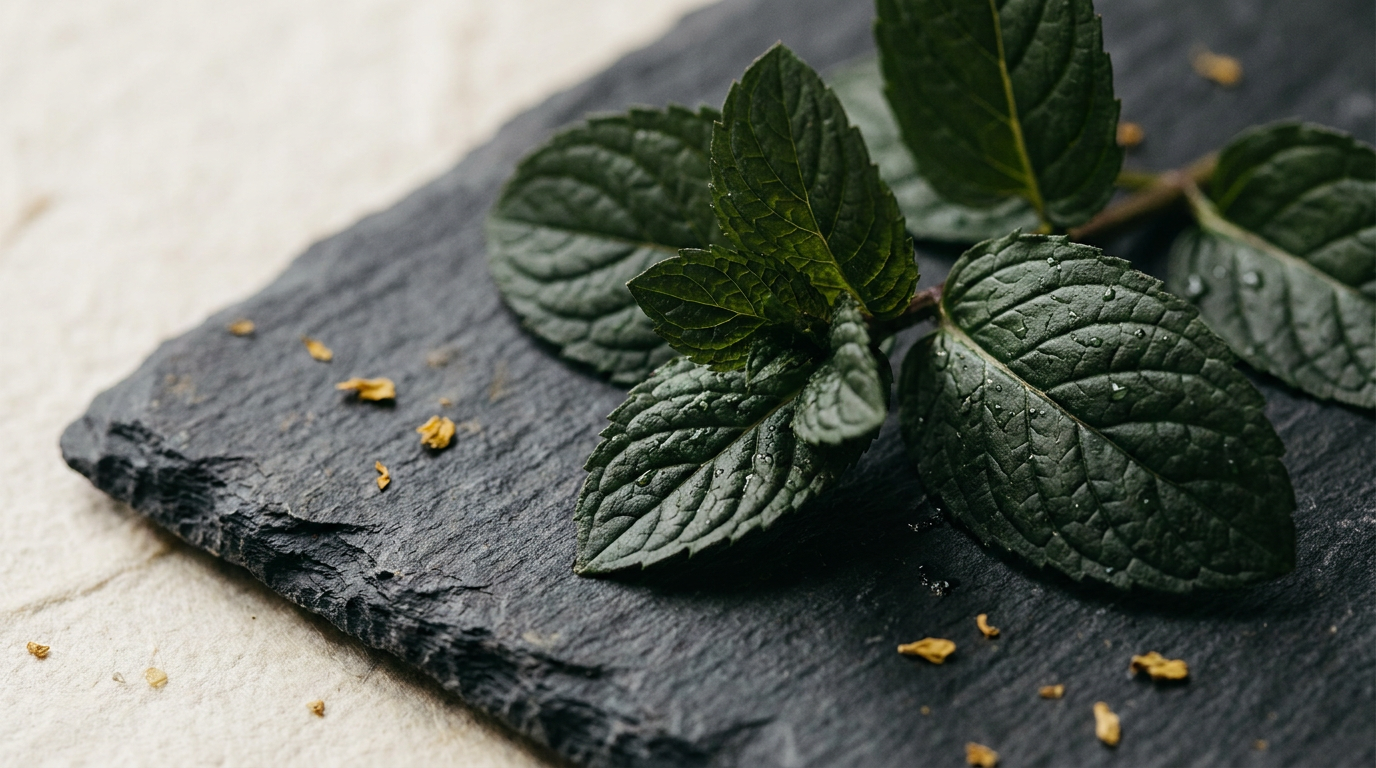
Peppermint (Mentha × piperita) is an aromatic herbaceous perennial and sterile natural hybrid of spearmint (Mentha spicata) and watermint (Mentha aquatica). Cultivated globally for its leaves and volatile essential oils, its characteristic pungent, cooling profile is driven predominantly by the monoterpenes menthol and menthone, which accumulate within specialised peltate glandular trichomes on the foliage [1].
Unlike spearmint, which garden historians trace back into classical antiquity with relative ease, true peppermint is an evolutionary newcomer. It does not breed true from seed. Every commercially viable plant grown today is a clone, propagated via stolons or root runners from an accidental European cross first documented with botanical rigour in late seventeenth-century England [2].
The accidental hybrid in Hertfordshire
In 1696, the English naturalist John Ray noted an unusual, particularly biting specimen of mint growing wild near Buntingford in Hertfordshire. Ray catalogued it in his Synopsis Methodica Stirpium Britannicarum as Mentha palustris, distinguishing it by its fierce, peppery heat from the milder garden mints then stewed into mutton sauces or steeped for stomach gripes.
By the mid-eighteenth century, market gardeners in Mitcham, Surrey, recognised that this pungent hybrid responded exceptionally well to the local sandy loam over London clay. The Mitcham district became the global benchmark for commercial peppermint oil. The hybrid was not engineered to meet an industrial brief. It simply survived because farmers realised that vegetative propagation yielded a crop with unmatched aromatic consistency, free from the genetic lottery of seeded mints.
Modern genetic analysis confirms that peppermint is an allotetraploid hybrid. Watermint contributes a distinctively round leaf morphology and a genetic disposition toward the synthesis of bitter, often toxic menthofuran under poor growing conditions. Spearmint brings hardiness, aggressive stolon growth, and high concentrations of complementary monoterpenes [1]. When these genomes fused, the metabolic pathway shifted primary volatile production toward (-)-menthol.
The chemistry of the leaf surface
Peppermint synthesises its aroma inside microscopic structures called peltate glandular trichomes, which sit perched across the epidermis of the leaf. Each trichome consists of a basal cell, a stalk cell, and a secretory head composed of eight disc cells capped by an expansive subcuticular oil reservoir [3].
Within these eight disc cells, the plant runs the methylerythritol phosphate (MEP) pathway, turning atmospheric carbon into geranyl diphosphate and subsequently limonene. From limonene, a sequence of enzymatic hydroxylations and reductions produces isopiperitenone, then pulegone, and finally (-)-menthone and (-)-menthol [1].
| Botanical species | Primary volatile compounds | Dominant sensory profile | Reproductive biology |
| :--- | :--- | :--- | :--- |
| Peppermint (Mentha × piperita) | Menthol (30–55%), Menthone (14–32%), Menthyl acetate | Sharp, piercing cold, peppery camphor | Sterile clone; propagated via stolons |
| Spearmint (Mentha spicata) | (-)-Carvone (50–70%), Limonene | Sweet, herbaceous, mild | Fertile; variable from seed |
| Watermint (Mentha aquatica) | Menthofuran, 1,8-Cineole | Earthy, musky, faintly resinous | Fertile; spread via rhizomes |
The exact ratio of these volatiles is notoriously sensitive to agricultural stress. Young leaves harvest early in the season lean heavily toward menthone. As the leaf matures, menthone reduces into free menthol, while a portion esterifies into menthyl acetate, which lends a softer, fruity note to mature oils [3]. If the crop suffers shade, overcast weeks, or excessive damp near harvest, the enzymatic pathway diverts intermediates toward menthofuran. In high concentrations, menthofuran imparts an acrid, rank bitterness that ruins a commercial distillation run.
Digestion, smooth muscle, and clinical limits
Aside from its sensory punch, peppermint occupies a rare position in herbal medicine: its traditional reputation for settling digestion holds up under clinical scrutiny, provided the preparation reaches the right part of the gut [4].
The primary active agent, (-)-menthol, acts as a natural calcium channel blocker in visceral smooth muscle. By inhibiting the influx of extracellular calcium ions through L-type voltage-gated channels, menthol dampens the contractility of intestinal smooth muscle, exerting an antispasmodic effect on the colon [4].
However, delivery dictates the outcome. When swallowed as raw leaf tea or standard oil drops, peppermint relaxes the lower oesophageal sphincter before it ever touches the lower bowel. The practical consequence for people with gastro-oesophageal reflux is immediate, acute heartburn as gastric acid escapes into the oesophagus. Enteric-coated capsules, which resist gastric acid and dissolve only upon reaching the alkaline environment of the duodenum, are required to bypass the stomach and relieve lower bowel spasms effectively [4].
Cooking with a cold fire
In Western kitchens, peppermint is routinely relegated to chocolate pairings, boiled sweets, or a restorative infusion after heavy meals. The leaf contains enough tannins and bitter flavonoids to give a hot infusion body, but extended boiling volatilises the delicate menthyl acetate, leaving an infusion that tastes uncomfortably medicinal.
In Levantine and North African cookery, dried peppermint serves an entirely different purpose. Dried gently out of direct sunlight, the leaves retain their oil reservoirs inside the intact trichomes. Crushed directly into fatty sheep's milk yoghurt, garlicky cucumber salads, or lentil stews, the menthol cuts through animal fat without demanding the sour acidity of lemon or vinegar. It is an astringent counterweight, not a dessert garnish. Detailed culinary and historical notes for peppermint illustrate how dried leaves maintain structural stability where fresh sprigs turn sodden.
Understanding peppermint begins with its status as a sterile freak of nature. It yields no wild seed lines and requires human hands to carry its roots into next year's furrow. In exchange, it offers an exceptionally clean, repeatable monoterpene profile that sharpens both a summer yoghurt salad and modern clinical pharmacology.
Frequently asked questions
Can you grow true peppermint from seed?
No. Peppermint is an allotetraploid hybrid and functionally sterile. Packets labelled "peppermint seeds" generally contain spearmint or an unstable mint cross. True peppermint must be planted from cuttings, stolons, or root divisions of an existing Mentha × piperita specimen.
Why does peppermint oil trigger heartburn in some people?
Menthol relaxes smooth muscle tissue by interfering with calcium ion influx. When taken without an enteric coating, the oil relaxes the lower oesophageal sphincter muscle, allowing stomach acid to wash back into the oesophagus.
What causes some peppermint tea to taste harsh or bitter?
Harshness usually stems from poor harvest timing or over-extraction. Leaves picked in waterlogged or low-light conditions often contain higher levels of menthofuran and pulegone. Furthermore, infusing dried peppermint in boiling water for longer than five minutes leaches astringent polyphenols that overpower the volatile oils.
Sources & citations
- Lange, B.M. and Croteau, R. (1999). Isoprenoid biosynthesis via a mevalonate-independent pathway in plants: Cloning and functional characterization of 1-deoxy-D-xylulose 5-phosphate reductoisomerase from peppermint. Proceedings of the National Academy of Sciences, 96(24), pp. 13714–13719. https://doi.org/10.1073/pnas.96.24.13714
- Tucker, A.O. and Naczi, R.F. (2007). Mentha: An Overview of Its Classification and Relationships. In: Lawrence, B.M. (ed.) Mint: The Genus Mentha. Boca Raton: CRC Press, pp. 1–39. https://doi.org/10.1201/9780849307980.ch1
- Turner, G.W., Gershenzon, J. and Croteau, R.B. (2000). Distribution of peltate glandular trichomes on developing leaves of peppermint. Plant Physiology, 124(2), pp. 655–664. https://doi.org/10.1104/pp.124.2.655
- Khanna, R., MacDonald, J.K. and Levesque, B.G. (2014). Peppermint oil for the treatment of irritable bowel syndrome: a systematic review and meta-analysis. Journal of Clinical Gastroenterology, 48(6), pp. 505–512. https://doi.org/10.1097/MCG.0b013e3182a88357