
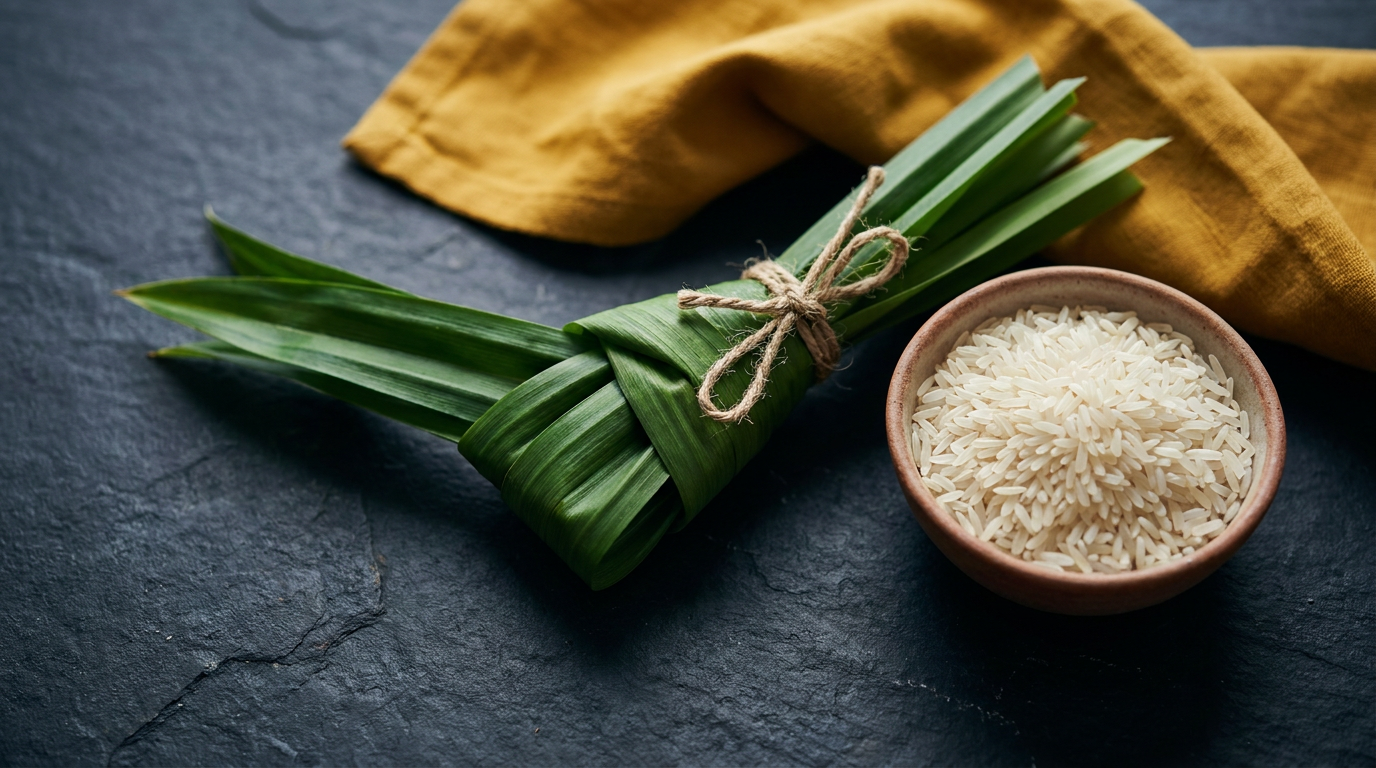
Pandan (Pandanus amaryllifolius) is a tropical plant valued across Southeast Asia for its grassy, sweet aroma, driven principally by the volatile compound 2-acetyl-1-pyrroline (2AP). Often labelled the region's vanilla, pandan functions differently in cooking: while vanilla relies on vanillin to sweeten fats, pandan adds toasted, nutty notes that enhance both savoury rice dishes and starch-based sweets.
Calling pandan the "vanilla of Southeast Asia" is an old habit of colonial trade writing. Observers encountering a fragrant green leaf used in sweet custard buns, cakes, and glutinous rice puddings reached for the nearest European reference point. The comparison explains its cultural ubiquity, but it misleads anyone trying to cook with it. Vanilla is resinous, phenolic, and round; pandan is vegetal, nutty, and distinctly toasted.
To understand why pandan tastes the way it does, one has to look not at orchard pods, but at grain chemistry.
The Popcorn Molecule
The signature aroma of Pandanus amaryllifolius is not an exotic botanical anomaly. Its primary aromatic driver is 2-acetyl-1-pyrroline, commonly abbreviated as 2AP [1]. This is the identical volatile organic compound that gives fragrant rice varieties like Thai jasmine and Indian basmati their characteristic scent. It is also the molecule responsible for the aroma of freshly buttered popcorn, white bread crust straight from the oven, and roasted sesame seeds [2].
In bread and roasted grain, 2AP forms through the Maillard reaction, the non-enzymatic browning that occurs when amino acids meet reducing sugars under heat. Pandan does not wait for an oven. The plant synthesises 2AP enzymatically inside its living leaves while growing in damp tropical soil, accumulating it in higher concentrations than almost any other known plant tissue [3].
When you tie a blanched pandan leaf into a knot and drop it into a pot of boiling rice, you are not simply perfuming the water. You are reinforcing the baseline chemistry of the grain itself. The natural 2AP present in ordinary, non-aromatic white rice is negligible; pandan supplements the missing volatiles, providing an economical way to replicate the profile of aged jasmine rice in daily cooking.
| Attribute | Pandan (Pandanus amaryllifolius) | Bourbon Vanilla (Vanilla planifolia) |
| :--- | :--- | :--- |
| Primary Volatile | 2-Acetyl-1-pyrroline (2AP) | 4-Hydroxy-3-methoxybenzaldehyde (Vanillin) |
| Aroma Family | Roasted, nutty, grassy, popcorn-like | Creamy, phenolic, woody, sweet |
| Savoury Application | Extensive (nasi lemak, chicken wrapped in leaf) | Rare, mostly experimental |
| Solubility & Binding | Volatile in water; stabilised by fats | Alcohol-soluble; dissolves readily in fats |
| Heat Stability | Degrades under sustained high heat | Moderate; vanillin survives typical baking |
Water, Fat, and Volatility
Cooking with pandan presents an immediate technical difficulty: 2AP is a notoriously volatile molecule with a very low odour threshold [2]. It is delicate. Long boiling degrades the compound, leaving behind dull, fibrous vegetal bitterness without the fragrant top notes.
Southeast Asian cooking practices address this degradation through two distinct extraction methods.
The first method is mechanical bruising followed by ambient water extraction. To make the paste for kaya (coconut and egg jam) or chiffon cake, cooks pound fresh leaves with a small amount of cold water, strain the emerald juice, and discard the fibrous cellulose. This extracts both the aroma and chlorophyll without thermal breakdown. If allowed to sit in a glass jar in the refrigerator overnight, the suspension separates into clear water at the top and a dense, fragrant green sediment at the bottom. Cooks discard the top layer to avoid dilution.
The second method relies on lipid capture. In dishes like Malaysian nasi lemak or Indonesian nasi uduk, pandan leaves steep gently in coconut milk alongside lemongrass and ginger. Coconut milk contains medium-chain triglycerides, which help trap and solubilise hydrophobic volatiles, retarding their escape into the steam while the rice cooks.
Because 2AP oxidises rapidly when exposed to air and light, dried pandan leaves sold in temperate grocery shops are almost entirely stripped of their aroma. They retain some green colour, but the distinct toasted-rice character is largely gone. Frozen leaves preserve far more of the original compound, provided they have remained sealed against freezer burn.
The Artificial Trap
Most commercial pandan pastes and extracts lean heavily on synthetic flavourings and brilliant green food dye (often Tartrazine and Brilliant Blue FCF). Synthetic 2AP is unstable and chemically tricky to store in a bottle; as a result, commercial "pandan flavouring" frequently uses artificial vanillin, ethyl maltol, and coumarin-like compounds to construct a confection that smells like aggressive marzipan rather than pandan.
Working with the actual plant requires accepting that its flavour is subtler than synthetic extracts suggest. It belongs to starch, fat, and gentle heat. When treated as an aromatic bridge rather than a green substitute for vanilla extract, pandan reveals its real utility: an immediate, enzymatic expression of toasted warmth.
Frequently Asked Questions
### Can dried pandan leaves substitute for fresh leaves?
Dried pandan leaves retain negligible amounts of 2-acetyl-1-pyrroline. While they can impart a faint grassy colour to teas, they will not deliver the characteristic aroma of the fresh leaf. Frozen whole leaves from an Asian grocer are a vastly superior alternative.
### Why does pandan make desserts turn bright green?
Natural pandan juice contains high levels of chlorophyll, which provides a soft, olive-green hue to batters and custards. The neon green colour associated with commercial pandan cakes, however, comes from synthetic food colourings added to commercial extracts, not the plant itself.
### How does pandan function in savoury cooking?
In savoury dishes, pandan is rarely blended into a paste. Instead, whole leaves are tied into knots and simmered in broths, tucked into rice pots, or wrapped around seasoned chicken before deep-frying (gai hor bai toey), transferring aroma and protecting the meat from direct scorching.
Sources & citations
- Yoshihashi, T., Nguyen, T. T. H., & Kabaki, N. (2002). Area-dependent volatile aroma compound (2-acetyl-1-pyrroline) of pandan leaves (Pandanus amaryllifolius Roxb.). Journal of Agricultural and Food Chemistry, 50(21), 6061–6064. https://doi.org/10.1021/jf020241t
- Buttery, R. G., Ling, L. C., & Juliano, B. O. (1982). 2-Acetyl-1-pyrroline: an important aroma component of cooked rice. Chemistry and Industry, (23), 958–959.
- Wongpornchai, S., Sriseadka, T., & Choonvisase, S. (2003). Identification and quantitation of the core aroma-active compounds in Thai pandan (Pandanus amaryllifolius Roxb.) leaves. Flavour and Fragrance Journal, 18(4), 325–330. https://doi.org/10.1002/ffj.1215