
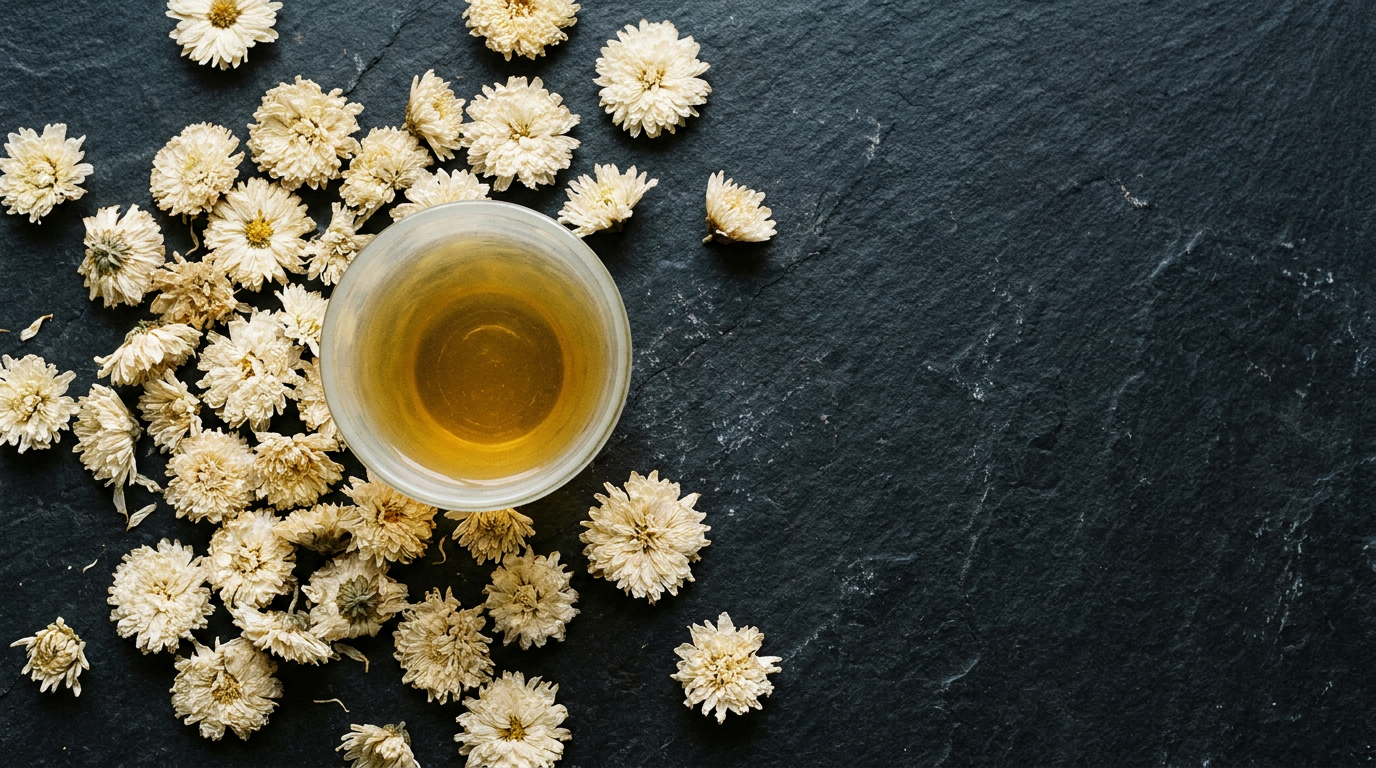
Chrysanthemum tea is an infusion of dried Chrysanthemum morifolium or Chrysanthemum indicum flower heads, consumed across East Asia as a caffeine-free tisane. Historically prescribed to clear heat and soothe eye fatigue, its primary active constituents are flavones, chiefly luteolin, apigenin, and chlorogenic acid, which demonstrate measurable anti-inflammatory and antioxidant activity in cellular models, distinct from clinical ocular cures.
The architecture of heat
In southern China, when the summer humidity settles into concrete and lungs, the default response is rarely cold soda. It is an infusion of dried flower heads poured from a glass jug that has been left to come to room temperature.
The framework governing this habit is shanghuo, a traditional classification roughly translated as internal heat. It is an umbrella term covering sore throats, mouth ulcers, dry eyes, and flushed cheeks, typically blamed on greasy food, poor sleep, or unrelenting weather. Western clinical medicine does not have a single diagnostic counterpart for shanghuo, but it recognises the biological states clustered beneath it: mucosal irritation, low-grade inflammatory signalling, and mild dehydration.
Chrysanthemum belongs firmly to the cooling category (han or liang). Unlike peppermint, which creates an actual drop in perceived temperature by binding menthol to the TRPM8 cold receptor in the mouth, chrysanthemum works without tricking nerve endings. It tastes slightly grassy, faintly bitter, and distinctly sweet at the back of the palate. The cooling sensation is physiological and systemic rather than an instantaneous sensory illusion.
The botany of the basket
Not all dried chrysanthemums are the same flower, though markets frequently toss them into identical plastic bins. The trade distinguishes sharply between cultivars of Chrysanthemum morifolium and wild relatives, selecting them for specific extractions [1].
| Variety | Origin | Sensory profile | Extraction focus |
| :--- | :--- | :--- | :--- |
| Hangbaiju | Tongxiang, Zhejiang | Sweet, thick, floral | Daily infusion; high chlorogenic acid |
| Taiju (fetal bud) | Tongxiang, Zhejiang | Crisp, concentrated, honeyed | Early harvest buds; volatile oil retention |
| Huangshan Gongju | Huangshan, Anhui | Clean, mild, light yellow broth | Traditional eye rinse and heat clearing |
| Yejuhua (C. indicum) | Wild / Various | Intensely bitter, medicinal | High sesquiterpenes; topical and acute use |
Hangbaiju remains the standard for domestic pots. It produces a soft, pale infusion that holds its sweetness over four or five water additions. Taiju, picked just before the ray florets open, contains a higher proportion of intact glandular trichomes, which preserve volatile monoterpenes like camphor and 1,8-cineole. Gongju, dried over charcoal in Anhui for centuries to supply the imperial court, yields a paler, less viscous liquor with a drier finish.
The eye-strain folklore: luteolin versus lutein
For centuries, traditional Chinese formularies paired chrysanthemum with goji berries (Lycium barbarum) under the aphorism qingre mingmu, which translates to clearing heat and brightening the eyes. Today, the modern office worker drinks it to counter twelve uninterrupted hours of glowing liquid crystal screens.
There is a peculiar linguistic and chemical confusion here. Wellness marketing frequently claims chrysanthemum is rich in lutein, the macular pigment that filters blue light in the human retina. It is not. Chrysanthemum contains very little lutein. What it carries in abundance is luteolin, a flavone with a deceptively similar name [2].
Luteolin is an interesting molecule. In rodent models and isolated cell lines, it inhibits the nuclear factor-kappa B (NF-κB) pathway and suppresses the production of pro-inflammatory cytokines such as TNF-alpha and interleukin-6 [3]. In retinal pigment epithelial cells exposed to photo-oxidative stress, luteolin application reduces intracellular reactive oxygen species [4].
Translating those Petri dish findings to an afternoon desk mug, however, requires caution. Flavones have poor oral bioavailability. When you drink chrysanthemum tea, only a fraction of the native luteolin reaches peripheral tissues unchanged; most undergoes rapid glucuronidation in the liver and gut mucosa. The tea will not alter your refractive error, and it will not reverse macular degeneration. If your dry, tired eyes feel better after three glasses, you are likely feeling the benefits of systemic rehydration, the mild anti-inflammatory effects of absorbed phenolic metabolites, and the involuntary five minutes away from your screen required to boil the kettle.
Extracting the flower
Extracting chrysanthemum is less finicky than steeping green tea, but careless handling still ruins the balance. The phenolic compounds extract steadily over time, but prolonged exposure to rolling boiling water in a closed vacuum flask oxidises the chlorogenic acid, turning the liquor an unappealing murky grey-green.
Use water at roughly 90 to 95 degrees Celsius. A glass vessel is traditional and sensible: you can watch the florets rehydrate and unfurl, and you can pour off the liquor before the bitterness of the green receptacles dominates.
Five or six whole heads per 250 millilitres of water will yield a clean, golden broth in three minutes. If you want the traditional pairing, drop in four dried goji berries; their gentle polysaccharides supply natural sweetness, softening the astringency without needing refined sugar.
Frequently asked questions
Does chrysanthemum tea contain caffeine?
No. It is a tisane prepared entirely from flower heads of the Asteraceae family and is naturally free of caffeine and theobromine.
Can people with ragweed allergies drink chrysanthemum tea?
Exercise caution. Chrysanthemum belongs to the Asteraceae family, the same botanical family as ragweed, daisies, and marigolds. Cross-reactivity can trigger contact dermatitis or oral allergy symptoms in sensitive individuals.
Why does my chrysanthemum tea turn green after sitting?
The colour shift occurs when chlorogenic acid and other polyphenols in the petals oxidise upon contact with air, or when alkaline mineral content in tap water reacts with the floral pigments. It is safe to drink, though the flavour becomes flatter.
Sources & citations
- Lin, L.-Z., & Harnly, J. M. (2010). Identification of the phenolic components of chrysanthemum flower (Chrysanthemum morifolium Ramat). Food Chemistry, 120(1), 319–326. https://doi.org/10.1016/j.foodchem.2009.09.083
- Wang, Y., et al. (2019). Evaluation of antioxidant and anti-inflammatory activities of Chrysanthemum morifolium extracts. Journal of Ethnopharmacology, 245, 112158. https://doi.org/10.1016/j.jep.2019.112158
- Theoharides, T. C., et al. (2018). Luteolin as a therapeutic option for multiple sclerosis and other neuroinflammatory disorders. Frontiers in Neuroscience, 12, 831. https://doi.org/10.3389/fnins.2018.00831
- Yuan, H., et al. (2012). Protective effects of luteolin on retinal pigment epithelial cells under oxidative stress. Investigative Ophthalmology & Visual Science, 53(14), 4880.