
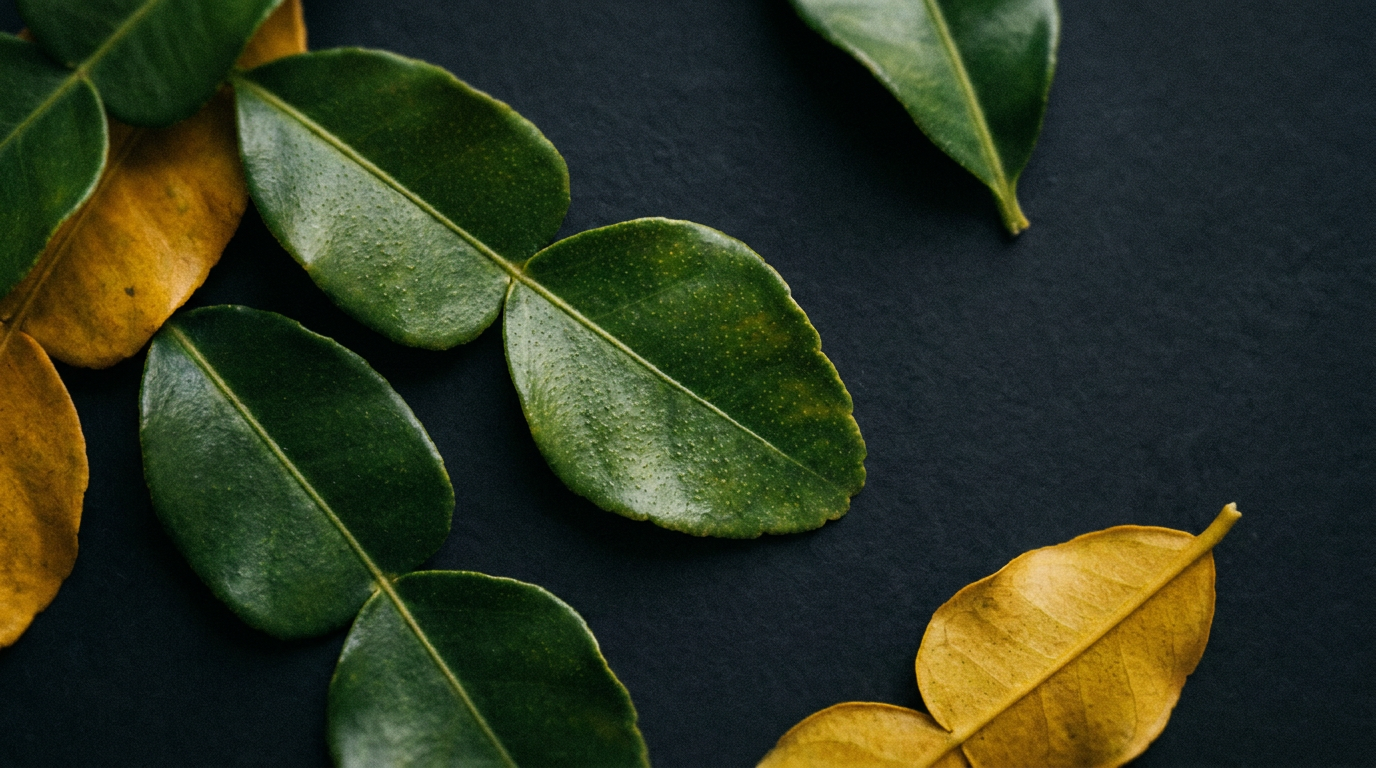
Makrut lime leaves (Citrus hystrix) derive their distinct, piercing aroma from exceptionally high concentrations of citronellal, an acyclic monoterpenoid aldehyde that constitutes over sixty percent of the leaf's essential oil [1]. Unlike standard citrus foliage or lime fruit, these double-lobed leaves release an intense floral-citrus volatility when their oil glands are ruptured, cut, or simmered in stocks and curries.
The anatomy of an hourglass leaf
Pick up a leaf from Citrus hystrix and the first oddity is structural: it appears to be two leaves joined end-to-end. Botanically, the lower segment is an expanded, winged petiole (the leaf stalk), while the upper segment is the true leaf blade. Both sections are studded with translucent pellucid glands: spherical cavities embedded beneath the epidermis that store essential oils under slight hydrostatic pressure [2].
Outside Southeast Asia, the plant is historically catalogued in older spice literature under the name "kaffir lime." That designation carries severe racial slurs in South Africa and southern Africa, derived from colonial Arabic and Portuguese trade terms. In contemporary culinary botany and trade, the plant is increasingly named makrut, lime hystrix, or simply by its binomial designation.
Whatever the label on the packet, holding the leaf against a light source reveals hundreds of tiny dots across both lobes. Those dots are oil reservoirs. How you treat them determines whether you get an unmistakable wash of electric citrus or merely stiff, bitter cellulose.
Citronellal: the single compound doing the work
Most citrus fruits bank their olfactory identity on limonene. Lemon peel, orange zest, and common Persian lime (Citrus latifolia) are heavily dominated by limonene, which delivers a familiar, linear citrus profile.
Citrus hystrix leaves operate on a different chemical axis. The primary volatile compound is (S)-(-)-citronellal, accounting for 60 to 80 percent of the leaf's volatile fraction, supported by minor amounts of citronellol, linalool, and sabinene [1, 3]. Citronellal is the same molecule that defines lemongrass and citronella grass (Cymbopogon), but in Citrus hystrix it pairs with floral monoterpenes and woody sesquiterpenes without the soapy overtones common to grass stems.
This explains why substituting lime juice or lime zest for the leaf never quite succeeds. Lime juice provides citric acid and water with negligible aromatics; lime zest delivers limonene. Neither provides citronellal. They taste like lime; makrut leaf smells like warm, high-frequency green perfume.
| Attribute | Fresh or Frozen Makrut Leaf | Commercial Dehydrated Makrut Leaf | Persian Lime Zest (Citrus latifolia) |
| :--- | :--- | :--- | :--- |
| Primary Volatile | Citronellal (up to 80%) | Degraded terpenes; trace citronellal | Limonene (up to 65%) |
| Oil Cavity State | Intact, liquid-filled glands | Collapsed, oxidised structures | Intact flavedo glands |
| Aromatic Quality | Piercing, floral-citrus, woodsy | Faint, hay-like, dusty | Bright, acidic, direct lemon-lime |
| Best Application | Simmered broths, raw chiffonade | Low-moisture spice rubs only | Baked goods, direct garnishes |
Why supermarket dried leaves fail
Walk down the spice aisle of an ordinary grocer, and you will find dried makrut lime leaves sitting in small glass jars. They are usually pale olive, brittle, and priced steeply for a few grams.
They are almost entirely useless. Citronellal is a volatile monoterpene aldehyde. When the leaf is subjected to warm commercial air-drying, those delicate molecules volatilise and evaporate. The remaining unsaturated fatty acids and terpenes oxidise in the presence of ambient air and light [2]. The result is a leaf that smells of dry hay and autumn foliage, with only an echo of citrus trapped in recalcitrant inner tissues.
Freezing, by contrast, preserves the cellular structure and prevents volatile evaporation. Fresh leaves kept in a sealed polyethylene bag in the freezer retain their aromatic payload for twelve months or longer without perceptible loss of citronellal. If fresh branches are unavailable, head to the frozen section of an East or Southeast Asian grocer rather than the dry spice rack.
The mechanics of the kitchen: strip, tear, or chiffonade
The central midrib of the leaf is woody, fibrous, and bitter. If you are serving the leaf raw, as in a Thai larb or northern Vietnamese chicken salad, folding the leaf in half and tearing out this tough spine is mandatory. Stack the destemmed halves tightly, roll them into a cigar, and slice across with a very sharp blade into hair-thin threads. Bruising the leaf with a blunt knife crushes the oil cells unevenly and darkens the cut edges; a razor-sharp cut severs the glands cleanly, releasing the oil exactly where the leaf lands on the palate.
When using the leaf whole in a liquid—such as a coconut-based curry, a sour broth like tom yum, or a pot of jasmine rice—the approach changes. The volatile oils require thermal assistance to move into the surrounding broth. Tearing the leaf across its lobes fractures the internal cell walls. Drop them into the liquid during the last ten to fifteen minutes of cooking. Simmering them for two hours will drive off the top notes, leaving the broth with only dull baseline terpenes.
Frequently asked questions
### Can dried makrut lime leaves substitute for fresh leaves?
Not effectively. Industrial dehydration removes the majority of citronellal, leaving behind fibrous tissue that tastes mostly of dried grass. If fresh leaves are unavailable, frozen leaves are by far the best alternative.
### Can I use regular lime leaves instead?
Leaves from standard Persian (Citrus latifolia) or Key lime (Citrus aurantiifolia) trees contain significantly less citronellal and lower overall oil volume. They provide a mild, slightly bitter citrus scent but lack the pungent, perfumed intensity of Citrus hystrix.
### Can lime zest replace makrut lime leaf in a curry?
Zest can supply citrus aromatics, but its profile is dominated by limonene rather than citronellal. If forced to substitute, combining a small quantity of fresh lime zest with crushed fresh lemongrass mimics the aromatic balance far better than lime zest alone.
### How should extra fresh leaves be stored?
Seal clean, dry leaves in an airtight zip-top freezer bag with as much air pressed out as possible. They freeze flat, do not clump together, and can be used straight from the freezer without thawing.
Sources & citations
- Jirovetz, L., Buchbauer, G., Fleischhacker, W., & Ngassoum, M. B. (2002). Analysis of the essential oil of the leaves of Citrus hystrix DC. from Thailand. Flavour and Fragrance Journal, 17(5), 373-376.
- Kasuan, N., Muhammad, Z., Mansor, Z., Sulaiman, N., & Taib, M. N. (2013). Extraction of Citrus hystrix D.C. (Kaffir Lime) Essential Oil Using Automated Steam Distillation Process. Agriculture and Agricultural Science Procedia, 2, 344-350.
- Tinjan, P., & Jirapakkul, W. (2007). Comparative study on aroma-active compounds of Thai kaffir lime (Citrus hystrix DC) leaf essential oil. Kasetsart Journal (Natural Science), 41(3), 512-518.