
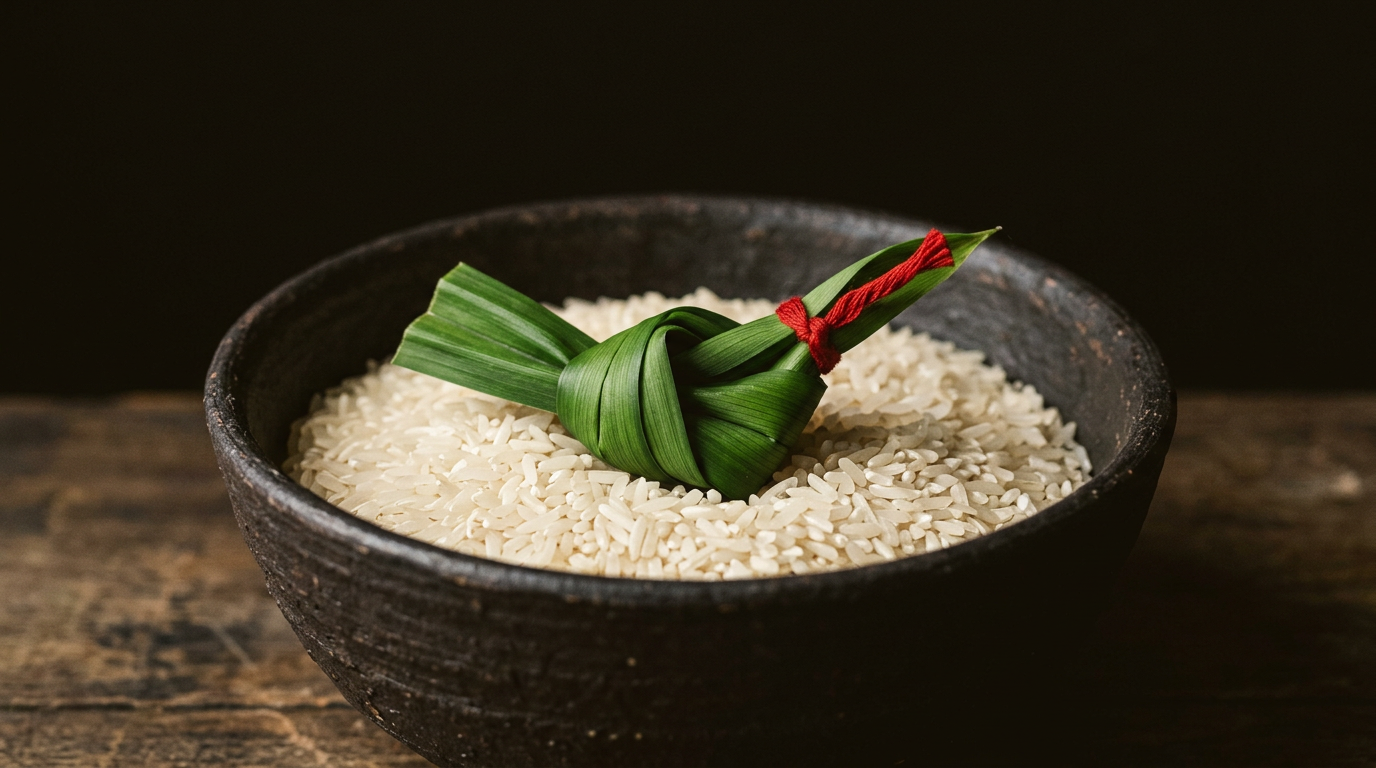
The easiest, most profound upgrade to your daily pot of rice costs next to nothing and takes five seconds. The simple pandan leaves rice recipe involves just one step: adding a knotted leaf to your rice cooker. This single gesture, common across Southeast Asia, transforms a commodity grain into something aromatic, complex, and deeply comforting, perfuming your entire kitchen with notes of vanilla, toasted nuts, and fresh grass.
The Scent Profile of a Continent
Pandan, or Pandanus amaryllifolius, is a tropical plant whose long, slender green leaves are integral to cooking from Sri Lanka to the Philippines. Often called the "vanilla of Southeast Asia," the comparison is useful but incomplete. While it shares a sweet, comforting quality with vanilla, pandan’s profile is greener, nuttier, and more herbaceous. It's a foundational flavor, used to infuse everything from coconut curries and chicken dishes to neon-green cakes and custards. You can explore the plant's full range in our pantry guide to [/ingredient/pandan](pandan).
But its true genius lies in its partnership with rice. Many of the most prized rice varieties in the world, like Basmati and Jasmine, are celebrated for their distinctive aroma. The key molecule responsible for this scent is a compound called 2-acetyl-1-pyrroline, or 2AP [1]. It’s what we register as toasty, warm, and vaguely popcorn-like. Pandan leaves are exceptionally rich in this very same compound [2].
Adding a pandan leaf to a pot of plain, less-aromatic rice is a brilliant culinary hack. As the rice steams, the heat releases the volatile 2AP from the leaf, which is then absorbed by the grains. You are essentially infusing a neutral base with the very essence of a premium fragrant rice. It’s a quiet act of alchemy, turning the everyday into the exceptional.
A Simple Pandan Leaves Rice Recipe
This isn't a formal recipe so much as a technique. It works for any rice you cook, from short-grain to long-grain, in a pot or a rice cooker.
- Measure and Rinse: Measure one cup of your preferred white rice (about enough for two people). Rinse it under cool water until the water runs mostly clear.
- Add Water and Leaf: Add the appropriate amount of water for your rice. Take two or three fresh or frozen pandan leaves and tie them into a simple overhand knot. This bruising helps release the aromatic compounds. Submerge the knot in the water with the rice.
- Cook: Cook the rice as you normally would.
- Rest and Fluff: Once cooked, let the rice rest, covered, for 10 minutes. Remove and discard the pandan knot before fluffing the grains with a fork or paddle.
That's it. The result is rice that tastes not just flavored, but fundamentally better.
| Feature | Plain White Rice | Rice with Pandan |
| :--- | :--- | :--- |
| Aroma | Neutral, slightly starchy | Complex: nutty, vanilla, grassy |
| Flavor | Mild, starchy base | Subtly sweet, herbaceous, rich |
| Key Compound | Starch | Starch + 2-acetyl-1-pyrroline (2AP) |
| Kitchen Impact | Minimal | Fills the home with a comforting scent |
A Note on Sourcing and Lineage
Why isn't this technique as common as adding a bay leaf to soup in the West? The answer lies in our culinary canons—histories shaped by trade routes, colonial preference, and agricultural policy. Knowledge systems that value pandan have existed for millennia, yet remain secondary in many global culinary conversations. It's a classic example of a colonised-food story.
Today, rediscovery is easy. Fresh and frozen pandan leaves are readily available in the Asian markets of most major cities. In the [/region/us](US), you can find them in the sprawling markets of Houston; in the UK, a bundle costs a few quid in London's Chinatown. In the UAE, where it is often known as rampe, it’s a staple in the grocery stores of Karama for both savory dishes and the beloved dessert kue. This accessibility offers a chance to correct the historical oversight in our own kitchens.
By adding a single leaf to your pot of rice, you're not just making a better meal. You're participating in a rich, diasporic tradition and subtly expanding your own definition of what good food is.
---
Frequently Asked Questions
What does pandan taste like in rice?
Pandan imparts a subtle flavor that's hard to pin down—it's a mix of vanilla, coconut, and a grassy, nutty aroma. It doesn't overpower the rice but makes it taste richer and more fragrant, similar to high-quality jasmine or basmati rice.
Can I use pandan extract instead of leaves for this rice recipe?
You can, but we don't recommend it for the basic pandan leaves rice recipe. Most commercial extracts contain artificial coloring and flavoring, and their potency can easily overwhelm the delicate grains. Fresh or frozen leaves provide a more natural and nuanced aroma.
Does pandan have any health benefits?
Traditionally, pandan has been used in folk medicine for various purposes. Modern research suggests its extracts may have antioxidant and anti-inflammatory properties [3]. However, the small amount used for infusing rice is primarily for aroma and flavor, not significant nutritional or medicinal benefit.
Where can I buy fresh pandan leaves?
Look for them in the fresh produce or frozen section of most Asian grocery stores. In the United States, they are widely available in cities with large Southeast Asian communities. If you live in a warm climate, you can even grow a pandan plant in a pot on a sunny windowsill.
Sources & citations
- Buttery, R. G., & Ling, L. C. (1982). 2-Acetyl-1-pyrroline: An important aroma component of cooked rice. Chemistry & Industry. [https://www.soci.org/chemistry-and-industry]
- Yahya, F., & Chong, G. H. (2018). Comparison of optimization techniques for the extraction of 2-acetyl-1-pyrroline (2AP) from Pandanus amaryllifolius. Journal of Food Processing and Preservation, 42(10), e13759. [https://onlinelibrary.wiley.com/journal/17454549]
- Ghasemzadeh, A., & Jaafar, H. Z. E. (2013). Profiling of phenolic compounds and their antioxidant and anticancer activities in pandan (Pandanus amaryllifolius Roxb.) extracts. International Journal of Molecular Sciences, 14(11), 22522–22542. [https://www.ncbi.nlm.nih.gov/pmc/articles/PMC3856041/]