
We believe what’s left out of a product is as important as what goes in. That’s why for every batch of spices we source, we publish a third-party lab report detailing its purity, potency, and safety. This isn’t just data; it's a verifiable promise in a food system where trust is often a marketing slogan, not a standard operating procedure.
This document is called a Certificate of Analysis, or CoA. And while it may look like a dense, boring page of numbers, it represents a fundamental shift in what we should expect from the food we eat. It's the difference between a brand telling you something is pure, and a brand showing you the proof.
The Ghost in the Jar
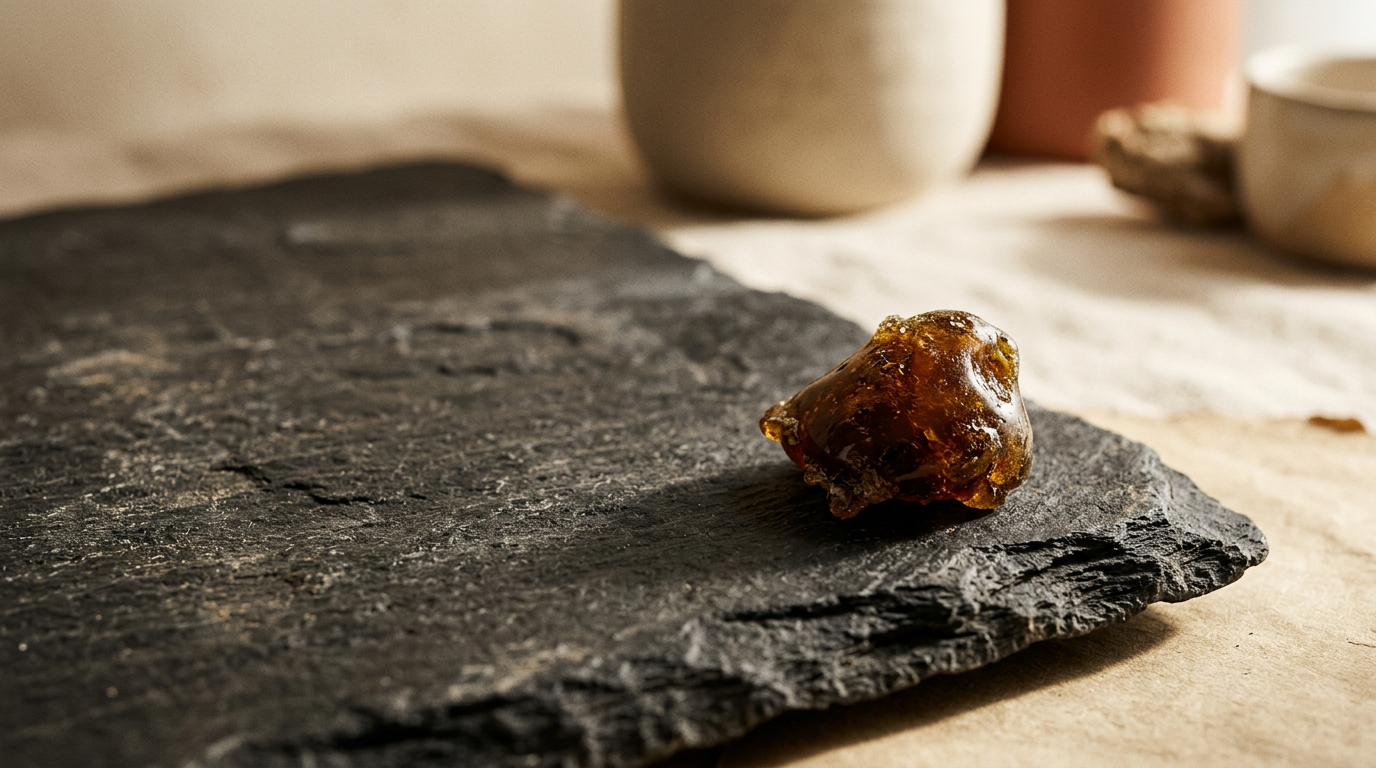
Consider asafoetida, the pungent, savory resin known as hing in much of South Asia. For thousands of years, Ayurveda has prized it for its carminative properties, believed to aid digestion and soothe bloating [1]. Its funky, alliaceous aroma is transformative in cooking, blooming in hot oil to provide a deep flavor foundation of onion and garlic without the actual alliums.
But pure asafoetida resin is incredibly potent and sticky, making it difficult to use. To make it into a powder, it has traditionally been compounded with a filler. The problem is what that filler often consists of: wheat flour. For the millions with celiac disease or gluten sensitivity, a pinch of conventional hing can be a hidden trigger [2]. Other times, it's diluted with cheaper gums, starches, or other resins, cheating you of the flavor and function you paid for.
This is the ghost in the jar: the undeclared ingredient, the corner cut in a faraway facility, the dilution that happens somewhere along a long and opaque supply chain. You can’t taste the 10 parts per million of lead, you can't see the microbial contamination, and you might not notice the gluten until it's too late. The simple claim of “100% Pure” on a label has been rendered almost meaningless by a market that rarely checks.
From 'Trust Me' to 'Show Me'
We started this company because we believe there is a better way. A way built not on marketing claims, but on verifiable data. Publishing our lab reports isn’t a stunt; it’s our standard operating procedure.
When we source a batch of asafoetida from our partners in Kandahar, we don't just ask if it's gluten-free. We send a sample to an independent, accredited lab and test for it. We also test for the active compounds that make asafoetida, well, asafoetida—like Ferulic acid, a powerful antioxidant that science is just now beginning to understand in this context [3].
This simple act changes the conversation from 'trust me' to 'show me.' It is our commitment laid bare. Here is a simplified look at how our standard of proof differs from the industry norm:
| Test Parameter | Standard Industry Practice | Our Standard |
| :--- | :--- | :--- |
| Heavy Metals | Basic panel (Lead, maybe) | Expanded panel (Pb, As, Cd, Hg) below safe limits |
| Authenticity/Adulterants | Rarely tested for | Specific tests (e.g., Gluten in Asafoetida) |
| Active Compounds | Not tested or verified | Quantified (e.g., Ferulic Acid) |
| Microbiology | Basic plate count | Tested for E. coli, Salmonella, yeasts, and molds |
| Accessibility | Available to B2B customers on request | Linked on our site for every batch you can buy |
This level of rigor isn't easy or cheap. It requires building sourcing relationships founded on a shared expectation of quality. It means rejecting batches that don't meet our standards, even when it affects our supply. It means investing in the infrastructure to track every lot from farm to lab to you.
But we believe this is the future of food. A future where you don't have to take a company's word for it. You can see the numbers for yourself. You can hold us, and eventually the entire industry, to a higher standard. That's a promise far more potent than any marketing slogan. That's the promise in the PDF.
FAQ
1. What is a Certificate of Analysis (CoA)?
A CoA is a document issued by an accredited laboratory that confirms a product meets a defined set of specifications. For our spices, this includes tests for heavy metals, microbial contaminants, pesticides, and the concentration of key bioactive compounds.
2. Why don't all companies share these reports?
Frankly, it's expensive and operationally complex. It also holds a company accountable in a way that makes many uncomfortable. A batch that fails a test must be rejected, which can disrupt supply chains and profits. Many brands prefer the simplicity of making claims without the obligation of providing proof.
3. Are your spices 'organic'?
While many of our spices are grown using organic methods, we prioritize comprehensive safety testing over a single certification. The 'organic' label doesn't always guarantee a product is free from environmental contaminants like heavy metals [4]. Our CoAs provide a more complete picture of purity, ensuring the spice is clean and safe, regardless of its certification status.
4. What happens if a batch fails testing?
It gets rejected. Period. We do not sell it. This is a non-negotiable part of our sourcing and quality protocol. We believe the short-term cost of rejecting a batch is a worthy investment in the long-term trust of our customers.
Sources & citations
- Amalraj, A., & Gopi, S. (2017). Biological activities and medicinal properties of Asafoetida: A review. Journal of Traditional and Complementary Medicine, 7(3), 347–359. https://www.ncbi.nlm.nih.gov/pmc/articles/PMC5506628/
- Celiac Disease Foundation. (n.d.). Sources of Gluten. https://celiac.org/gluten-free-living/what-is-gluten/sources-of-gluten/
- Bagheri, S. M., et al. (2015). The ethnobotany, phytochemistry and pharmacology of Ferula assa-foetida L. Industrial Crops and Products, 124. https://www.sciencedirect.com/
- Food and Agriculture Organization of the United Nations (FAO). (2019). Food safety and quality. https://www.fao.org/food-safety/en/
- Gautam, N., Sharma, K., & Sharma, G. (2021). Adulteration in spices: a review. International Journal of Chemical Studies, 9(1), 1210-1215. https://www.chemijournal.com/