
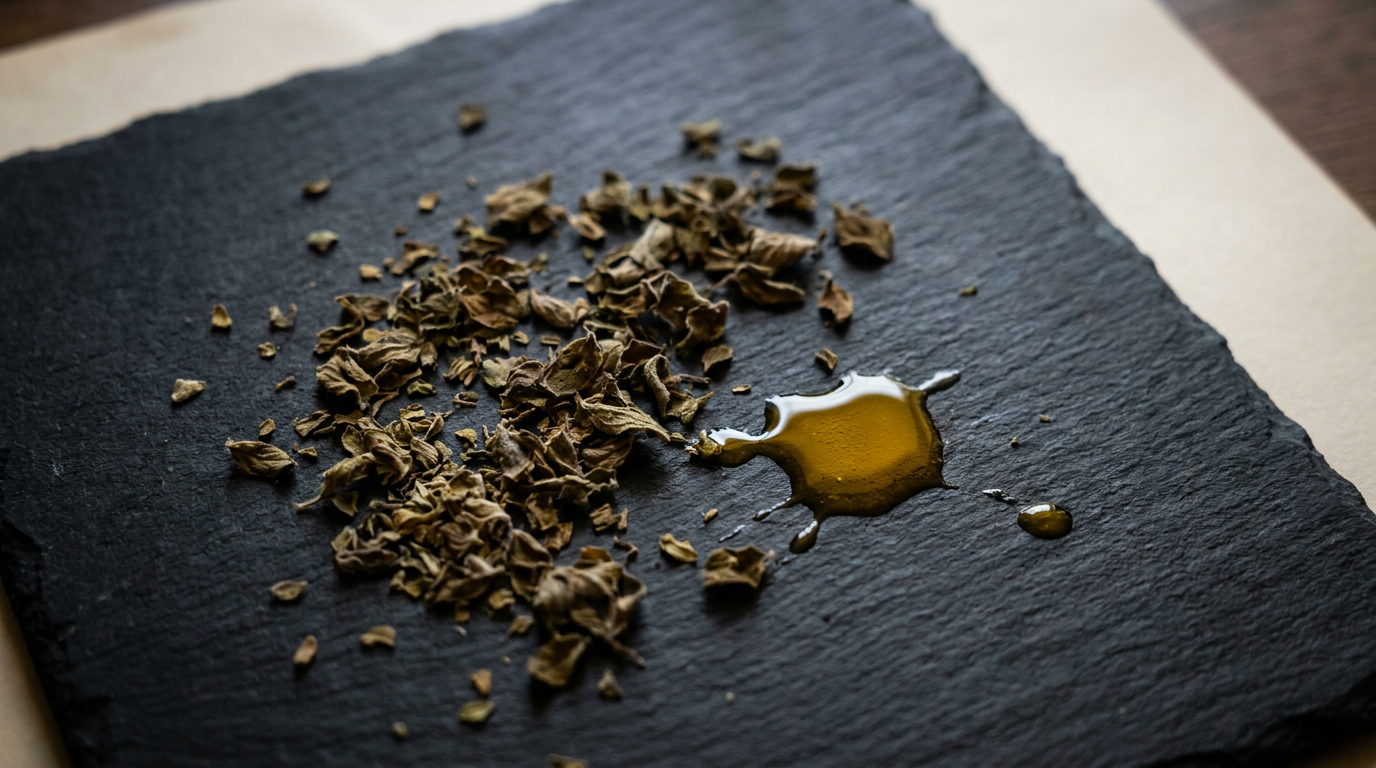
Oregano refers botanically to several plants sharing high concentrations of the monoterpenoid phenol carvacrol, most notably Origanum vulgare in the mint family (Lamiaceae) and Lippia graveolens in the verbena family (Verbenaceae). Characterised by warm, pungent, and peppery volatile profiles, both plants provide the camphoraceous warmth central to Mediterranean and Latin American culinary traditions, with dried preparations retaining potent aromatic stability [1].
If you ask a botanist for oregano, they will ask you what continent you mean. The word does not denote a tidy lineage. It describes an aroma profile that humans across different hemispheres selected for over centuries, converging on the same dominant compound: carvacrol.
In Europe, the plant in question is typically Origanum vulgare subsp. hirtum, commonly known as Greek oregano. In Mexico and Central America, the plant called oregano is almost always Lippia graveolens, an unrelated woody shrub belonging to the verbena family. As noted in the oregano entry, both herbs deliver a warm, slightly pungent punch, yet they arrive at that punch via distinct evolutionary paths.
The Chemistry of Carvacrol and Thymol
The characteristic bite of oregano comes from volatile phenols. Chief among them is carvacrol (2-methyl-5-(1-methylethyl)phenol), often accompanied by its isomer, thymol, alongside the precursor hydrocarbons p-cymene and gamma-terpinene [2].
Carvacrol acts directly on transient receptor potential channels in the human mouth, primarily TRPV3 and TRPA1. These are the same thermal and chemical receptors that react to warmth and pungency. The sensation is not hot like capsaicin, nor is it numbing like eugenol in cloves. It is a dry, resinous prickle that lingers on the tongue. In wild plants, this compound serves as an effective deterrent against herbivores and microbial pathogens. The plant synthesises carvacrol in peltate glandular trichomes, which are microscopic resin sacks sitting on the surface of the leaf [3].
Where Origanum vulgare typically balances carvacrol with thymol and softer monoterpenes like terpinen-4-ol, Lippia graveolens tends to produce a higher concentration of carvacrol alongside strong camphor notes and cineole. The result is that Mexican oregano hits with an earthier, more medicinal intensity, while Greek oregano carries a sweet, grassy undertone.
| Feature | Mediterranean Oregano (Origanum vulgare) | Mexican Oregano (Lippia graveolens) |
| :--- | :--- | :--- |
| Botanical Family | Lamiaceae (Mint family) | Verbenaceae (Verbena family) |
| Dominant Volatile | Carvacrol, thymol, terpinen-4-ol | Carvacrol, camphor, 1,8-cineole |
| Aroma Profile | Grassy, warm, sweet-peppery | Pungent, earthy, citrus-resinous |
| Heat Tolerance | Moderate; best added midway through cooking | High; holds up well to slow braising |
| Primary Culinary Uses | Tomato sauces, roasted meats, vinaigrettes | Chilis, adobos, pozole, bean broths |
Why the Dried Leaf Outperforms the Fresh
Culinary writing often maintains that fresh herbs are inherently superior to dried ones. For soft herbs like coriander, basil, or chervil, this rule holds because their light aroma relies on volatile alcohols and aldehydes that evaporate or oxidise rapidly during desiccation.
Oregano is an exception. The glandular trichomes that house oregano's essential oils are remarkably durable. When the plant is dried correctly out of direct sunlight, water evaporates from the leaf tissues while the non-polar essential oils remain trapped in the peltate glands [4].
Drying shrinks the vegetable mass without venting most of the carvacrol. By weight, dried oregano can contain a significantly higher concentration of accessible volatile oils than fresh leaves. Fresh oregano also carries substantial amounts of chlorophyll and water, which can contribute bitter, vegetal notes when cooked into long stews. In contrast, the dried herb has lost those sharp green elements, leaving behind pure phenolic resin. For slow-cooked sauces, chilli pastes, and braises, the dried herb is frequently the more appropriate ingredient.
Lipid Solubility in the Pan
Carvacrol and thymol are sparingly soluble in water, but dissolve readily in fats. If you toss dried oregano into a simmering tomato sauce that lacks fat, the flavour molecules remain largely tethered to the leaf fragments, dispersing unevenly into the acidic broth.
To draw out the herb's aromatics, introduce it to warm fat early in the cooking process. Blooming dried oregano in warm olive oil or lard for thirty to sixty seconds allows the monoterpenoids to dissolve into the cooking medium. The lipid phase then coats the rest of the ingredients evenly, carrying the warmth of the herb throughout the entire dish rather than leaving isolated pockets of dry seasoning.
Frequently Asked Questions
### Can you substitute Greek oregano for Mexican oregano?
In small quantities, yes, but they produce different balance in a finished dish. Mexican oregano contains camphor and 1,8-cineole, giving it an herbal, citrus-forward edge that pairs naturally with chiles and cumin. Greek oregano has more floral, sweet notes that can taste incongruous in traditional Mexican adobos or braises.
### Why does some dried oregano taste dusty and faint?
Monoterpenes may be stable inside intact glandular trichomes, but light and oxygen eventually break them down. If the oregano was ground into dust before packaging, the trichomes ruptured months ago, allowing carvacrol to oxidise and evaporate. Look for whole dried leaves rather than powder, and rub them between your palms immediately before cooking.
### Does wild oregano differ from cultivated varieties?
Significantly. Wild populations of Origanum vulgare exhibit broad genetic diversity. Depending on soil, rainfall, and altitude, wild plants can vary from pungent, carvacrol-dominant chemotypes to bland, linalool-heavy specimens that possess virtually no classic oregano bite [4]. Commercial cultivars are typically selected specifically for stable, high-carvacrol yields.
Sources & citations
- Skoula, M., & Harborne, J. B. (2002). The taxonomy and chemistry of Origanum. In S. E. Kintzios (Ed.), Oregano: The Genera Origanum and Lippia (pp. 67–108). CRC Press.
- Pascual, M. E., Slowing, K., Carretero, E., Sánchez Mata, D., & Villar, A. (2001). Lippia: traditional uses, chemistry and pharmacology: a review. Journal of Ethnopharmacology, 76(3), 201–214. https://doi.org/10.1016/s0378-8741(01)00234-3
- Bosabalidis, A. M. (2002). Structural features of Origanum plants. In S. E. Kintzios (Ed.), Oregano: The Genera Origanum and Lippia (pp. 11–36). CRC Press.
- Vokou, D., Kokkini, S., & Bessière, J. M. (1993). Geographic variation of Greek oregano (Origanum vulgare ssp. hirtum) essential oils. Biochemical Systematics and Ecology, 21(2), 287–295. https://doi.org/10.1016/0305-1978(93)90044-T