
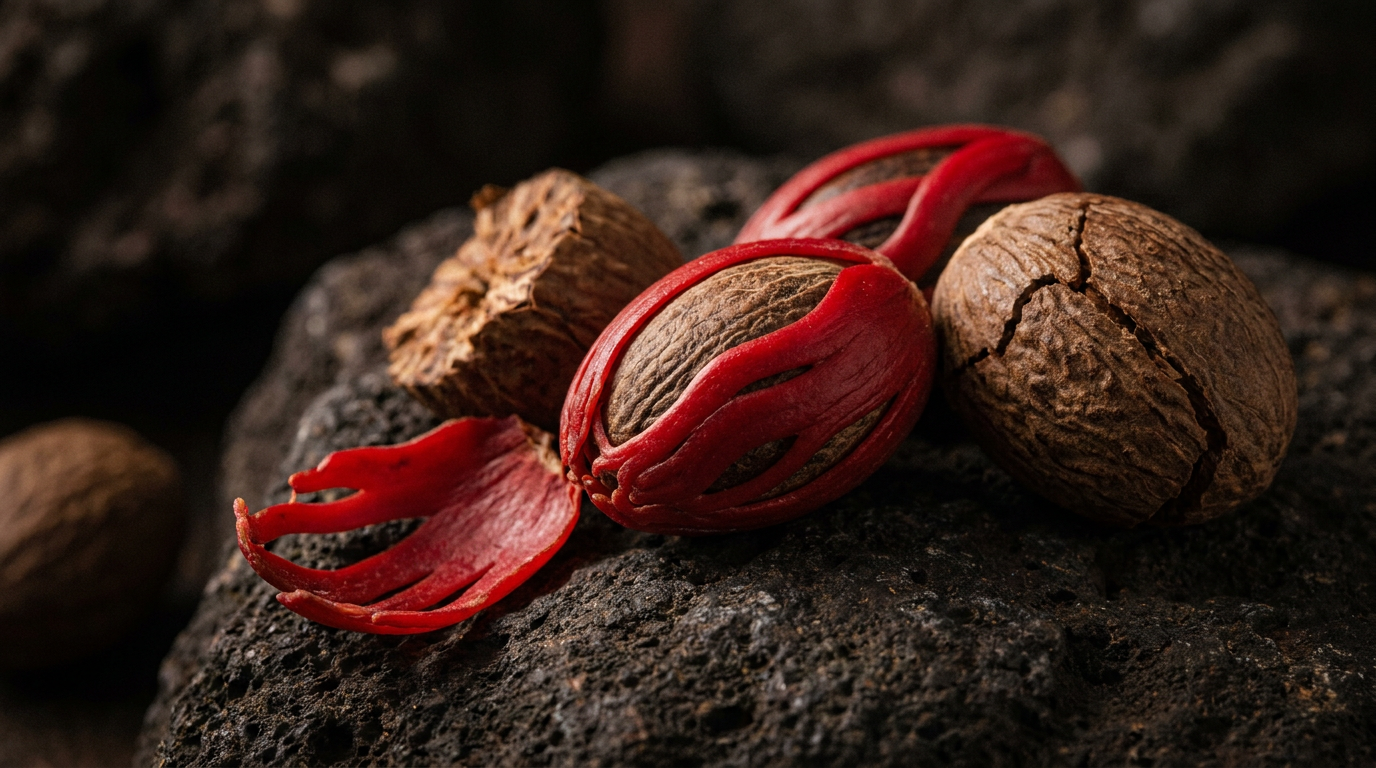
Nutmeg is the dried seed kernel of Myristica fragrans, an evergreen tree indigenous to the volcanic Banda Islands of Indonesia. Prized for its warm, bittersweet aroma, its sensory profile is driven by volatile phenylpropanoids—chiefly myristicin, elemicin, and safrole—alongside terpene hydrocarbons such as sabinene and pinene [1]. These lipid-soluble compounds shape both its culinary affinity for dairy fats and its documented dose-dependent neurotoxicity.
The architecture of a volcanic seed
Unlike many common culinary spices derived from bark or dried berries, nutmeg is the internal seed of an apricot-sized drupe. When the fruit splits open on the branch, it reveals a dark, glossy shell netted inside a brilliant crimson aril. That aril, peeled and dried separately, becomes mace. Crack the fibrous inner shell, and you find the nutmeg itself: a dense, albumen-rich endosperm marbled with dark veins of essential oil [1].
For centuries, Myristica fragrans grew naturally only in the nutrient-dense volcanic soils of the Banda archipelago in eastern Indonesia. That extreme botanical isolation made it a focal point of seventeenth-century mercantile violence. In 1621, the Dutch East India Company (VOC), under Governor-General Jan Pieterszoon Coen, systematically depopulated the Banda Islands to secure an absolute monopoly over global production [2]. The Dutch went as far as trading their claim on the island of Manhattan to the British in the 1667 Treaty of Breda, partially to retain unthreatened control of Run, a tiny Banda island dense with nutmeg trees. The monopoly held until the late eighteenth century, when French botanist Pierre Poivre smuggled viable seeds to Mauritius, dispersing the crop across the tropics.
The chemistry of dairy and myristicin
Nutmeg appears consistently in European milk-based preparations: béchamel, custards, rice puddings, eggnog, and potato gratins. This is not purely customary; it is functional flavour chemistry.
The dominant volatile constituents in fresh nutmeg—primarily myristicin (accounting for up to 4–10% of the volatile fraction), elemicin, and safrole—are lipid-soluble phenylpropanoids [3]. In water, these volatile oils float and flash off quickly under high cooking temperatures. In a matrix containing emulsified dairy fat, however, the fat droplets trap and slow the release of these hydrophobic aromatics. The lipids also soften the sharp astringency of the seed's condensed tannins, allowing the sweet, woody, and clove-adjacent notes to unfold gradually across the palate.
Whole nutmeg retains its volatile compounds inside its waxy, oil-rich endosperm for years. Pre-ground nutmeg, by contrast, loses its lighter monoterpenes—such as alpha-pinene and sabinene—within weeks of exposure to oxygen and ambient humidity. What remains in stale pre-ground powder is predominantly oxidised residual fats and heavier phenolic remnants, producing a flat, medicinal dust rather than a bright, warm aromatic lift.
Seed versus aril: Nutmeg and mace compared
Although nutmeg and mace come from the exact same fruit, their aromatic compounds exist in noticeably different proportions.
| Attribute | Nutmeg (seed kernel) | Mace (aril) |
| :--- | :--- | :--- |
| Botanical role | Dried seed endosperm | Lacy dried aril surrounding the shell |
| Dominant notes | Warm, sweet, woody, slightly camphorous | Brighter, citrus-forward, peppery, floral |
| Primary volatiles | Myristicin, sabinene, elemicin, safrole | Higher ratio of monoterpenes; lower fixed fats |
| Fat content | 30–40% ("nutmeg butter", rich in trimyristin) | Low fixed lipids (under 10%) |
| Heat stability | High; oil matrix buffers compound loss | Moderate; delicate top notes dissipate faster |
| Best culinary role | Long-cooked dairy, starch gratins, dense baking | Broths, light sauces, pickling liquids, charcuterie |
Mace carries higher concentrations of lighter monoterpenes, giving it a sharper, citrus-peel top note. Nutmeg contains roughly 30 to 40 per cent fixed vegetable fats, known as nutmeg butter, composed largely of trimyristin [1]. This internal lipid reservoir buffers the aromatic compounds during prolonged simmering, making grated nutmeg far more resilient in a long-baked gratin than mace.
The dose makes the poison
Nutmeg carries a documented history of toxic misuse, primarily because of myristicin and elemicin [4]. In small culinary applications—a few scrapes over a custard or into a cheese sauce—nutmeg introduces fractions of a milligram of these substances, which the human liver metabolises without adverse effect.
At ingestion levels above five grams of raw ground seed (roughly one to two whole nutmegs), the metabolism shifts. Ingested myristicin undergoes metabolic conversion or exerts direct neuroactive effects, acting as a weak monoamine oxidase inhibitor and producing an anticholinergic-like toxidrome [4]. Symptoms of nutmeg poisoning typically begin three to six hours post-ingestion and include dry mouth, tachycardia, profound nausea, acute anxiety, and delirium. The effects can persist uncomfortably for forty-eight hours.
Nutmeg belongs on a microplane grater, applied with restraint. Its biological defence mechanisms against tropical pests happen to provide exceptional complexity in food, provided we respect the concentration of its chemistry.
Frequently asked questions
### How much freshly grated nutmeg should I use in cooking?
A light grating is usually sufficient. In most savoury sauces or bakes serving four to six people, one-eighth to one-quarter of a teaspoon (roughly 0.5 to 1 gram) delivers distinct aroma without overwhelming other ingredients or posing any safety concern.
### Why does pre-ground nutmeg taste so different from whole nutmeg?
Whole nutmeg encloses its volatile essential oils within dense, fatty tissue until grated. Pre-grinding fractures this structure, allowing the delicate monoterpenes (sabinene and pinene) to evaporate rapidly, leaving behind heavier, often oxidised compounds that taste dull and dusty.
### Can mace be substituted directly for nutmeg?
Yes, but with adjustment. Mace is more pungent and carries a more pronounced citrus and floral character. When substituting ground mace for freshly grated nutmeg, use slightly less and add it closer to the end of cooking to protect its lighter volatile oils.
Sources & citations
- Royal Botanic Gardens, Kew. "Myristica fragrans Houtt. (Nutmeg)." Plants of the World Online. https://powo.science.kew.org/taxon/urn:lsid:ipni.org:names:586071-1
- Milton, Giles. Nathaniel's Nutmeg: Or, the True and Incredible Adventures of the Spice Trader Who Changed the Course of History. Penguin Books, 1999.
- Maya, S. et al. "Nutmeg and its active constituent myristicin: A review on their nutritional and therapeutic qualities." Phytochemistry Reviews, vol. 20, 2021, pp. 111–134.
- Forrester, Mathias B. "Nutmeg intoxication in Texas, 1998–2004." Human & Experimental Toxicology, vol. 24, no. 11, 2005, pp. 563–566. https://pubmed.ncbi.nlm.nih.gov/16323472/