
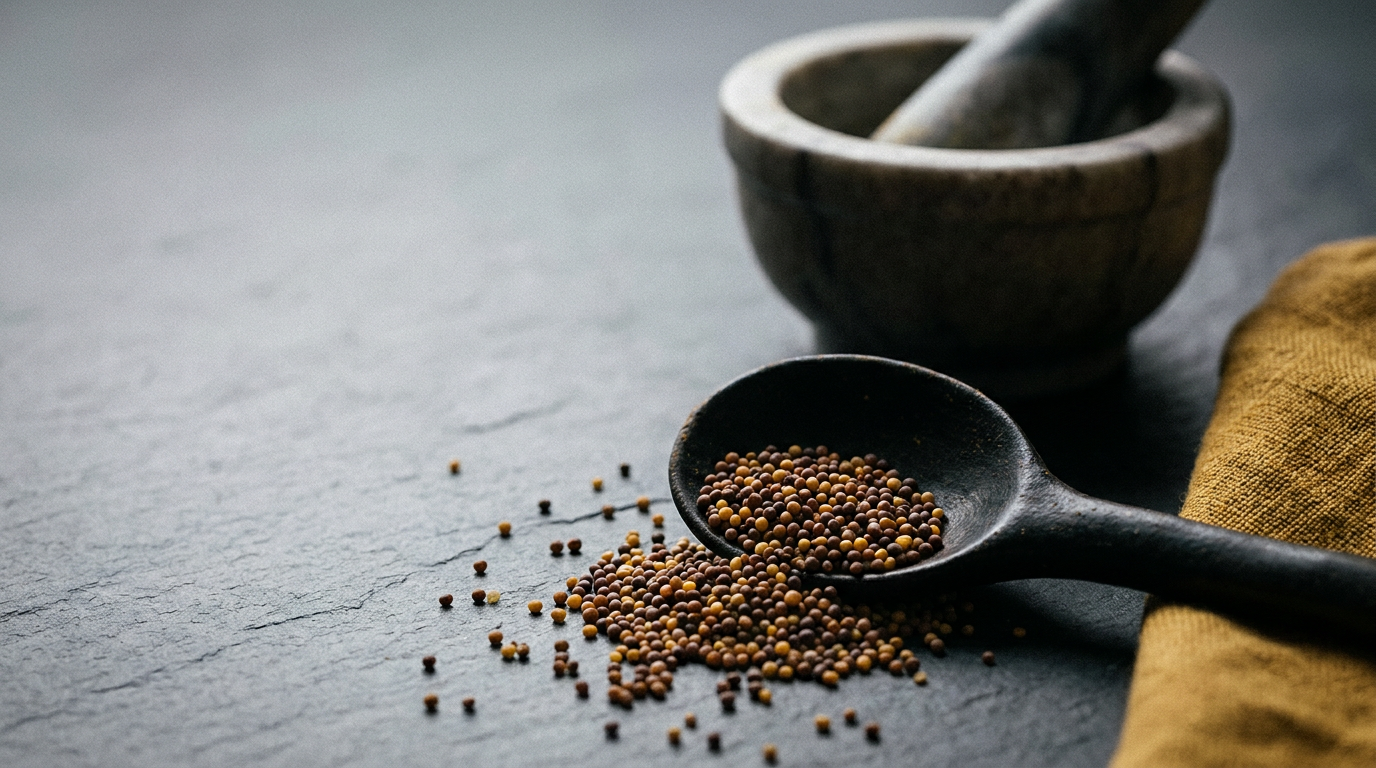
Mustard seeds are the dried, spherical seeds of brassica plants—principally Sinapis alba, Brassica juncea, and Brassica nigra—celebrated for their sharp, nasal pungency. Intact seeds lack aroma and heat. Their characteristic pungency develops only when crushing ruptures plant cell walls, allowing the enzyme myrosinase to hydrolyse glucosinolates into volatile isothiocyanates in the presence of water [1].
Take a spoonful of whole mustard seeds from the jar and sniff them. You get dry straw and a faint earthy oiliness, nothing more. Chew them whole between your front teeth, and they crack harmlessly into oily grits. The nasal sting that clears your sinuses when eating English mustard or Bengali shorshe bata does not exist inside the dormant seed. It is synthesized on demand.
This is a binary chemical defence system engineered by the Brassicaceae family to deter herbivores. Inside the dry seed, two critical components are kept in separate cellular compartments. In the vacuoles sit glucosinolates, water-soluble organic compounds containing sulphur and nitrogen. In specialized cells called idioblasts sit reserves of myrosinase, a hydrolytic enzyme. As long as the seed remains dry and structurally intact, they never meet [2].
The Three Cultivars and Their Precursors
Culinary traditions rely on three distinct species, each carrying a different glucosinolate profile that determines the speed, intensity, and volatility of its heat.
| Common Name | Botanical Species | Dominant Glucosinolate | Resulting Isothiocyanate | Sensory Profile |
| :--- | :--- | :--- | :--- | :--- |
| Yellow / White | Sinapis alba | Sinalbin | 4-hydroxybenzyl isothiocyanate | Heavy, persistent tongue heat; low volatility; does not hit the nose |
| Brown / Indian | Brassica juncea | Sinigrin | Allyl isothiocyanate | Highly volatile; sharp nasal sting; grassy, bitter finish |
| Black | Brassica nigra | Sinigrin | Allyl isothiocyanate | Intense volatile burn; nutty when roasted; difficult to harvest mechanically |
Yellow mustard relies on sinalbin, which produces 4-hydroxybenzyl isothiocyanate upon hydrolysis. This is a relatively heavy molecule with low vapour pressure. It stays on the tongue, triggering TRPV1 and TRPA1 pain receptors directly in the oral cavity without rising into the nasopharynx.
Brown and black mustards rely on sinigrin, which yields allyl isothiocyanate (AITC). AITC is exceptionally light and volatile. The moment you crush brown seeds in water, AITC vaporises at body temperature, travels past the soft palate, and binds vigorously to TRPA1 receptors in your nasal passage [3]. The sensation is identical to wasabi and horseradish because all three plants deploy the exact same defensive molecule.
Water, Acid, and Thermal Denaturation
The myrosinase reaction is strictly dependent on moisture and temperature. If you crush dry seeds into a fine powder without liquid, the glucosinolates and enzymes mingle in stasis; no sting forms. Introduce cold water, and the hydrolysis takes place within seconds, reaching peak pungency at around ten to fifteen minutes [4].
Cooks who prepare table mustards navigate two thermodynamic boundaries:
- The thermal shutoff: Myrosinase is a protein. Like most plant enzymes, it denatures and permanently loses activity when exposed to temperatures above 60°C (140°F). If you stir mustard powder directly into boiling stock or hot oil, you destroy the enzyme before it can convert the glucosinolates. The resulting dish gains bitterness and nutty brassica flavours, but zero nasal heat.
- The acid freeze: Myrosinase operates best at a near-neutral pH (6.0–7.0). Strong acids, such as vinegar, verjuice, or lemon juice, slow the enzymatic reaction down dramatically. If you add vinegar immediately to dry mustard powder, you permanently stifle the heat. Commercial producers of sharp French mustard let the crushed seeds hydrate in water or grape must first, allowing the enzymatic reaction to produce maximum isothiocyanate, before adding vinegar to lock that pungency in place and prevent degradation.
Left in water without an acid fixative, isothiocyanates begin to break down into bitter, unpalatable polysulphides within a few hours. Acid acts as a molecular preservative, which is why commercial mustard retains its bite in the refrigerator for months while a fresh water-and-mustard paste dulls by evening.
The Pop in the Pan
The chemistry explains why Indian tadka or chhonk treats brown mustard seeds in a manner that seems to contradict their fiery reputation. Dropped into hot oil (often 180°C or higher), the seed coats crackle and pop as internal moisture vaporises.
This rapid dry-heat frying instantly denatures the myrosinase enzyme inside the seed. Because water was never present at an active enzymatic temperature, allyl isothiocyanate is never formed. The pungent sting is averted entirely. In its place, the high heat promotes Maillard reactions among the seed’s abundant proteins and lipids, releasing nutty, pyrazine-heavy, slightly astringent aromatic notes that underpin dal, curries, and vegetable sautés.
Frequently Asked Questions
### Why does home-ground mustard paste sometimes taste bitter instead of hot?
If crushed mustard seeds are exposed to very hot water, the myrosinase enzyme denatures before allyl isothiocyanate can form. This leaves unconverted glucosinolates and polyphenols behind, resulting in harsh bitterness without pungency. Use cold or lukewarm water when grinding to ensure maximum enzyme activity.
### Can I substitute yellow mustard seeds for brown seeds in a curry?
Yellow seeds (Sinapis alba) do not behave like brown seeds (Brassica juncea). They contain sinalbin rather than sinigrin, have a thicker mucilaginous seed coat, and become acrid rather than savoury when fried in hot oil. Stick to brown or black mustard for tempering in fat.
### Why does prepared mustard lose its kick over time?
Isothiocyanates are chemically unstable and volatile. Even in an acidic medium like vinegar, they slowly hydrolyse and oxidise when exposed to air and room temperature. Storing prepared mustard in an airtight jar inside the refrigerator dramatically slows this loss.
Sources & citations
- Bones, A. M., & Rossiter, J. T. (2006). The enzymic and chemically induced decomposition of glucosinolates. Phytochemistry, 67(11), 1053–1067. https://doi.org/10.1016/j.phytochem.2006.02.024
- Kissen, R., Rossiter, J. T., & Bones, A. M. (2009). The ‘mustard oil bomb’: not so simple after all. Current Opinion in Plant Biology, 12(3), 227–234. https://doi.org/10.1016/j.pbi.2009.02.003
- Jordt, S. E., et al. (2004). Mustard oils and cannabinoids excite sensory nerve fibres through the TRP channel ANKTM1. Nature, 427(6971), 260–265. https://doi.org/10.1038/nature02282
- McGee, H. (2004). On Food and Cooking: The Science and Lore of the Kitchen. Scribner, pp. 415–418.