
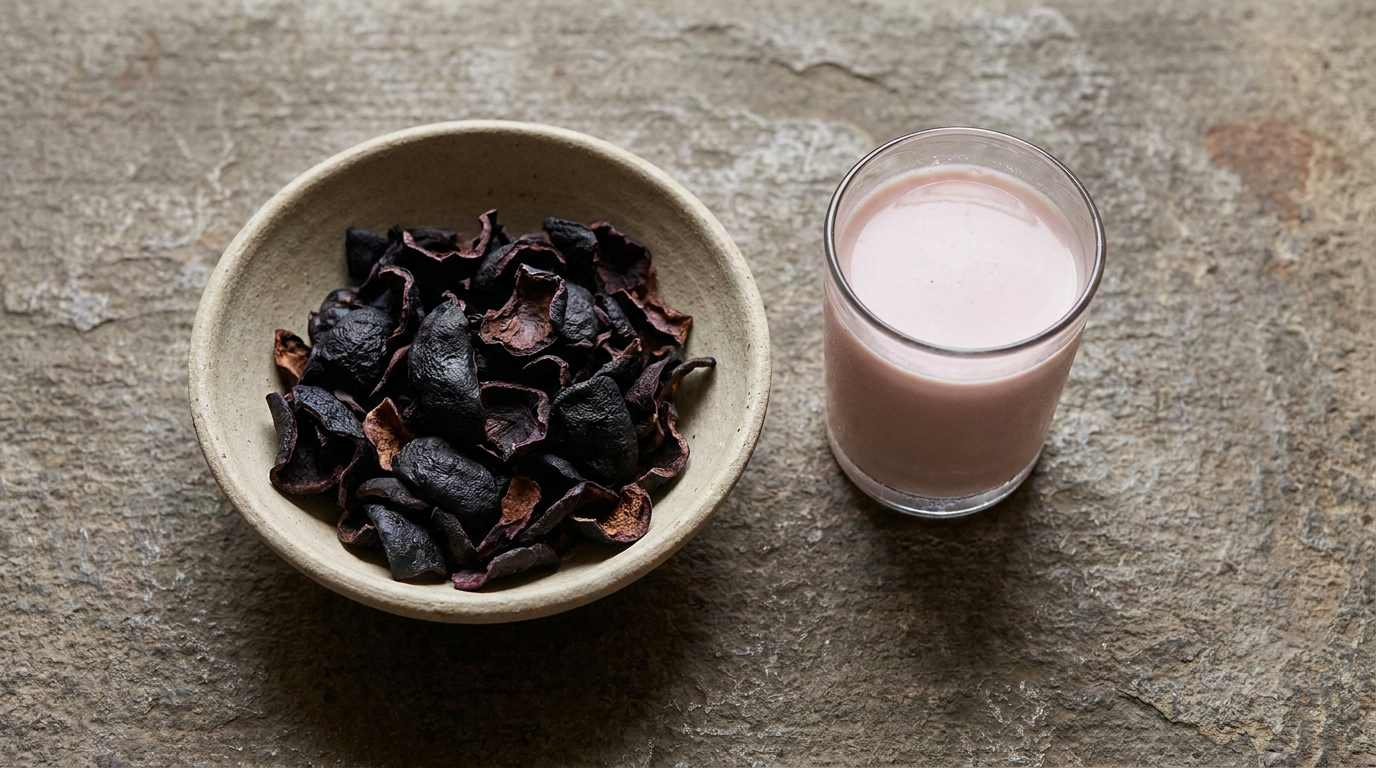
Kokum (Garcinia indica) is a wild-harvested fruit endemic to India’s Western Ghats, prized across the Konkan coast as a souring agent and cooling summer tonic. Unlike tamarind, which relies on tartaric acid, kokum delivers its sharp, astringent tartness through hydroxycitric acid alongside anthocyanins and garcinol, a bioactive polyisoprenylated benzophenone with documented antioxidant and anti-inflammatory properties [1].
For cooks unfamiliar with the Western Ghats, regional Indian souring agents are often collapsed into tamarind or dried mango powder (amchur). This is an error of culinary chemistry. Souring is not a single generic note; the identity of the acid dictates how heat, fats, and aromatics behave in the pan.
The chemistry of coastal acidity
In Goa, coastal Maharashtra, and coastal Karnataka, kokum fills the role that vinegar or citrus occupies elsewhere. Fresh kokum fruits are small, round, and turn a mottled purple-red when ripe during the pre-monsoon heat of March to May. The fresh fruit is rarely shipped inland; it deteriorates rapidly. Instead, the thick rind is peeled, repeatedly soaked in the pulp's own raw juice, and sun-dried until it turns leathery, curled, and deep purple-black. This dried rind is known locally as aamsul or simply kokum.
| Sourcing Agent | Botanical Source | Primary Organic Acid | Visual & Sensory Profile |
| :--- | :--- | :--- | :--- |
| Kokum | Garcinia indica | Hydroxycitric acid (HCA), malic acid | Deep magenta to black; sharp, clean, astringent, fruit-forward tartness |
| Tamarind | Tamarindus indica | Tartaric acid | Deep brown; viscous, caramelised, heavy, sweet-sour |
| Amchur | Mangifera indica | Citric and malic acid | Pale beige-tan; dry, dusty, pungent, direct tartness |
Tamarind contains significant natural sugars and tartaric acid, lending a rich, sticky gravitas to broths. Kokum contains almost no free sugars once dried. Its primary acid, (-)-hydroxycitric acid (HCA), comprises roughly 10 to 23 percent of the dried rind by weight [2]. HCA provides an immediate, bright, and palate-cleansing tartness that does not leave the tongue coated. This makes it particularly effective in fish curries, where heavy caramelised sourness would overwhelm delicate marine fats.
Garcinol and the pharmacology of cooling
Kokum’s folk reputation as a "cooling" food during brutal coastal summers has empirical backing in gastrointestinal physiology. The rind contains garcinol, a polyisoprenylated benzophenone derivative unique to the Garcinia genus [1].
In laboratory models, garcinol demonstrates robust anti-inflammatory and radical-scavenging activity. More specifically for digestive comfort, garcinol has been studied for its ability to suppress gastric mucosal injury by inhibiting the production of inflammatory cytokines and reducing lipid peroxidation in gut tissue [3]. When people drink kokum sherbet after exposure to 40°C heat, the physiological relief is real: the organic acids stimulate salivation and gastric juices, while the anthocyanins and garcinol address oxidative and inflammatory stress in the intestinal tract.
Commercial wellness marketing has occasionally seized upon hydroxycitric acid as a miraculous fat-burner, citing isolated metabolic studies on Garcinia cambogia (a close relative). The clinical reality for human weight loss has remained modest and frequently inconsistent. Treating kokum as an appetite suppressant misses the point entirely. Its value lies in digestive protection and clear-headed culinary acid balance.
How to handle the rind
Dried kokum requires different handling depending on the medium:
- In water-based infusions (Sherbet): To prepare the base for kokum sherbet, steep dried, unsalted rinds in hot water for twenty minutes, then press the softened skins to extract the brilliant magenta juice. The colour comes from anthocyanins (predominantly cyanidin-3-sambubioside) [4]. When combined with cold water, roasted cumin, black salt (kala namak), and a small amount of unrefined sugar, the result is an electrolyte drink that hydrates more efficiently than plain water.
- In fats and curries: Unlike amchur, kokum does not dissolve. Drop two or three pieces of rind directly into a simmering curry (such as a Goan fish curry or Konkani dal) ten minutes before finishing. The heat extracts the HCA and tannins into the sauce without clouding the liquid or imparting starch.
- *With coconut milk (Solkadhi):* Solkadhi is the defining digestive drink of the Konkan. Kokum extract is whisked into freshly grated, strained coconut milk seasoned with a crushed paste of green chilli, garlic, and salt. The organic acids gently curd the rich fats of the coconut milk if the proportions are unstable, so the infusion must be balanced delicately. The cold fat moderates the sharp acid; the acid cuts through the richness of the fat.
When purchasing kokum, check whether it has been cured with salt. Unsalted kokum is preferred for sherbets and drinks; salted kokum (aamsul) is common in grocery stores and requires adjusting the sodium elsewhere in your recipe.
Frequently asked questions
### Is kokum the same as mangosteen?
Kokum (Garcinia indica) is closely related to the purple mangosteen (Garcinia mangostana), belonging to the same genus. However, mangosteen is cultivated primarily for its sweet, fleshy white arils eaten as dessert fruit, whereas kokum is grown for the medicinal and culinary souring properties of its acidic outer rind.
### Can I substitute tamarind directly for kokum?
Tamarind can replace the acidity in a recipe, but it alters the character entirely. Tamarind provides a dark brown colour, higher viscosity, and residual sweetness. If substituting tamarind for kokum in a curry, use half the amount of tamarind paste and add a splash of lemon juice to mimic kokum’s clean, light finish.
### Why does kokum turn food pink or purple?
The dried rind of kokum contains concentrated water-soluble anthocyanins. When rehydrated or cooked in clear or white broths (such as coconut milk), these pigments leach out immediately, creating shades ranging from light rose to deep crimson and purple.
Sources & citations
- Padhye, S., Ahmad, A., Oswal, N., & Sarkar, F. H. (2009). Fluorinated garcinol derivatives and their pharmacological potential. Current Medicinal Chemistry, 16(21), 2761–2778. https://pubmed.ncbi.nlm.nih.gov/19610738/
- Parthasarathy, V. A., Chempakam, B., & Zachariah, T. J. (2008). Chemistry of Spices. CAB International, pp. 411–418.
- Baliga, M. S., Bhat, H. P., Pai, R. J., Boloor, R., & Princita, P. (2011). The chemistry and medicinal uses of the underutilized Indian fruit Garcinia indica Choisy (kokum): A review. Food Research International, 44(7), 1790–1799.
- Nayak, C. A., Rastogi, N. K., & Raghavarao, K. S. M. S. (2010). Bioactive constituents from Garcinia indica Choisy (kokum) and their extraction. Journal of Food Science and Technology, 47(4), 437–443. https://pubmed.ncbi.nlm.nih.gov/23572666/