
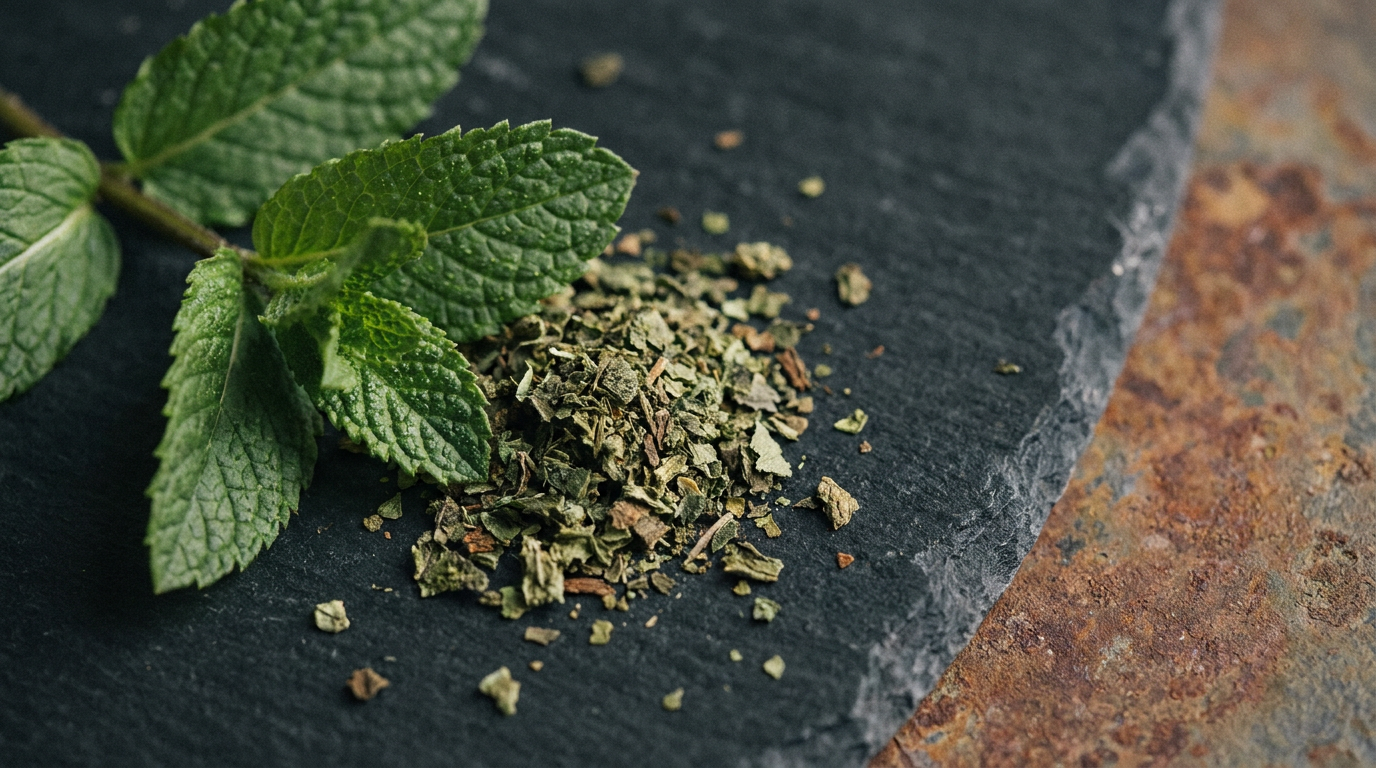
Mint refers to a genus of aromatic perennial herbs, widely recognised for its fresh, cool flavour and invigorating aroma, used in cuisines and traditional remedies worldwide [1]. Scientifically classified under the genus Mentha, its characteristic cooling effect is caused by volatile monoterpenes—most notably menthol—which trigger cold-sensing TRPM8 thermal receptors in sensory nerves rather than physically reducing oral temperature [2].
When you bite into a fresh leaf or drink an infusion, no thermal energy leaves your tongue. A thermometer placed against the tissue registers roughly 37°C before, during, and after. The sensation is neurological deception.
The TRPM8 channel and thermal illusion
The mammalian nervous system detects temperature using transient receptor potential (TRP) ion channels embedded in sensory nerve endings. For hot sensations, the capsaicin in chillies activates TRPV1 at temperatures above 43°C. For cold, the primary sensor is TRPM8, an ion channel that normally activates when local tissue temperature drops below approximately 26°C [2].
When TRPM8 detects actual cold, its pore opens, allowing calcium and sodium ions to flood the nerve cell. This electrical impulse travels to the brain, which maps the signal as cold. Menthol—specifically the stereoisomer (-)-menthol—binds allosterically to the TRPM8 channel [3]. This binding does not force the channel open in absolute terms; rather, it shifts the thermal activation threshold upward.
Under the influence of menthol, TRPM8 begins firing at normal resting body temperature. Ambient room air or a sip of lukewarm water, previously registered as neutral, suddenly delivers the physiological electrical signature of near-freezing liquid. The trick is persistent: because menthol is lipophilic, it dissolves into the cell membranes of your mucosal tissue and resists being rinsed away by water alone.
Spearmint, peppermint, and two different chemicals
The genus Mentha contains dozens of species and hundreds of named hybrids, but cookery relies primarily on two: spearmint (Mentha spicata) and peppermint (Mentha × piperita). Conflating them ruins dishes, because their primary volatile chemistries target different receptors.
Peppermint is a sterile natural hybrid of watermint (Mentha aquatica) and spearmint. Its essential oil is dominated by (-)-menthol (typically 30–55%) and (-)-menthone (14–32%) [4]. It delivers the aggressive, lung-clearing chill prized in confectionery, liqueurs, and medicinal balms.
Spearmint contains virtually no menthol. Its signature aroma comes from (R)-(-)-carvone, an optical isomer that smells cleanly sweet, herbaceous, and warm, accompanied by limonene [4]. Carvone does not activate the TRPM8 cold channel with anything resembling menthol's potency. When Levantine, Maghrebi, or Vietnamese recipes call for mint, they almost universally require spearmint or related high-carvone landraces. Using peppermint in a bowl of pho, a plate of tabbouleh, or a pot of Maghrebi green tea leaves the dish tasting like dental hygiene products rather than food.
| Species | Dominant Volatile | Receptor Activity | Common Kitchen Role |
| :--- | :--- | :--- | :--- |
| Spearmint (M. spicata) | (R)-(-)-carvone | Weak TRPM8; olfactory olfactory bulb dominant | Savoury salads, teas, braised meats |
| Peppermint (M. × piperita) | (-)-menthol, menthone | Potent TRPM8 agonist | Sweet confections, infusions, desserts |
| Field Mint (M. arvensis) | Menthol (up to 80%) | Extreme TRPM8 agonist | Commercial menthol extraction, medicinal oils |
For a broader look at botanical classification and historical cultivation across the genus, consult our detailed reference on mint.
Why dried mint behaves like a warm spice
In Western Europe and North America, cooks treat mint almost exclusively as a soft fresh herb. Across the eastern Mediterranean, the Caucasus, and Central Asia, the dried leaf (kuru nane in Turkish) is used as an everyday spice, sprinkled over sizzling olive oil, strained yoghurt, and hot lentil soups.
This is not a poor substitute for fresh leaves; it is a chemically distinct ingredient. When mint is dried slowly at modest temperatures, the most volatile top-note monoterpenes—including a significant portion of free menthol—evaporate into the air. What remains is a concentrated matrix of more stable compounds: rosmarinic acid, luteolin glycosides, and heavier sesquiterpenes [4].
Crushed into hot fat, dried spearmint does not cool the palate. The heat rapidly blooms the fat-soluble carvone while oxidised polyphenols release a deep, tea-like, faintly bitter savouriness. It performs the culinary function of dried oregano or marjoram rather than a cooling garnish. Attempting that same blooming step with fresh leaves introduces water, lowers the fat temperature, and scorches the delicate chlorophyll, yielding an unpleasant, lawn-mower astringency.
Cooking fresh mint directly into long-simmered sauces also fails for a related reason: polyphenol oxidase enzymes quickly turn the bruised leaves black, while heat strips the monoterpenes, leaving behind bitter tannins. If fresh mint belongs in a hot dish, it belongs at the very end, off the heat, folded in when the temperature has dropped enough to preserve the volatiles.
Frequently asked questions
### Why does drinking cold water after chewing mint feel icy?
Menthol binds to the TRPM8 receptors in your mouth, shifting their firing threshold so they register normal temperatures as cold. When you introduce actual cold water—say 10°C—the already sensitised receptors fire at a frequency normally reserved for ice, multiplying the perceived cold sensation.
### Can I swap peppermint for spearmint in savoury recipes?
Rarely without altering the character of the dish. Peppermint contains high levels of menthol, which overwhelms delicate savoury flavours with medicinal sharpness. Spearmint is dominated by carvone, which produces a gentle, sweet herb flavour suited to lamb, yoghurt, and raw vegetables.
### Why does dried mint taste so different from fresh mint?
Drying drives off the lightest, most volatile monoterpenes while leaving behind heavier phenolic compounds, tannins, and bound aromatic glycosides. The result is an earthy, pungent profile that behaves more like dried marjoram or thyme than an icy green herb.
### Does fresh mint physically cool your body down?
No. Menthol causes a subjective feeling of cooling and can stimulate mild peripheral vasodilation, but it does not cause a systemic drop in core body temperature. It alters sensory perception, not thermodynamics.
Sources & citations
- Kew Royal Botanic Gardens. Mentha L. Plants of the World Online. https://powo.science.kew.org/taxon/urn:lsid:ipni.org:names:30001416-2
- McKemy, D. D., Neuhausser, W. M., & Julius, D. (2002). Identification of a cold receptor reveals a general role for TRP channels in thermosensation. Nature, 416(6876), 52–58. https://doi.org/10.1038/nature719
- Voets, T., et al. (2004). The principle of temperature-dependent gating in cold- and heat-sensitive TRP channels. Nature, 430(7001), 748–754. https://doi.org/10.1038/nature02732
- Lawrence, B. M. (2006). Mint: The Genus Mentha. CRC Press / Medicinal and Aromatic Plants - Industrial Profiles. ISBN: 978-0-8493-0779-9.