
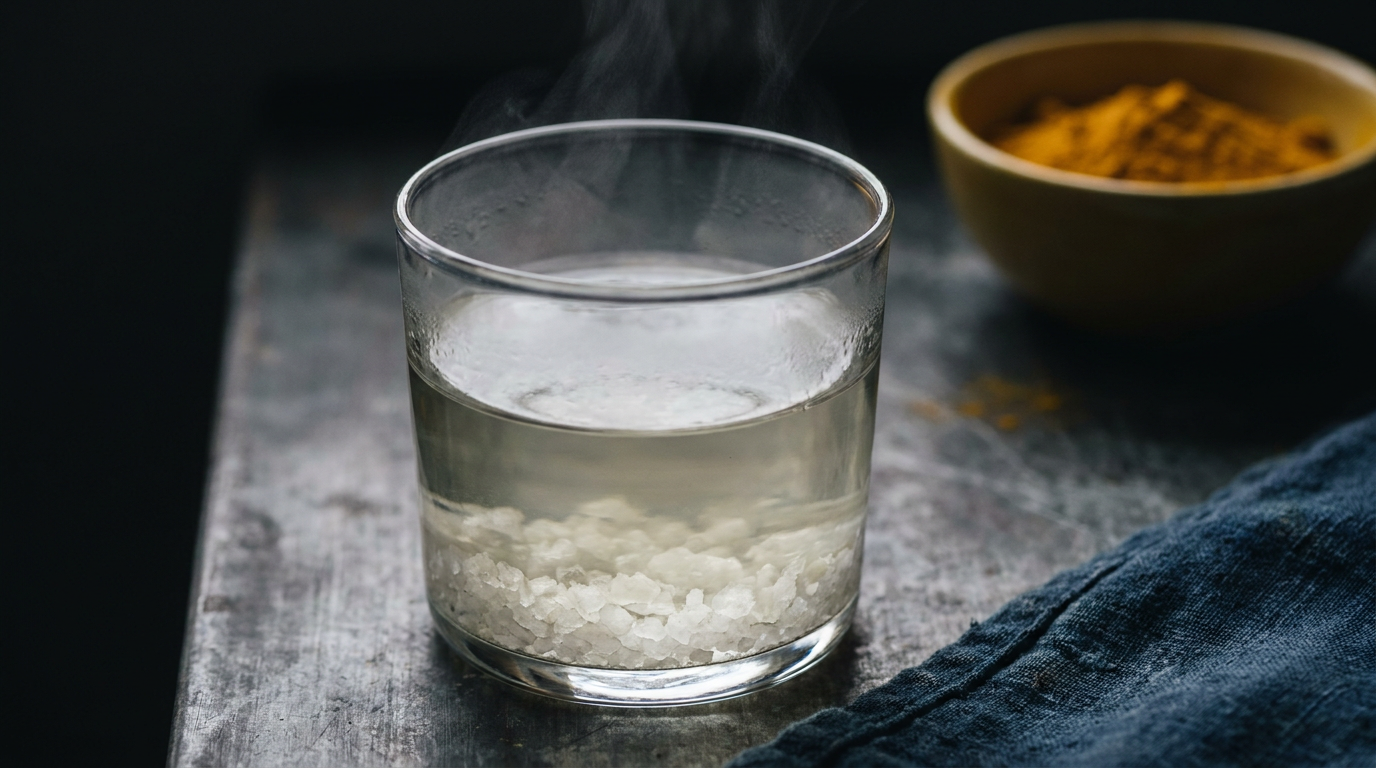
A salt water gargle is a traditional home remedy prepared by dissolving sodium chloride in warm water to soothe oropharyngeal discomfort. By creating an osmotic gradient across the mucosal membrane, hypertonic or isotonic saline draws excess fluid out of swollen tissues, reduces local oedema, thins mucus, and mechanically flushes pathogens and debris from the posterior pharynx without disrupting mucosal integrity.
Few household interventions survive three thousand years without someone dressing them up in proprietary packaging. The warm salt rinse remains stubborn. It resists patenting because it requires only sodium chloride, tap water, and thirty seconds at a bathroom basin. It is also one of the rare home habits that general practitioners, otolaryngologists, and classical texts endorse with roughly the same rationale.
Yet the physiology of swilling salted water around the back of the mouth is often misstated. It does not chemically sterilise the throat, nor does it function like a synthetic antibiotic. Its efficacy rests almost entirely on basic physics: fluid dynamics and osmotic draw.
The physics of the osmotic gradient
When a viral or bacterial infection lodges in the epithelial lining of the pharynx, the immune response triggers localized inflammation. Capillaries dilate, fluid leaks into the interstitial spaces between cells, and the mucosa swells. This oedema creates the tight, raw tenderness that makes swallowing saliva miserable.
Normal human extracellular fluid has a physiological salinity of roughly 0.9 percent sodium chloride. When you dissolve half a level teaspoon of table salt (about 2.5 to 3 grams) into a glass of warm water (around 200 to 250 millilitres), you produce a mildly hypertonic solution, sitting somewhere between 1.2 and 1.5 percent salinity.
Introduce that hypertonic liquid to the inflamed posterior pharyngeal wall, and the principle of osmosis takes over. Water naturally migrates across semi-permeable cell membranes from areas of lower solute concentration to higher solute concentration. The bath of saline pulls interstitial fluid out of the boggy, distended epithelial tissue [1]. The swelling subsides incrementally, taking pressure off local nociceptors and easing the mechanical ache of swallowing.
At the same time, sodium chloride disrupts the ionic bonds that hold thick, cross-linked mucin glycoproteins together. Tenacious, pathogen-laden phlegm thins out, turning from a glue-like adherent into a looser fluid that can be cleared with a light cough or spat into the sink.
From the Sushruta Samhita to Edinburgh
The documentation for saline gargling stretches back well before cellular osmolarity had a name. In classical Ayurvedic medicine, fluid holding and gargling are formalized under kavala graha (swishing a manageable volume of liquid in the oral cavity) and gandusha (filling the mouth completely to hold medicated liquids under tension). While sesame oil and astringent decoctions of Terminalia chebula dominate certain protocols, warm saline appears repeatedly in classical texts for clearing kapha—excess mucus, heaviness, and throat blockage [2]. Hippocrates similarly recommended warm sea brine and vinegar gargles for acute pharyngeal inflammation.
Modern medicine spent decades treating the practice as harmless grandmotherly folklore until clinical trials began measuring what happens at the mucosal surface. In our profile on the salt water gargle, we outline the practical mechanics of this traditional preparation.
In 2019, researchers at the University of Edinburgh published the ELVIS (Edinburgh Low-risk Intervention with Saline) pilot study. They examined whether hypertonic saline nose drops and gargles reduced upper respiratory infection severity. Patients using the saline protocol shortened their illness duration by nearly two days, reduced their over-the-counter medication use, and demonstrated significantly reduced viral shedding in nasal swabs compared to control subjects [3].
The investigators noted an additional intracellular mechanism: epithelial cells exposed to elevated chloride ions use those ions to produce hypochlorous acid via an intracellular enzyme pathway, effectively boosting local cellular defences against replicating viruses.
Getting the concentration right
More salt does not mean faster relief. Highly hypertonic solutions—exceeding 3 percent salinity—cease to be therapeutic and become corrosive. They desiccate the mucosal lining, damage the protective microscopic cilia responsible for clearing airway secretions, and cause rebound inflammation.
| Solution Type | Approximate Ratio | Salinity | Physiological Effect |
| :--- | :--- | :--- | :--- |
| Isotonic | ~0.5 tsp salt per 500 ml water | ~0.9% | Matches tissue tonicity; cleanses debris without fluid shifting. |
| Mildly Hypertonic | ~0.5 tsp salt per 250 ml water | ~1.2%–1.5% | Optimal; draws fluid from swollen tissue, thins mucin layer. |
| Severely Hypertonic | >1.5 tsp salt per 250 ml water | >3.5% | Irritating; damages mucosal epithelial cells and ciliary clearance. |
Standard fine culinary salt dissolves easiest. Coarse rock salt or kosher salt works identically, though you need to allow sufficient time for the crystals to dissolve fully in warm water; undissolved grit scraping across raw tonsillar tissue is counterproductive. Special mineral salts (such as unrefined grey salt or pink Himalayan halite) offer no measurable clinical advantage over standard evaporated sodium chloride in this application.
Frequently asked questions
### Does a salt water gargle actually kill bacteria and viruses?
Not directly. It is not an antiseptic bath comparable to povidone-iodine or chlorhexidine. It acts mechanically and physically: loosening mucus, dislodging microbes, and altering tissue fluid balance. While hypertonic environments can dehydrate some bacterial cells, the gargle's primary utility is symptom reduction and clearance, not contact-time sterilisation.
### Should the water be boiling or warm?
Warm, strictly around body temperature (37°C to 40°C). Scalding water damages the fragile, already-compromised mucosa of an inflamed pharynx. Warmth promotes local vasodilation and muscle relaxation, making the mechanical action of gargling far more tolerable.
### Can you swallow the gargle?
No. The objective is to expose the oropharynx to the fluid, use bubbling air to scour the posterior wall, and spit it out. Ingesting hypertonic salt water draws fluid into the digestive lumen, potentially irritating the gastric lining and contributing unnecessary sodium to systemic circulation.
### How often should you gargle during an acute sore throat?
Three to four times a day is generally sufficient. Gargling excessively—every twenty minutes, for instance—can strip the thin mucosal lipid barrier, leaving the pharynx dry and more sensitive to mechanical abrasion.
Sources & citations
- Allan, G.M. and Arroll, B., 2014. Prevention and treatment of the common cold: making sense of the evidence. CMAJ, 186(3), pp.190-199. https://doi.org/10.1503/cmaj.121442
- Sharma, P.V. trans., 1981. Sushruta Samhita: Text with English Translation, Chowkhamba Visvabharati, Varanasi (Uttaratantra, Mukharoga section).
- Ramalingam, S., Graham, C., Dove, J., Morrice, L. and Sheikh, A., 2019. A pilot, open labelled, randomised controlled trial of hypertonic saline nasal irrigation and gargling for the common cold. Scientific Reports, 9(1), p.1015. https://doi.org/10.1038/s41598-018-37703-3
- Satomura, K. et al., 2005. Prevention of upper respiratory tract infections by water gargling: a randomized trial. American Journal of Preventive Medicine, 29(4), pp.302-307. https://doi.org/10.1016/j.amepre.2005.06.013