
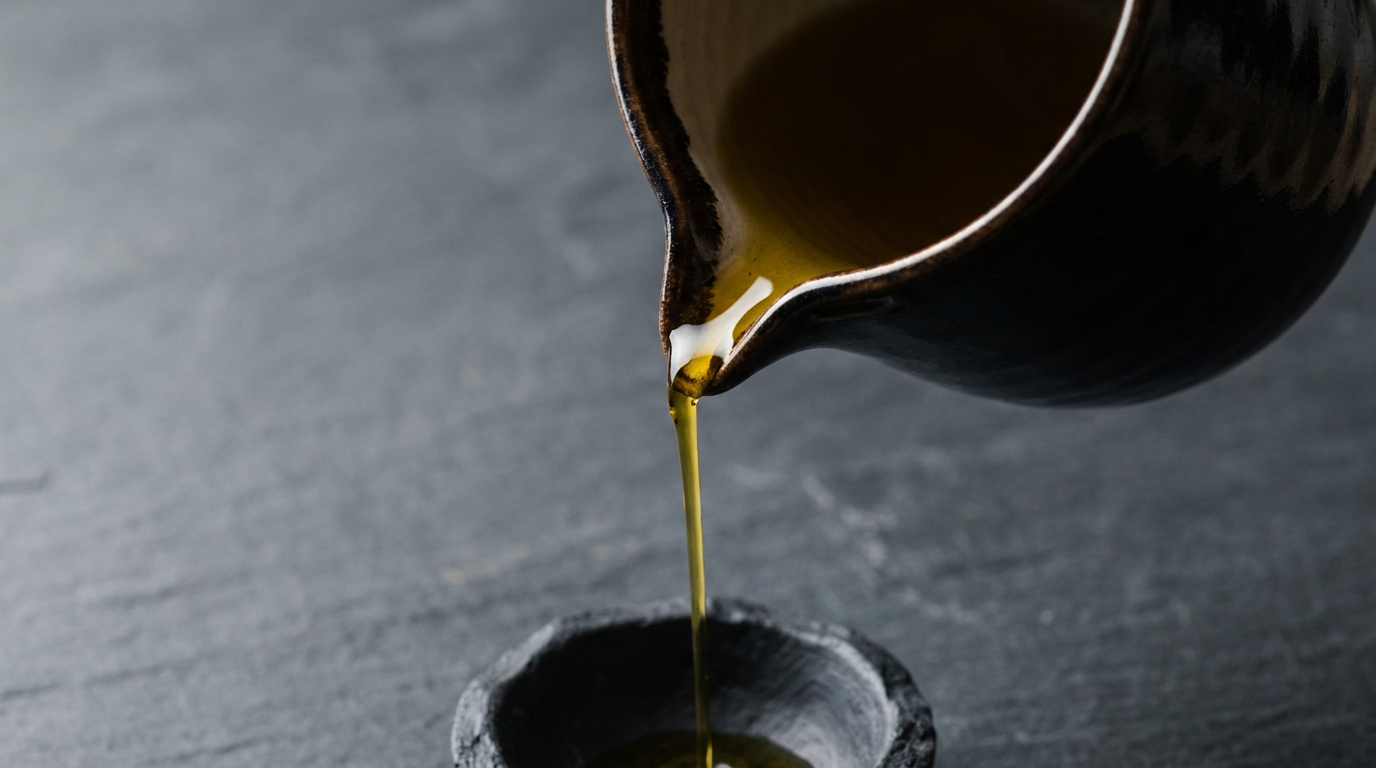
Camellia oil, pressed from the seeds of Camellia japonica or Camellia oleifera, is a lightweight botanical lipid comprising over 80 percent oleic acid. Known traditionally in Japan as tsubaki-abura, it closely resembles human sebum in fatty acid distribution. This composition allows rapid penetration into the hair shaft and stratum corneum while offering notable oxidative stability compared to other plant oils.
The lipid architecture of the seed
Strip away the marketing around geishas and wooden combs, and you find a singular fatty acid profile. Most plant seed oils lean heavily towards linoleic acid, a polyunsaturated fat that oxidises rapidly upon exposure to heat and light. Camellia seed oil does the reverse. It is overwhelmingly monounsaturated, dominated by oleic acid (C18:1) at roughly 78 to 85 percent of its total lipid volume, with modest amounts of palmitic, stearic, and linoleic acids making up the balance [1].
This high concentration of monounsaturates explains its historical survival. On Izu Ōshima, the volcanic island south of Tokyo that has produced tsubaki-abura since the Edo period, cold-pressed camellia oil kept for months without turning rancid in humid maritime air. Craftsmen used it to protect carbon steel blades from rust precisely because monounsaturated oils resist the polymerisation and breakdown common to drying oils like flax. For the skin and hair, that same chemical stability translates into reliable barrier support without the rapid, unpleasant volatile changes seen in less stable nut oils.
Alongside oleic acid, cold-pressed camellia contains naturally occurring squalene, vitamin E (tocopherols), and triterpenoid saponins [2]. Squalene is a native component of human skin lipids, meaning the oil integrates smoothly into intercellular cement rather than merely sitting on the surface.
Camellia, argan, and jojoba: an actual comparison
Beauty rhetoric tends to group botanical oils together under vague descriptors like "liquid gold" or "deeply nourishing". In the laboratory, they behave differently because their fatty acid distributions vary significantly. Comparing camellia with its two most prominent shelf rivals reveals very distinct physical properties.
| Attribute | Camellia Oil (Camellia japonica) | Argan Oil (Argania spinosa) | Jojoba "Oil" (Simmondsia chinensis) |
| :--- | :--- | :--- | :--- |
| Lipid Class | Triglyceride | Triglyceride | Liquid wax ester |
| Dominant Component | Oleic acid (~80–85%) | Oleic (~45%), Linoleic (~35%) | Gadoleic / Erucic wax esters (~85%) |
| Skin Feel | Silky, rapid dry-down | Rich, moderate glide | Dry, light, low tack |
| Hair Shaft Action | Penetrates cuticle; coats cortex | Surface conditioning; adds shine | Forms thin, non-occlusive film |
| Oxidative Stability | High (low polyunsaturated fat) | Moderate (higher linoleic acid) | Exceptionally high (chemically a wax) |
Argan oil carries a far higher proportion of polyunsaturated linoleic acid, roughly 35 percent [3]. That gives argan a heavier slip, but it also means it behaves better for skin that clogs under heavy monounsaturates. Jojoba, by contrast, is not technically a triglyceride oil at all; it is an esterified wax chemically akin to the wax esters found in juvenile sebum. Where jojoba regulates surface moisture, camellia works deeper into porous hair structures and thick skin barriers.
Hair shafts and barrier function
Because oleic acid molecules are relatively compact compared to bulky polyunsaturates or polymerised waxes, camellia oil can access the internal cortex of damaged hair. Hair cuticles lift when damaged by heat or friction. Oleic-rich triglycerides slip into these fissures, lubricating the structural keratin strands and reducing water loss from within the shaft [4].
This mechanical behaviour explains why Japanese sumo wrestlers have relied on it as a base for bintsuke-abura (hair pomade), and why carpenters conditioned wooden joinery planes with it. The oil does not create a suffocating, hydrophobic shell. It conditions the substrate from within.
There is, however, a caveat. Oleic acid acts as a penetration enhancer, softening lipid bilayers in human skin. For dry, mature, or mechanically weathered skin, this helps repair a compromised permeability barrier. For acne-prone skin, or individuals with seborrheic dermatitis, flooding the epidermis with an isolated 80 percent oleic lipid can feed common surface yeasts such as Malassezia. An ingredient does not have to be bad to be wrong for a specific face.
Sourcing matters: *japonica* versus *oleifera*
If you buy a bottle labelled simply "camellia oil", look closely at the botanical name. Camellia oleifera, widely cultivated in mainland China and northern Vietnam, is primarily an agricultural tea-seed cooking oil. It has a high smoke point and a clean nutritional profile, but industrial solvent-extracted varieties undergo high-heat refining that strips volatile polyphenols and squalene.
Cosmetic camellia traditionally calls for Camellia japonica, cold-pressed from the seeds of flowering camellia shrubs. It retains its golden tint, faint botanical scent, and complete unsaponifiable fraction. Both plants deliver exceptional oleic content, but cold extraction preserves the minor compounds that give the lipid its functional value on biological tissue.
Frequently asked questions
### Is camellia oil the same as tea tree oil?
No. Tea tree oil comes from Melaleuca alternifolia, an Australian plant, and is an essential oil containing volatile terpenes that must be diluted. Camellia oil is a cold-pressed, non-volatile carrier oil derived from the seeds of the Camellia family, completely safe to apply neat.
### Can camellia oil be used on acne-prone skin?
Exercise caution. Because camellia is exceptionally high in oleic acid, it can be comedogenic for individuals prone to cystic congestion or seborrheic dermatitis. It is better suited to dry, mature, or compromised skin barriers, as well as brittle hair.
### What does authentic camellia oil smell like?
Unrefined, cold-pressed Camellia japonica oil has a faint, neutral-to-nutty scent with a very mild earthy undertone. It should never smell pungent, sour, or heavily perfumed.
Sources & citations
- Wang, X., et al. (2017). "Composition and characteristics of camellia oil." Journal of Food Science and Technology, 54(8), 2276–2284. [https://doi.org/10.1007/s13197-017-2665-2]
- Akihisa, T., et al. (1997). "Triterpene alcohols and squalene from the seeds of Camellia japonica." Phytochemistry, 46(8), 1339–1343. [https://doi.org/10.1016/S0031-9422(97)00494-0]
- Guillaume, D., & Charrouf, Z. (2011). "Argan oil and other Argania spinosa products in complementary medicine." Alternative Medicine Review, 16(3), 275–279.
- Gavazzoni Dias, M. F. (2015). "Hair cosmetics: An overview." International Journal of Trichology, 7(1), 2–15. [https://doi.org/10.4103/0974-7753.153450]