
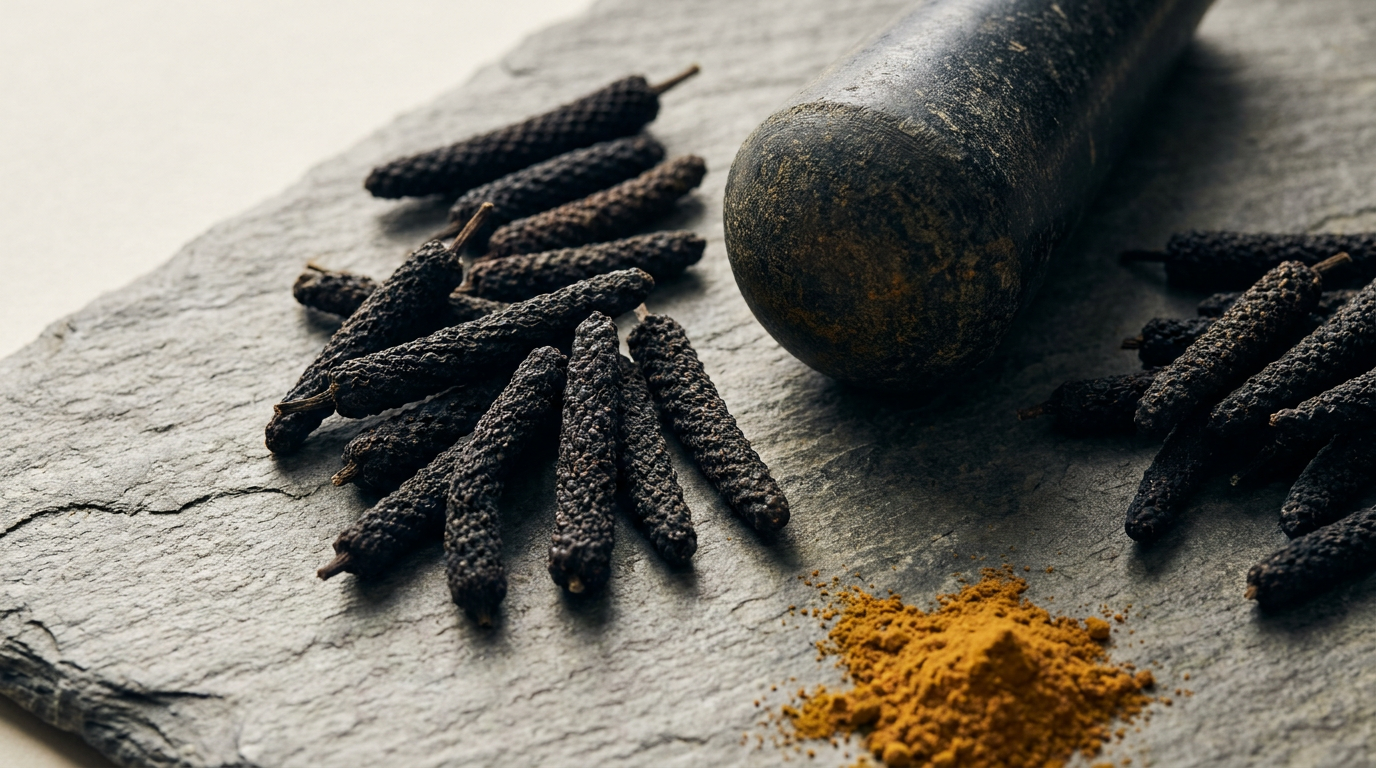
Long pepper (Piper longum), known historically as pippali, is a flowering vine in the family Piperaceae whose dried fruit catkins deliver a complex heat driven by piperine and piperlongumine. Valued at more than double the price of black pepper in ancient Rome, it dominated classical Eurasian trade before disappearing from European kitchens following the arrival of the New World chili.
Pliny the Elder had little patience for the Roman appetite for spice. In the twelfth book of his Natural History, he paused his inventory of trade routes to complain about the economics [1]. Long pepper, he noted, fetched fifteen denarii a pound in Rome. White pepper cost seven, and black pepper just four. Pliny could not understand why Romans paid so heavily for an ingredient valued solely for its pungency, a quality that offered neither nutrition nor pleasant sweetness.
Yet for well over a millennium, long pepper remained the standard heat of European and Mediterranean cooking. It sat in the spiced wine recipes of Apicius and anchored medieval sauces across northern Europe. Then, by the seventeenth century, it virtually vanished from the Western pantry, retreating to the Indian subcontinent where it had originated.
The economics of a catkin
The loss of long pepper was not a matter of taste decaying. It was a structural displacement driven by botany and colonial shipping.
Piper longum grows as a slender aromatic climber. Unlike Piper nigrum (black and white pepper), which produces round drupes along pendulous spikes that can be stripped quickly by hand, long pepper produces fused, microscopic berries packed along an upright, cylindrical catkin. These catkins must be harvested individually before they fully ripen and dried carefully in the shade to prevent internal fungal decay. The labour required per dry kilogram is substantially higher than that for ordinary peppercorns.
| Attribute | Long Pepper (Piper longum) | Black Pepper (Piper nigrum) |
| :--- | :--- | :--- |
| Botanical structure | Fused catkin of minute fruits | Clustered individual drupes |
| Primary pungent amide | Piperine and piperlongumine | Piperine |
| Aroma volatile profile | Sweet, woody, terpenoid, floral | Sharp, pinene-rich, citrus-woody |
| Historical Roman cost | 15 denarii per Roman pound | 4 denarii per Roman pound |
| Harvest labour | High; individual catkin selection | Moderate; mass spike stripping |
When Portuguese traders carried Capsicum annuum from the Americas back to Europe and Asia in the sixteenth century, the market calculations collapsed. Chilis grew vigorously in temperate gardens, required minimal processing, and delivered fierce capsaicin heat at a fraction of the cost of imported Piperaceae. Black pepper survived because of its massive existing volume, mechanised supply corridors, and distinct flavour. Long pepper, being fragile to ship and expensive to harvest, was dropped from European trade ledgers.
Beyond piperine
Long pepper does not taste like black pepper with more volume. It burns later, coats the palate differently, and finishes with a distinct sweet-woody fragrance reminiscent of cardamom, nutmeg, and black tea.
Both plants rely on piperine for their immediate bite, which activates the transient receptor potential vanilloid 1 (TRPV1) ion channels in mammalian sensory neurons [2]. But Piper longum carries a second, distinct alkaloid: piperlongumine (also called piplartine).
Piperlongumine has attracted contemporary pharmacological interest. Laboratory work demonstrates that piperlongumine alters cellular redox states, showing selective toxicity against certain cancer cell lines and displaying senolytic properties in vitro by targeting non-proliferating, aged cells [3]. These findings belong to cell and animal models, not everyday seasoning. Cooking with long pepper will not replace clinical therapeutics. What the research does demonstrate, however, is that Piper longum possesses a secondary metabolite profile chemically distinct from standard black pepper.
The unbroken line in Ayurveda
While long pepper became a historical curiosity in European archives, it never left South Asia. In Ayurveda, pippali has served as a cornerstone botanical for at least two millennia, forming one third of Trikatu alongside black pepper and dried ginger (Zingiber officinale).
Classical Ayurvedic formulations categorise pippali as deepana (appetite-stimulating) and rasayana (rejuvenating), prescribing it frequently for respiratory ailments and sluggish digestion. Modern pharmacological evaluation has shown that the combination of piperine and piperlongumine acts as a bioenhancer, increasing the intestinal absorption and bioavailability of concurrent compounds [4]. Ayurvedic practitioners did not write in terms of cytochrome P450 inhibition or P-glycoprotein transport, but their persistent pairing of pippali with less bioavailable roots reflected an accurate empirical observation of how the body handles compounds.
In modern Indian regional cookery, long pepper quietly persists. It appears in traditional spice blends for Bengali fish broths, Kashmiri gravies, and slow-simmered Nihari, where its floral, non-astringent heat holds up over long hours of heat without turning unpleasantly bitter.
Treating long pepper as an antique novelty ignores its functional distinctness. To use it today, grind a single dried catkin through a microplane or pound it in a mortar. It belongs in fatty, slow-cooked braises, rich broths, and dark fruit preserves, where a cook needs real warmth without the raw, resinous edge of black peppercorns.
Frequently asked questions
### What does long pepper taste like compared to black pepper?
Long pepper shares the immediate pungency of black pepper due to piperine, but its heat develops more slowly. Its volatile oil profile contains notes of sweet earth, ginger, nutmeg, and black tea, making it less sharp and more aromatic than Piper nigrum.
### Can I substitute black pepper for long pepper in recipes?
You can substitute black pepper for heat, but the aromatic profile will change. Black pepper possesses higher concentrations of sharp monoterpenes like pinene and limonene. If substituting, use slightly less black pepper and consider adding a faint pinch of ground allspice or mace to restore the warm, sweet depth.
### Why is long pepper more difficult to grind than black pepper?
The catkin of long pepper is dense and fibrous, making it unsuitable for standard rotary pepper mills. It is best grated using a fine rasper or microplane, or cracked in a heavy stone mortar before being ground to a powder.
### What does contemporary clinical research say about piperlongumine?
Piperlongumine is studied in laboratory settings for its anti-inflammatory, senolytic, and anti-tumour properties, particularly its ability to induce reactive oxygen species in abnormal cells. However, almost all current data comes from cell cultures and animal models; human clinical trials are still limited.
Sources & citations
- Pliny the Elder. The Natural History, Book XII, Chapter 14. Translated by John Bostock and H.T. Riley. London: Taylor and Francis, 1855.
- McNamara, F.N., Randall, A., & Gunthorpe, M.J. (2005). Effects of piperine, the pungent component of black pepper, at the human vanilloid receptor (TRPV1). British Journal of Pharmacology, 144(6), 781–790. https://doi.org/10.1038/sj.bjp.0706040
- Raj, L., et al. (2011). Selective killing of cancer cells by a small molecule targeting the stress response to ROS. Nature, 475(7355), 231–234. https://doi.org/10.1038/nature10167
- Atal, C.K., Dubey, R.K., & Singh, J. (1985). Biochemical basis of enhanced drug bioavailability by piperine. Journal of Pharmacology and Experimental Therapeutics, 232(1), 258–262.