
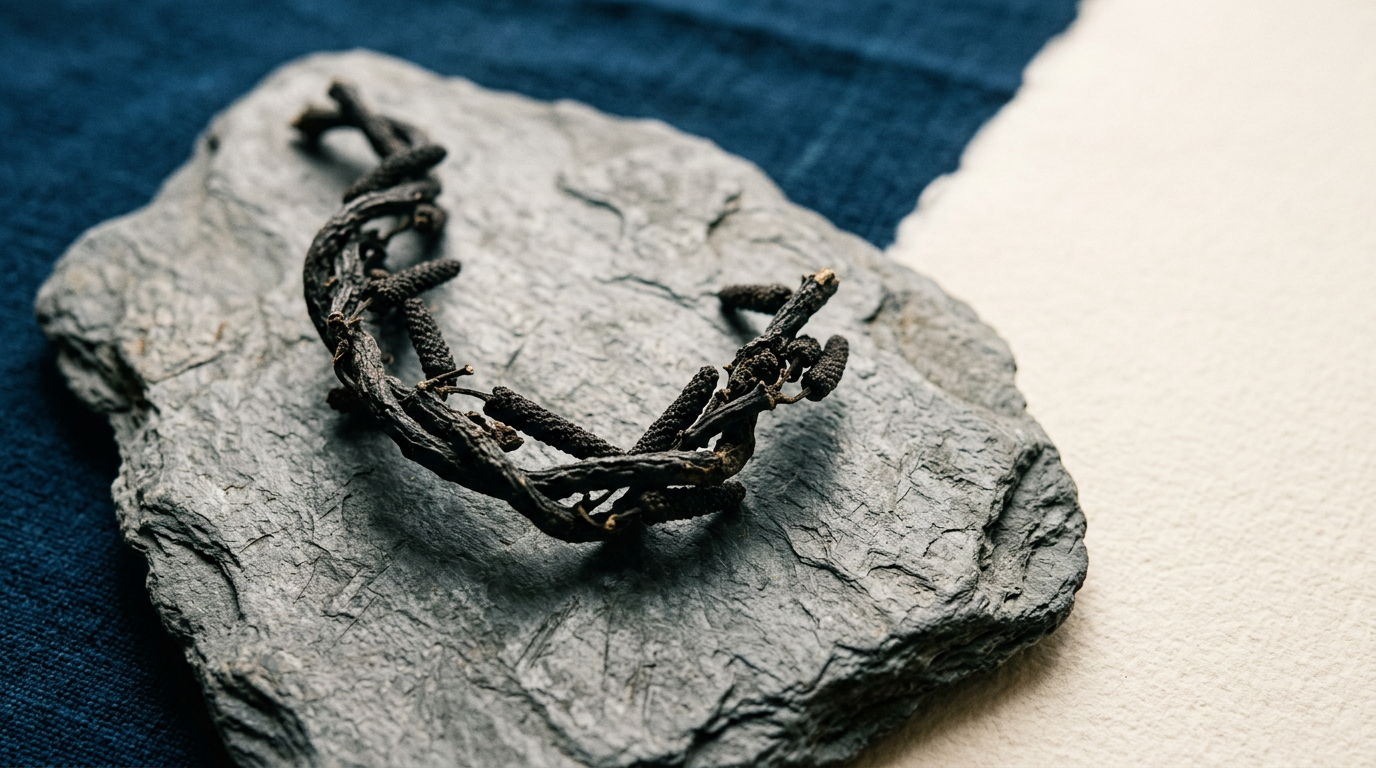
The long pepper pippali benefits celebrated in Ayurvedic texts for millennia were once the wonder of the ancient world. Before its now-common cousin, black pepper, conquered the globe, it was this intriguing, cone-shaped spice that Roman coffers bled for. Hailing from the verdant foothills of the Himalayas in India, long pepper was the original pepper, the one Pliny the Elder lamented was worth its weight in silver [1].
So what happened? How did a spice that defined luxury for centuries become a historical footnote in the West?
The Pepper That Built Empires (and Emptied Treasuries)
Long pepper, or pippali (Piper longum), looks more like a tiny, gnarled birch catkin than a peppercorn. Its flavor profile is far more complex than the sharp, one-note heat of black pepper (/spice/black-pepper). It starts with a familiar warmth but quickly blossoms into notes of cardamom, cinnamon, and anise, finishing with a lingering, earthy sweetness. It’s a complete narrative in a single spice.
This complexity made it a sensation. From ancient Greece to Rome, it was used not just as a seasoning but as a medicine and an aphrodisiac. Roman aristocrats would grate it over everything from roasted meats to sweetened wine. The demand was so ferocious that it drove a significant portion of the empire's trade eastward along treacherous overland routes, enriching merchants but draining the state of precious metals. The value was staggering; in the first century CE, a Roman pound of long pepper could cost fifteen denarii—the equivalent of a soldier's monthly pay [2].
For nearly 1,500 years, it was the pepper of Europe. But the world was about to change.
How a Spice Gets Colonised-Food Status
The fall of Constantinople in 1453 choked the overland spice routes, sending prices soaring and spurring European powers to find an alternative: the sea. When Portuguese explorer Vasco da Gama successfully navigated around Africa to reach India's Malabar Coast, he didn't just open a new trade route; he sealed long pepper's fate.
His ships returned laden with Piper nigrum, the common black peppercorn. It was easier to cultivate, easier to harvest in bulk, and, via the new sea lanes, far cheaper to transport. The colonial spice trade was built on volume and efficiency, not nuance. Long pepper's more delicate cultivation needs and lower yields made it a poor fit for the new, scaled-up model. By the 18th century, it had all but vanished from European kitchens, a victim of economic disruption and a shift in global power [3].
While the West forgot, India didn't. In its homeland, pippali remained a cornerstone of both cuisine and medicine. It is a key ingredient in the Ayurvedic formulation Trikatu (“three pungents”), a blend of long pepper, black pepper, and ginger revered for its digestive and respiratory support. The continued exploration of long pepper pippali benefits in clinical science, particularly around its unique compound piperlongumine, is a modern validation of this ancient wisdom [4].
| Feature | Long Pepper (Piper longum) | Black Pepper (Piper nigrum) |
| :--- | :--- | :--- |
| Appearance | Small, elongated cone of dried catkins | Small, dried spherical drupe |
| Flavor | Complex, warm, sweet, with notes of nutmeg & anise | Sharp, pungent, singular heat |
| Key Compound | Piperlongumine | Piperine |
| Traditional Use | Respiratory and digestive aid (Ayurveda) | General seasoning, digestive stimulant |
| Price (Historically) | Extremely high; ~15x more expensive than black pepper in Roman times | Cheaper, more accessible post-16th century |
Rediscovering Lost Flavor
Today, long pepper is slowly returning. In the [US](/region/us), you might find it in a high-end food hall in Brooklyn, sold by the ounce and coveted by chefs for its unique aromatic profile. In the UK, it appears ground into complex chutneys at London's Borough Market, adding a depth that black pepper can't match. And in the bazaars of Kolkata, India, you'll see it sold by the pā, a traditional scoop, cherished for both its flavor and its revered place in home remedies.
Its revival isn't just about culinary novelty. It’s about reconnecting with a more diverse, less monolithic world of flavor. It’s a quiet reminder that the tastes on our tables are shaped by history, economics, and power. To choose long pepper is to taste a story that was almost erased—a story of what was prized before the world was mapped, commodified, and simplified for us. And as we continue to understand the full spectrum of long pepper pippali benefits, it becomes clear that what the Romans knew by instinct, we are only just beginning to prove with science.
---
### Frequently Asked Questions
1. What does long pepper taste like?
It has a complex flavor that is hotter and more nuanced than black pepper. It has an initial pungency followed by sweet, earthy notes of cinnamon, nutmeg, and cardamom.
2. How do you use long pepper?
You can use it whole in braises, stews, or pickles, where its flavor can infuse slowly. More commonly, it's ground fresh using a Microplane or a powerful spice grinder (it is too dense for most standard pepper mills). Use it where you would black pepper, but expect a more complex and aromatic result.
3. Is long pepper spicier than black pepper?
Yes, most people find it to be noticeably hotter, but its heat is also more aromatic and less sharp than that of black pepper. The heat builds and lingers differently.
4. What is Trikatu?
Trikatu is a classical Ayurvedic formula consisting of three pungent spices in equal parts: long pepper (pippali), black pepper (maricha), and dried ginger (shunthi). It is traditionally used to support digestion, metabolism, and respiratory health.
Sources & citations
- Dalby, A. (2000). Dangerous Tastes: The Story of Spices. University of California Press.
- Freedman, P. (2008). Out of the East: Spices and the Medieval Imagination. Yale University Press.
- Turner, J. (2004). Spice: The History of a Temptation. HarperCollins Publishers.
- Kumar, S., Kamboj, J., Suman, & Sharma, S. (2011). Overview for various aspects of the health benefits of Piper longum Linn. fruit. Journal of Acupuncture and Meridian Studies, 4(2), 134–140. https://www.sciencedirect.com/