
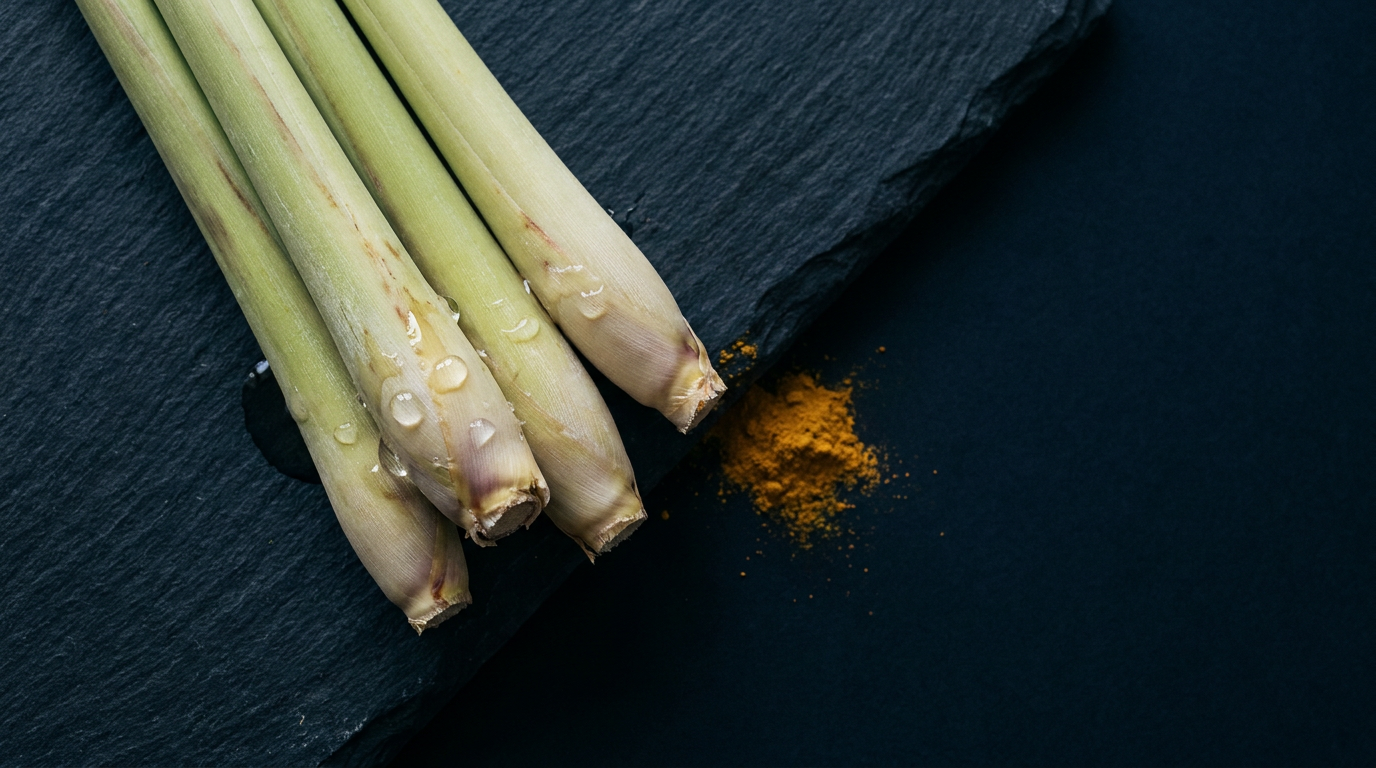
Lemongrass (Cymbopogon) owes its sharp, citrus aroma to citral, an isomeric mixture of geranial and neral that delivers lemon flavour without citrus acidity. While commercial repellents extract its volatile terpenes to deter mosquitoes temporarily, planting it offers little defence. In the kitchen, fresh, bruised stalks release bright, essential oils, while dried culinary teas rapidly lose potency to oxidation.
The chemistry of sourness without acid
When we register lemon, our tongue usually detects two entirely separate sensory inputs: the chemical burn of hydrogen ions on our taste receptors (citric and malic acid) and the vaporous, aromatic presence of monoterpene aldehydes in our retro-nasal passage. Lemon juice is roughly five to eight percent citric acid by weight. It coagulates dairy, turns green vegetables dull olive, and chemically cooks raw fish.
Lemongrass pulls off a useful botanical trick: it manufactures the aroma without the acid.
The dominant volatile compound in culinary lemongrass (Cymbopogon citratus) is citral, an aldehyde blend comprising two geometric isomers: geranial (trans-citral) and neral (cis-citral) [1]. Together, they routinely make up 65 to 85 percent of the plant's essential oil. Because the stalk contains negligible organic acids, infusing it into warm milk or delicate chicken stock yields intense citrus clarity with zero curdling and no sour rasp. It gives Thai tom yum its treble note, not by souring the broth—that task is left to tamarind or lime juice added at the finish—but by perfuming the steam.
The patio myth and the vaporisation problem
Few garden-centre claims are as persistent as the promise that a pot of lemongrass will banish mosquitoes from a summer table. It will not.
The myth persists because consumer repellents frequently list "citronella oil" or "lemongrass oil" on their labels. In laboratory olfactometer trials, concentrated citral and citronellal do disrupt the olfactory receptors female mosquitoes use to track human carbon dioxide and skin volatiles [2].
However, living plants do not casually spray high-pressure essential oil vapour into the air. Terpenes are secondary metabolites stored inside discrete parenchymal cells and vascular bundles. They exist largely to deter herbivores that chew the leaves, not to project a protective dome over humans sitting two feet away. For the volatile compounds to repel an insect, the plant cells must be mechanically ruptured, and the extracted oil must evaporate directly from the skin at a concentration high enough to mask host cues.
Even when applied topically as a pure essential oil, citral is a light monoterpene with a high vaporisation rate. Studies assessing botanical repellents note that unprotected lemongrass oil provides effective protection against Aedes mosquitoes for roughly thirty to sixty minutes before it volatilises away entirely [2]. Synthetic standards like DEET (N,N-Diethyl-meta-toluamide) persist for six to eight hours simply because their vapour pressure is several orders of magnitude lower.
Knowing your Cymbopogon
Part of the confusion comes from how the genus is traded. Several distinct species are lumped together on nursery tags and tea boxes, but their chemical phenotypes behave differently in water and cooking fats.
| Species | Common name | Primary volatile compounds | Typical application |
| :--- | :--- | :--- | :--- |
| Cymbopogon citratus | West Indian lemongrass | Geranial, neral, myrcene | Culinary stalks, fresh infusions |
| Cymbopogon flexuosus | East Indian lemongrass | Citral, geraniol, methyl heptenone | Essential oil extraction, commercial tea blends |
| Cymbopogon winterianus | Java citronella | Citronellal, geraniol, citronellol | Industrial insect repellents, perfumery (inedible) |
| Cymbopogon nardus | Ceylon citronella | Geraniol, citronellal, limonene | Non-culinary scented products, soap manufacture |
C. citratus forms the thick, fleshy, bulbous base prized in Southeast Asian kitchens. C. flexuosus produces thinner, woodier culms with a harsher, more perfume-forward character; it handles industrial processing well but makes an aggressive, soapy paste if pounded raw.
Why dried lemongrass tea tastes like hay
If you have ever brewed a mug of loose, grey-green dried lemongrass from a health food jar and found it tasting remarkably like boiled lawn clippings, the problem is oxidation.
Citral is chemically fragile. When exposed to heat, ambient oxygen, and ultraviolet light, geranial and neral degrade. They oxidise and cyclise into p-cymene, a terpene with a stale, woody, terpene-like profile, and photolyse into various off-flavoured ketones [3]. In commercial dehydration tunnels, the high surface-area-to-volume ratio of chopped lemongrass leaves causes the volatile fraction to plummet within weeks.
To get what the plant is actually capable of, you need fresh stalks, and you need to abuse them.
Because the essential oils reside in internal oil-gland reservoirs running through the fibrous layers of the bulb, slicing through the stalk with a razor-sharp knife only opens the cells directly along the cut. In a short steep, much of the flavour remains trapped. Bruising the stalk firmly with the flat of a cleaver or the base of a pestle fractures the cell walls along the longitudinal grain, liberating the citral droplets without chopping the stalk into fibrous splinters you have to fish out of your teeth later.
Simmered gently in water for eight to ten minutes, a crushed stalk yields an infusion that is intensely clean, pale yellow, and naturally sweet on the nose without a trace of tannic bitterness or oxidised hay.
Frequently asked questions
### Can I use citronella grass for cooking?
No. Citronella species (Cymbopogon winterianus and Cymbopogon nardus) contain high concentrations of citronellal and geraniol, which have an overwhelmingly soapy, medicinal, and bitter profile. They are unpalatable and can cause digestive irritation if consumed in culinary quantities.
### Why does fresh lemongrass need to be bruised before brewing?
The volatile citral is stored inside microscopic oil cells within the fibrous sheath. Lightly crushing or bruising the pale lower stalk ruptures these internal cell walls, allowing hot water to dissolve the hydrophobic essential oils into the infusion.
### How long does fresh lemongrass keep its essential oils?
Uncut stalks wrapped in damp paper and chilled in an airtight container retain their citral content for three to four weeks. Once chopped or minced, the increased surface area accelerates oxidation and moisture loss, degrading the bright top notes within twenty-four hours.
### Does adding lemongrass to hot water extract the same compounds as boiling it in fat?
No. Citral is hydrophobic and lipophilic. Water extracts water-soluble sugars and a portion of the volatile terpenes through steam distillation. Simmering bruised lemongrass in coconut milk or oil extracts a higher concentration of the heavier, less volatile aromatic compounds, creating a deeper, more persistent flavour.
Sources & citations
- Food and Agriculture Organization (FAO). "Cymbopogon citratus (DC.) Stapf." In: Ecocrop Database. fao.org
- Maia, M.F., & Moore, S.J. (2011). "Plant-based insect repellents: a review of their efficacy, development and testing." Malaria Journal, 10(Suppl 1): S11. doi:10.1186/1475-2875-10-S1-S11
- Turek, C., & Stintzing, F.C. (2013). "Stability of Essential Oils: A Review." Comprehensive Reviews in Food Science and Food Safety, 12(1): 40–53. doi:10.1111/1541-4337.12006