
Walk down any spice aisle, and you’ll find it: a uniform jar simply labeled “Turmeric.” It’s a staple, the source of curry’s golden hue and the foundation of a million ‘golden milk’ lattes. We treat it like a monolith, a consistent yellow powder. But this is like calling all red wine simply ‘red wine,’ ignoring the world of difference between a mass-market blend and a single-vineyard Pinot Noir.
The story of turmeric, or haldi, is a tale of forgotten diversity. The difference between the generic jar and a true heirloom varietal is not just a matter of taste—it’s a matter of chemistry. And nowhere is this clearer than when comparing standard supermarket turmeric with its celebrated cousin from a tiny corner of India: Lakadong turmeric.
The Contenders: A Tale of Two Turmerics
In one corner, we have the familiar plastic shaker of “turmeric powder.” This is typically a blend of different commercial varieties, often the ‘Madras’ or ‘Alleppey’ types, grown for high yield and disease resistance rather than potency. Sourced from vast commodity markets, its primary job is to provide color at the lowest possible price. The focus is on quantity, not quality.
In the other corner is Lakadong turmeric. It grows only in the Jaintia Hills of Meghalaya, a state in Northeast India known for its matriarchal communities, torrential rainfall, and unique ecology. Here, it is cultivated by small-holder farmers using traditional, organic methods passed down through generations. The specific soil and climate of the region—its terroir—are what make this spice unique. It is not a commodity; it is a specific agricultural fingerprint, recognized with a Geographical Indication (GI) tag by the Government of India [1].
From the Lab Bench: Curcumin Is Key
The vibrant yellow of turmeric comes from a group of compounds called curcuminoids. The most famous and well-studied of these is curcumin. Curcumin is the engine of the spice—the primary bioactive compound responsible for the anti-inflammatory and antioxidant properties celebrated in both ancient Ayurvedic texts and modern clinical trials [2].
This is where the difference between the two turmerics becomes stark. Standard supermarket turmeric usually contains a curcumin content of just 2-3%. It provides color, but its therapeutic potential is minimal. It's like a car with a beautiful paint job but a tiny engine.
Lakadong turmeric, by contrast, is a powerhouse. Thanks to its unique genetics and terroir, its curcumin content ranges from 7% to as high as 12% [3]. This isn’t a small difference. A teaspoon of Lakadong can contain more than three times the active curcumin as a teaspoon of its generic counterpart. This concentration is the direct result of a specific plant cultivated in a specific place—a combination that cannot be easily replicated elsewhere.
Here’s a simple breakdown of what sets them apart:
| Feature | Supermarket Turmeric | Lakadong Turmeric |
| :--- | :--- | :--- |
| Curcumin Content | 2–3% | 7–12% |
| Origin | Blended commodity; various regions | Jaintia Hills, Meghalaya, India (GI-tagged) |
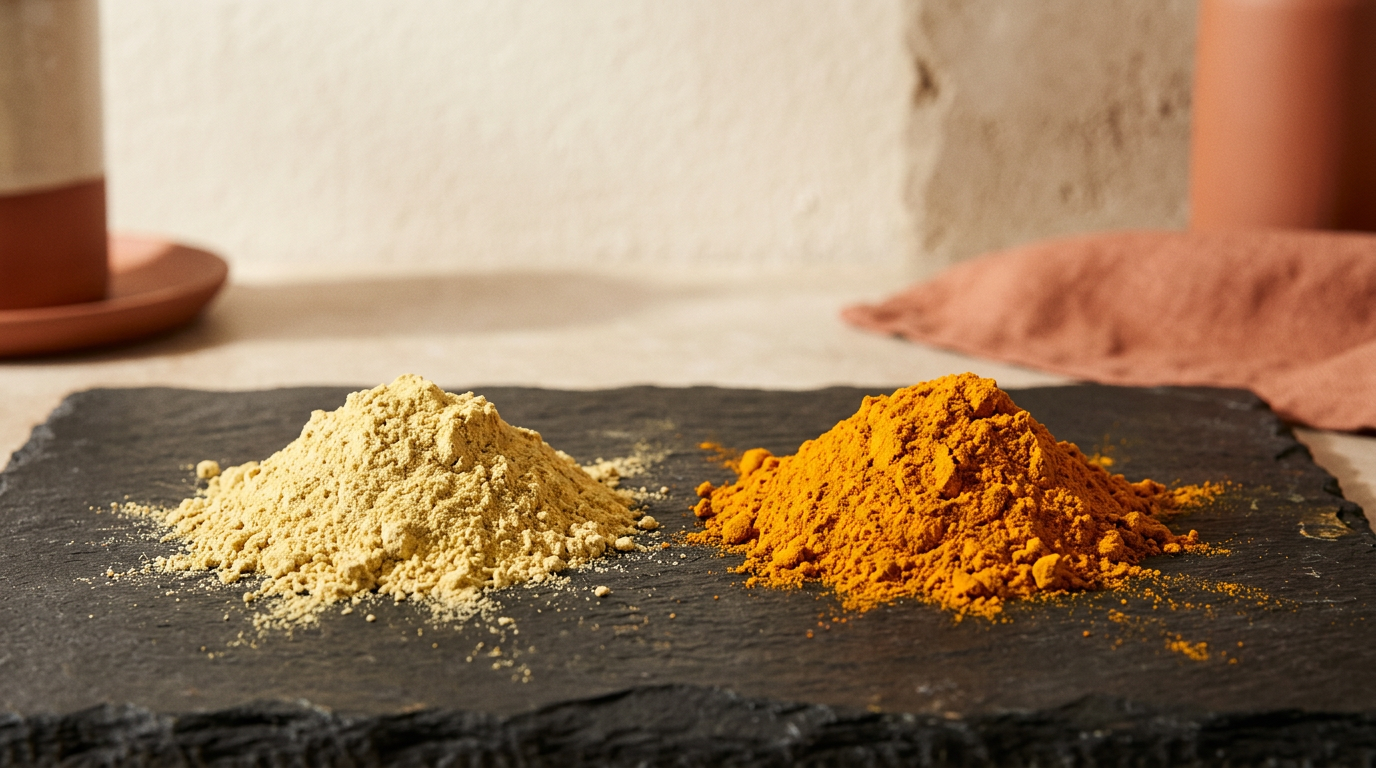
| Color | Pale, often flat yellow | Deep, vibrant saffron-orange |
| Aroma | Mildly dusty, sometimes faint | Pungent, earthy, and zesty |
| Farming | Conventional, large-scale | Traditional, small-holder farmers |
More Than a Number
The difference isn't just academic; you can see, smell, and taste it. Open a jar of generic turmeric, and you get a pale yellow dust with a mild, earthy smell. Open a jar of true Lakadong, and you’re hit with a wave of pungent, complex aroma—a mix of floral, earthy, and zesty notes. Its color is a deep, blazing orange, a visual testament to its concentrated curcuminoids. A pinch is enough to transform a dish with its flavor and intense hue.
This higher potency means you can use less of it, but more importantly, it means the spice is actually doing what you expect it to. When you’re adding a spoonful to a pot of soup or whisking it into a healing drink, you are delivering a meaningful dose of the compounds that science has shown to be so beneficial.
Why This Matters
In a globalized food system, it's easy for products to become disconnected from their origins. Spices become interchangeable colored dusts, their stories and potency erased by the demands of a low-cost supply chain. To learn more about this, you can read our guide to the [differences between Lakadong and supermarket haldi](/compare/lakadong-vs-supermarket-haldi).
Choosing a spice like [Lakadong turmeric](/spice/turmeric) isn't about culinary elitism. It’s an acknowledgment that efficacy is a product of place, and that the wisdom of the farmers in Meghalaya is validated by the numbers from a chromatograph. It asks a simple question: Do you want a spice for color, or do you want it for the full power the plant has to offer?
It’s a quieter, more thoughtful way to stock a pantry—one that values what’s inside the jar as much as the story behind it.
Sources & citations
- Geographical Indications Registry, Government of India. (2015). Geographical Indication No. 472: Lakadong Turmeric. Retrieved from ipindia.gov.in.
- Hewlings, S. J., & Kalman, D. S. (2017). Curcumin: A Review of Its Effects on Human Health. Foods, 6(10), 92. https://www.ncbi.nlm.nih.gov/pmc/articles/PMC5664031/
- Spices Board of India, Ministry of Commerce & Industry. Turmeric: Post Harvest Profile. This document and others from the board detail the curcumin levels of different Indian turmeric varieties. http://www.indianspices.com/
- Das, G., Patra, J. K., & Das, S. K. (2014). Turmeric (Curcuma longa L.): The Golden Spice of India. In Biotechnology of Neglected and Underutilized Crops. Springer, Cham.