
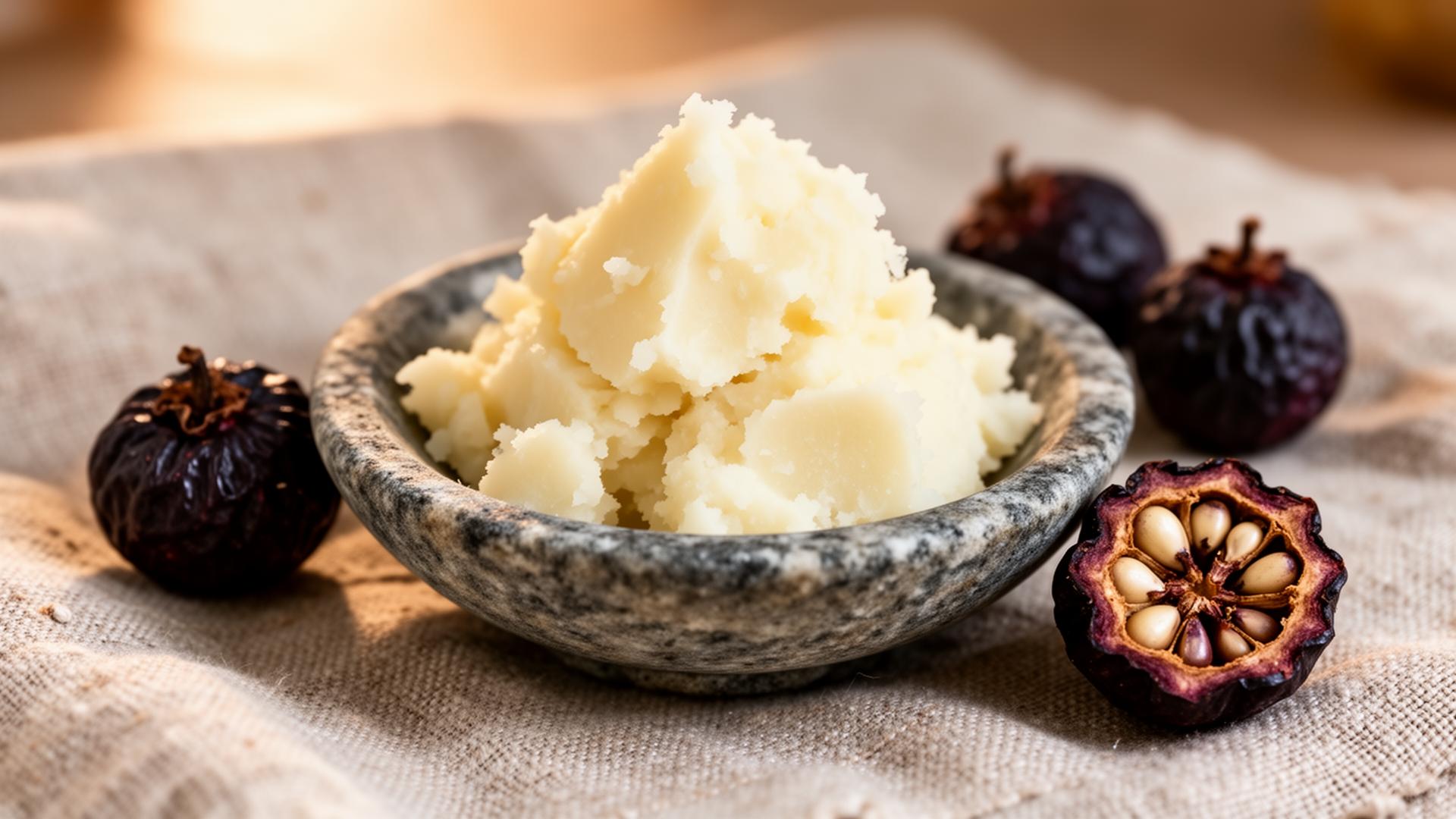
The Konkan coast presses Garcinia indica seeds into a fat so pale it almost looks like wax. Locals call it kokum butter. It is not a trend ingredient — coastal Maharashtrian and Karnataka households have been using it on cracked heels, lip fissures, and sun-burnt forearms for at least four generations that we can document, and probably much longer.
We keep coming back to it for one reason: the lab data is unusually clean.
The fatty-acid profile, plainly
Most plant butters used in skincare are dominated by oleic acid (C18:1), which is soft, penetrating, and oxidatively unstable. Kokum butter inverts that ratio. Published GC-MS analyses (see the Journal of the American Oil Chemists' Society characterisation work on Garcinia indica seed fat) consistently show:
- Stearic acid (C18:0): 50–56%
- Oleic acid (C18:1): 39–42%
- Palmitic acid (C16:0): 2–4%
- Linoleic acid (C18:2): <2%
Two things follow from those numbers.
First, the very low linoleic and linolenic content (under 3% combined) means kokum butter does not go rancid on a vanity shelf the way a high-oleic butter does. Shelf life at room temperature is typically 18–24 months without antioxidants added. That matters for any formulator who hates the smell of an oxidised balm.
Second, the stearic-heavy backbone gives kokum a melting point of roughly 39–40°C — just above skin temperature. It stays solid in the jar, then liquefies on contact. Shea butter melts around 32–35°C and feels soft at room temperature; cocoa butter sits at 34–38°C. Kokum is the firmest of the three, which is why traditional preparations in Sindhudurg are pressed into bricks rather than sold as a soft paste.
Why the traditional use lines up with the chemistry
Households along the coast use kokum butter for three things, in roughly this order: cracked heels after the monsoon, lips that split in dry coastal winds, and the inflamed skin around healing burns or insect bites. Each use maps onto something the fatty-acid profile predicts.
- Occlusion without greasiness. High-stearic fats form a film that slows transepidermal water loss without the slick after-feel of oleic-rich butters. This is the same reason stearic acid is the second ingredient in most pharmacy-grade barrier creams.
- Low irritation potential. With under 4% palmitic and almost no free linoleic, the comedogenicity score sits at the low end (most cosmetic-chemistry references place kokum at 1 on the 0–5 scale, the same as argan and lower than coconut at 4).
- A useful melt-point window. A fat that holds shape in the jar but releases on the skin needs no emulsifier to deliver. That is why a kokum lip salve can be a two-ingredient formulation (butter + beeswax) and still feel finished.
Kokum vs shea vs cocoa — the only honest comparison
| Property | Kokum | Shea | Cocoa |
|---|---|---|---|
| Stearic acid | 50–56% | 30–45% | 31–35% |
| Oleic acid | 39–42% | 40–55% | 32–37% |
| Melting point | 39–40°C | 32–35°C | 34–38°C |
| Comedogenicity (0–5) | 1 | 0 | 4 |
| Typical shelf life (no antioxidants) | 18–24 mo | 12–18 mo | 24+ mo |
| Aroma | Almost neutral | Nutty, sometimes smoky | Distinctly chocolate |
Shea is the better choice when you need flexibility — body butters, creams that need to spread. Cocoa is the better choice when you want fragrance carried by the fat itself. Kokum wins when the brief is "high occlusion, low scent, long shelf life, formulated minimally." Lip balms, heel salves, post-sun balms, and unscented baby preparations are the obvious fits.
What kokum butter cannot do
It cannot replace a moisturiser on dry-but-not-cracked skin — the melting profile makes it feel waxy on intact, hydrated stratum corneum. It cannot replace an SPF (no plant fat can; the broad-spectrum claims floating around online are not supported by any DIN 67501 or ISO 24443 data we have ever seen on kokum). And it cannot substitute for a topical steroid on eczema flares — barrier support helps, but the inflammatory cascade is a different problem.
The supply story behind the bottle
Kokum is a slow tree. Fruiting kicks in around year seven, peaks around year fifteen, and a single tree yields roughly 30–50 kg of fruit a year — of which the seed, the source of the butter, is a fraction. The pulp economy (kokum sherbet, aamsul for fish curries) takes most of the harvest in the Sindhudurg, Ratnagiri, and coastal Karnataka belts; the seed has historically been a by-product, often discarded.
When the cosmetic industry started paying for the seed in the 2000s, two things happened. Smallholder income rose — a tree that produced one revenue stream now produced two. And the temptation to harvest unripe fruit, which gives a poorer butter yield, also rose. The growers we work with in Sindhudurg only press fully ripened seed harvested between April and June, which is one of the small reliability decisions that ends up determining whether a butter is the 50% stearic version or a diluted 35% version that behaves more like a soft shea.
Where to start, if you are formulating
For a first batch, a 70:30 kokum-to-beeswax bar will give you a heel salve that holds a brick shape in 28°C ambient and melts cleanly on skin. For a lip balm, 60:30:10 kokum, jojoba, beeswax is a working starting point — the jojoba thins the melt and stops the bar feeling chalky. Both formulations are stable for over a year without preservatives because the water phase is zero.
For everything else, the rule is the same one our grandmothers used: melt a small piece on the back of the hand, wait thirty seconds, and decide whether the skin says yes. The lab data is useful. The skin is the last referee.
---
If you want to read more about the science behind a single ingredient, our [kokum spice page](/spice/kokum) and the [kokum ingredient profile](/ingredient/kokum) go deeper on provenance, varieties, and culinary use.