
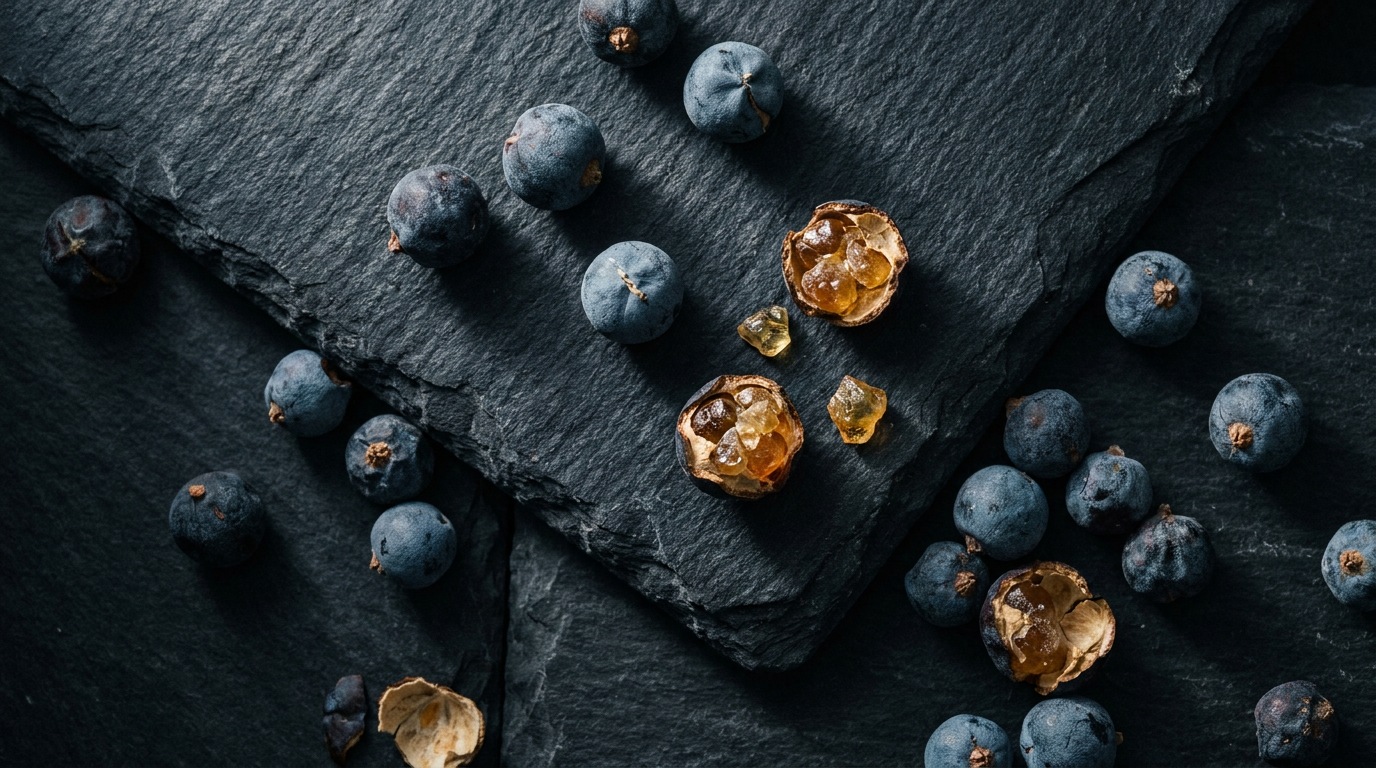
Juniper berries are not true botanical berries, but the fleshy, fused seed cones of the conifer Juniperus communis. Renowned for their pungent piney, resinous, and citrus profile, these dark purple cones owe their culinary character to high concentrations of volatile monoterpenes, principally alpha-pinene, myrcene, and sabinene, which cut through fatty game meats and provide the foundational flavour of gin [1].
The botanical lie on the branch
Calling the fruit of Juniperus communis a berry is a kitchen convenience. Angiosperms produce true berries from an ovary. Conifers are gymnosperms, meaning their seeds sit naked on bracts. In juniper, the three to six fleshy scale leaves surrounding the ovule fuse during maturation, swelling into a succulent, spherical structure called a galbulus [2]. It looks like a blueberry, but it behaves like an exceptionally dense pinecone.
Ripening requires patience. In the first year, the young cones remain hard, bitter, and green. By their second or third autumn, accumulation of anthocyanins turns them a waxy, blue-black shade dusted with a pale bloom of wild yeasts [2]. Because branches bear green and ripe cones simultaneously, commercial harvesting relies on hand-beating branches over tarpaulins rather than mechanical strip-picking. As noted in our broader cataloguing of culinary berries, dried seed pods that double as souring or seasoning agents carry distinct chemical challenges compared to garden soft fruit.
Monoterpenes and the alpine flavour profile
The essential oil of Juniperus communis accounts for roughly one to two percent of the ripe cone's dried weight. The volatile profile is dominated by monoterpene hydrocarbons, which explain the immediate olfactory hit of broken pine needles, turpentine, and winter air [1, 3].
| Compound | Typical Concentration | Sensory Contribution |
| :--- | :--- | :--- |
| Alpha-pinene | 40–50% | Pine resin, wood, clean medicinal bite |
| Sabinene | 5–15% | Warm pepperiness, woody citrus |
| Myrcene | 5–12% | Peppery balsam, green herbaceous background |
| Limonene | 2–6% | Sweet citrus top notes, fresh rind |
| Terpinen-4-ol | 1–3% | Faint nutmeg spice, earthy undertone |
Alpha-pinene carries the primary load. It is the same compound that gives Scotch pine (Pinus sylvestris) and rosemary their camphorous sharpness. Yet raw alpha-pinene alone would smell merely like a turpentine solvent. The rounding presence of sabinene, limonene, and small amounts of the sesquiterpene beta-caryophyllene lends juniper its bitter orange lift and faint woody warmth [3].
Why juniper works with heavy fat
Central and Northern European culinary traditions do not throw juniper into delicate chicken broths. It appears reliably alongside wild boar, venison haunch, goose, pork knuckle, and long-fermented cabbage like sauerkraut. This is not purely an accident of geography.
Game meats and waterfowl contain high levels of branched-chain fatty acids and unsaturated lipid profiles that oxidise during aging, producing livery, intensely metallic aromas. High-fat cuts coat the tongue with a persistent lipid barrier that dulls lighter flavours. Terpenes, particularly alpha-pinene and limonene, are lipophilic: they dissolve readily in melted animal fat during prolonged simmering [4]. Instead of coating the palate unchallenged, the rendered tallow carries these sharp, volatile compounds straight across the tongue, cutting through greasiness and moderating the volatile sulfur compounds generated by game and brassicas.
Extracting these compounds requires mechanical action. The leathery epidermal coating of the dried cone prevents rapid diffusion. A whole dried cone dropped into a braise will yield gentle bitterness, but very little pine top note. Crushing the cone lightly with the flat of a knife ruptures the internal resin sacs without pulverising the woody seeds inside. If ground to fine dust, the inner seed releases harsh, astringent tannins that can ruin a pan sauce.
Toxicity and species confusion
Not all juniper cones are edible. Juniperus communis is the culinary standard across Europe and North America. However, several related species in the Juniperus genus contain high concentrations of sabinol and podophyllotoxin, compounds that cause severe gastrointestinal irritation and renal distress [5].
Juniperus sabina (the savin juniper), common across mountainous southern and central Europe, contains toxic essential oils historically used as an abortifacient with lethal side effects [5]. Culinary sourcing requires careful botanical identification, particularly for wild foragers who mistake ornamental parkland junipers for native culinary stock.
Frequently asked questions
### Why do recipes call for crushing rather than grinding juniper?
The flavour of juniper sits in resin pockets within the soft cone flesh. Crushing fractures this outer flesh and allows cooking fats and broths to extract the monoterpenes. Grinding tears open the hard inner seeds, which contain high concentrations of unpleasantly bitter, mouth-drying tannins that spoil delicate pan juices.
### Can you eat whole juniper berries from a braise?
While non-toxic in ordinary culinary quantities, biting into a whole hydrated cone releases an overwhelming, concentrated blast of pinene and bitter resin that obliterates other flavours. Most cooks discard them before serving or enclose them in a spice bag.
### Is the juniper used in gin the same as the culinary spice?
Yes. London Dry and traditional gins rely on dried Juniperus communis cones as their legally mandated core botanical. The distillation process strips the volatile monoterpenes—chiefly alpha-pinene and limonene—into the neutral spirit vapour, leaving the heavy bitter tannins behind in the still pot.
### Are common ornamental junipers safe to harvest for food?
No. Many garden varieties belong to species such as Juniperus sabina or Juniperus oxycedrus, which can cause serious gastrointestinal poisoning or renal damage. Unless positive botanical identification confirms Juniperus communis, domestic and decorative bushes should not be used in cooking.
Sources & citations
- Adams, R. P. (2014). Junipers of the World: The genus Juniperus. 4th Edition. Trafford Publishing.
- Royal Botanic Gardens, Kew. (n.d.). Juniperus communis L. Plants of the World Online. https://powo.science.kew.org/taxon/urn:lsid:ipni.org:names:262276-1
- Höferl, M., Stoilova, I., Schmidt, E., Wanner, J., Jirovetz, L., Trifonova, D., Krastev, L., & Krastanov, A. (2014). Chemical composition and antioxidant properties of juniper berry (Juniperus communis L.) essential oil. Natural Product Communications, 9(1), 99–102.
- McGee, H. (2004). On Food and Cooking: The Science and Lore of the Kitchen. Scribner, pp. 410–412.
- European Medicines Agency. (2010). Assessment report on Juniperus communis L., pseudo-fructus. EMA/HMPC/402325/2009. https://www.ema.europa.eu