
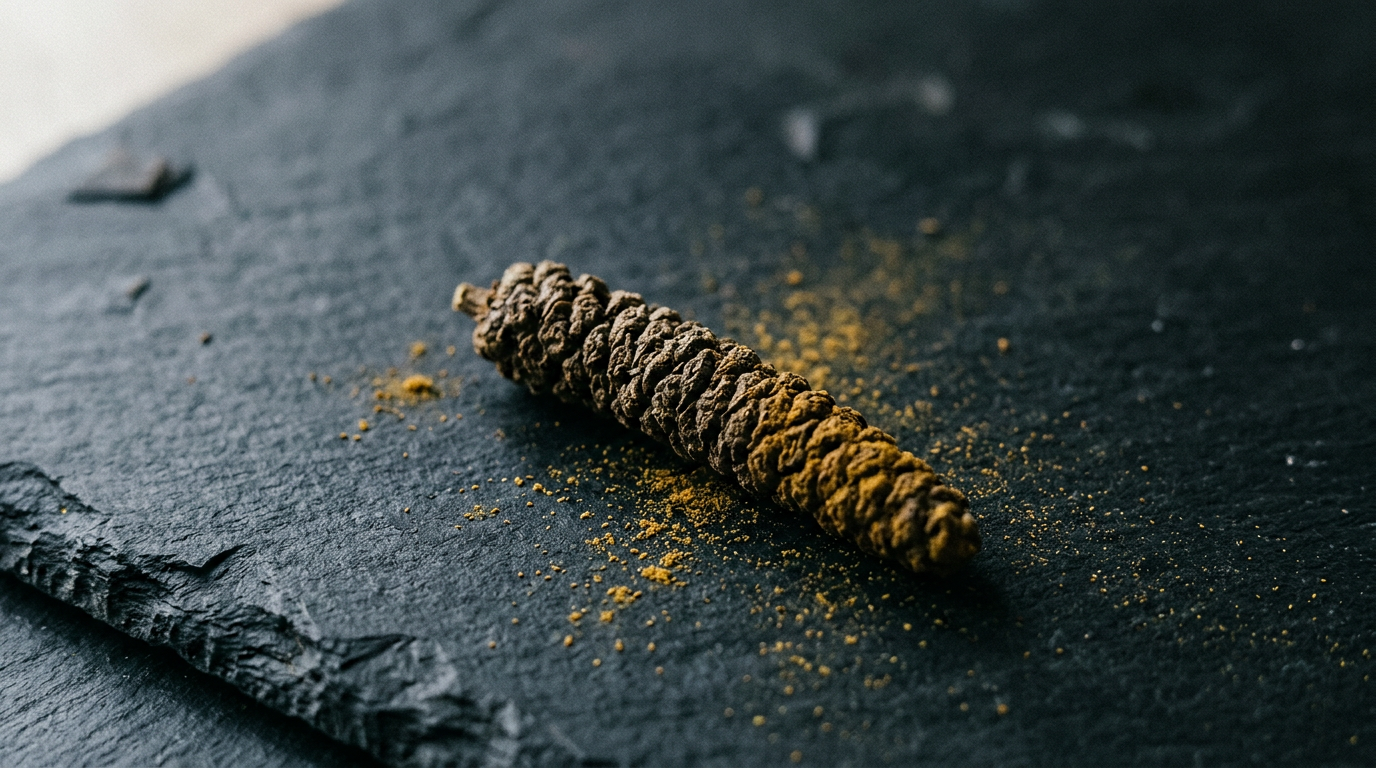
Long pepper (Piper longum), the ancient cousin of today’s black pepper, was once the most coveted spice in the world. Its complex heat and aromatic profile drove the Roman Empire to spend fortunes, influencing global trade routes centuries before black pepper became a pantry staple. This forgotten spice is a direct taste of a lost culinary world, a flavor that shaped history.
A Ruinous Appetite
In the first century CE, the Roman historian Pliny the Elder lamented the empire’s obsession with spices from the East. He complained that India, the Seres (China), and the Arabian Peninsula were draining the Roman treasury of at least 100 million sesterces each year—an astronomical sum spent on luxuries for the wealthy [1]. At the center of this trade was pepper. But it wasn't the familiar black peppercorn (Piper nigrum) we know today.
The Romans were infatuated with its relative, long pepper. Native to the foothills of the Himalayas, this peculiar-looking spice, resembling a tiny, elongated pinecone, was the star of Roman kitchens. Its flavor was more complex, more aromatic, and, therefore, more desirable. It was a symbol of status, a key ingredient in medicine, and a driver of one of the most significant and costly supply chains in the ancient world.
Roman ships would navigate the treacherous monsoon winds of the Indian Ocean, a journey detailed in the Periplus of the Erythraean Sea, to reach ports on the Malabar Coast. They traded Roman gold and silver for spices, textiles, and gems. The demand was so insatiable that it created a severe trade imbalance, effectively shipping the empire's wealth eastward, ounce by precious ounce [2]. When Alaric the Visigoth besieged Rome in 408 CE, his ransom demands included not just gold and silver, but also 3,000 pounds of pepper—a testament to its enduring value even as the empire crumbled.
A Tale of Two Peppers
For centuries, long pepper was simply the pepper in Europe. So what changed? Understanding the difference between these two botanical cousins reveals a story of agriculture, commerce, and shifting tastes.
| Feature | Long Pepper (Piper longum) | Black Pepper (Piper nigrum) |
| :--- | :--- | :--- |
| Appearance | A catkin-like spike of tiny, fused berries | Small, individual spherical drupes |
| Origin | Himalayan foothills, Southern India | Malabar Coast of India |
| Flavor Profile | Complex: sweet, musky, earthy, with notes of cinnamon and cardamom. A slow, lingering heat. | Sharp, pungent, immediate heat. Simpler, more direct flavor. |
| Historical Value| Once worth more than gold; the dominant pepper in ancient Rome and Europe. | Gained dominance in the 16th-17th centuries due to easier cultivation and sea trade. |
Long pepper's decline began as a matter of logistics. As sea routes became more established and supplanted the old land caravans, the more easily cultivated and harvested Piper nigrum became the commercially favored option. It was a more predictable, scalable crop. Long pepper, often harvested from the wild, gradually faded from European pantries, becoming a historical curiosity.
Tasting History
To taste long pepper today is to connect with a flavor profile that has been largely dormant in the West for 500 years. It’s an experience that goes beyond simple heat. The initial taste is surprisingly sweet and fragrant, almost like a blend of cinnamon, nutmeg, and cardamom. This warmth then gives way to an earthy, resinous middle note, before the characteristic piperine heat slowly builds on the back of the palate. It’s a lingering, numbing heat, less aggressive but more complex than that of black pepper.
This complexity is why it has remained a cornerstone in other traditions. In Ayurveda, long pepper (Pippali) is a foundational ingredient, prized for its therapeutic properties. It’s a key component of the classic herbal formula Trikatu (“three pungents”), along with black pepper and ginger, used to enhance digestion and bioavailability of other nutrients [3]. It never became a 'forgotten' spice here; its value was simply measured differently.
The re-emergence of long pepper in modern pantries isn’t just about novelty. It’s about a growing appreciation for nuance and a desire to connect with the full spectrum of flavor that has been flattened by industrial agriculture. It represents a move away from monoculture tastes and toward the biodiversity that has always existed in heritage foodways. It’s a reminder that what is common today was not always so, and that history holds flavors still waiting to be rediscovered.
### Frequently Asked Questions
1. What is long pepper?
Long pepper (Piper longum) is a flowering vine in the pepper family, native to India. The spice consists of the plant's fruit, which grows in a distinctive, cone-like spike of many tiny berries.
2. Is long pepper hotter than black pepper?
It's a different kind of heat. While it contains piperine, the same compound that gives black pepper its pungency, its heat is often described as more delayed and lingering. The overall flavor profile is more complex and aromatic, with sweet and earthy notes.
3. How do I use long pepper?
You can use it much like black pepper, but it shines in different applications. It's best to buy it whole and grate it fresh with a microplane. It’s excellent in slow-cooked stews, braises, and lentil dishes, and it pairs beautifully with rich meats, cheese, and even in some sweet preparations to add a surprising warmth.
4. Why is long pepper more expensive?
Long pepper is less widely cultivated than black pepper, and much of it is still harvested in a more traditional, less-industrialized manner. Its lower volume and more labor-intensive processing contribute to its higher price point.
Sources & citations
- Pliny the Elder. The Natural History, Book XII, Chapter 41. (John Bostock, M.D., F.R.S., H.T. Riley, Esq., B.A., Ed. 1855). https://www.perseus.tufts.edu/hopper/text?doc=Perseus:text:1999.02.0137
- McLaughlin, R. (2014). The Roman Empire and the Indian Ocean: The Ancient World Economy and the Kingdoms of Africa, Arabia and India. Pen & Sword History.
- Ghasemzadeh, A., Jaafar, H. Z., & Rahmat, A. (2014). "Phytochemical constituents and biological activities of different extracts of Piper longum." Journal of Medicinal Plants Research, 8(5), 299-305. https://www.ncbi.nlm.nih.gov/pmc/articles/PMC4910452/
- "Pepper: The Master Spice." Britannica. https://www.britannica.com/story/pepper-the-master-spice
- "Ayurvedic Medicine." Johns Hopkins Medicine. https://www.hopkinsmedicine.org/health/wellness-and-prevention/ayurvedic-medicine