
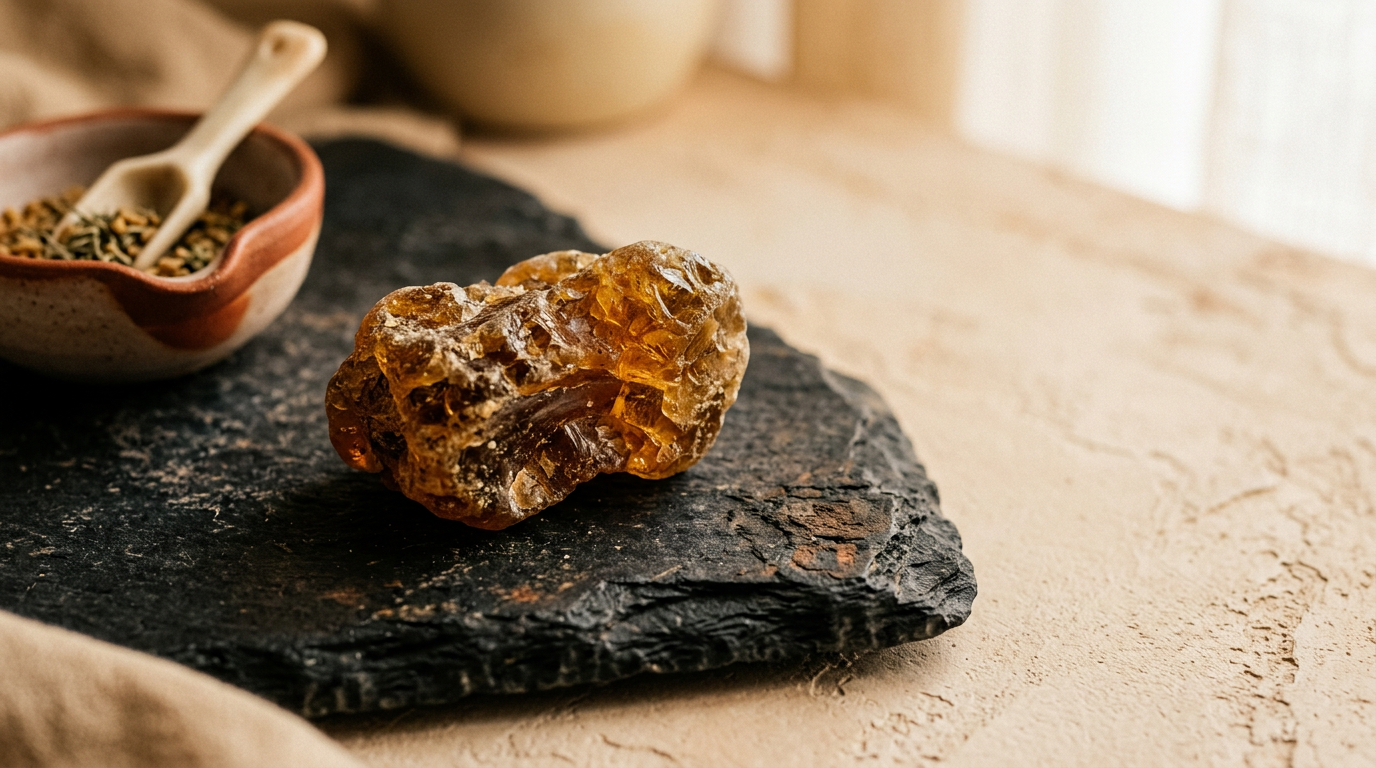
The primary hing asafoetida benefits relate to digestive health, long prized in Ayurveda and now substantiated by clinical research. This potent plant resin, known for its strong sulfurous odor, contains compounds that act as powerful antispasmodics and digestive aids, offering a natural approach to alleviating symptoms like bloating and gas, and supporting overall gut comfort and function.
The Shock and Awe of a Spice
To encounter raw hing (asafoetida) for the first time is a memorable event. Its aroma is not subtle. It’s a potent, unapologetic wave of sulfur, garlic, and something almost animalic. The name itself is a warning: asa is a Latinised form of the Persian word for resin, and foetidus is Latin for “stinking.” It's the reason it's sometimes called “devil’s dung” in English.
This olfactory assault is by design. The Ferula assa-foetida plant, native to the deserts of Iran and mountains of Afghanistan, produces this oleo-gum-resin in its taproot as a defense mechanism. The powerful organosulfur compounds that give hing its characteristic punch are meant to deter herbivores. But for thousands of years, humans have done the opposite: sought it out, traded it across continents, and made it a cornerstone of their cuisine and medicine.
From Ayurvedic Lore to Pharmacological Proof
In Ayurveda, hing is a first-line defense against ailments of Vāta dosha—the principle of air and space associated with movement in the body. An excess of Vāta is said to manifest as bloating, gas, cramping, and constipation. For millennia, Ayurvedic practitioners have recommended a pinch of hing, bloomed in ghee, to pacify these symptoms [1]. It's particularly famous for being added to lentils and beans, foods also known to aggravate Vāta.
This isn't just folklore. Modern pharmacology gives us a clear mechanism for the powerful hing asafoetida benefits. The resin is rich in ferulic acid esters and complex sulfur compounds. These molecules have been shown to have significant antispasmodic and carminative (gas-relieving) properties. Clinical studies demonstrate that extracts of asafoetida can relax the smooth muscle tissue of the intestinal tract, directly counteracting the painful spasms associated with conditions like Irritable Bowel Syndrome (IBS) [2, 3]. It doesn't just mask the symptoms; it works on the underlying physiological mechanism. It's calming the storm in your gut at a cellular level.
Taming the Devil in the Kitchen
The secret to unlocking hing's magic lies in heat. Raw, it's overpowering. But when a tiny amount is fried for a few seconds in hot oil or ghee—a technique known as tadka or tempering—a transformation occurs. The harsh, sulfuric notes mellow and deepen into a savory, umami-rich flavor reminiscent of sautéed onions, leeks, and garlic. It becomes a flavor enhancer, adding a background complexity that you might not be able to name but would certainly miss if it were gone.
This is why it's a staple in the pantries of /region/ind, despite not being native to the subcontinent. Traders have carried it for centuries to the great spice markets like Khari Baoli in Delhi. It's especially vital in Jain and certain Brahminical cuisines, where onions and garlic are eschewed, providing a similar savory depth.
Know Your Hing: The Purity Problem
The leap from potent resin to kitchen staple introduces a critical issue: adulteration. The pure, authentic resin is sticky, expensive, and requires being shaved or crushed before use. To make it more user-friendly, most commercial hing sold is a compounded powder. But what is it compounded with? More often than not, wheat flour.
In a typical UK supermarket, the little yellow plastic tub of hing powder is often mostly filler. This creates problems for those with celiac disease or gluten sensitivity and also dilutes the very compounds responsible for its benefits.
| Feature | Pure Asafoetida Resin | Compounded Hing Powder |
| :--- | :--- | :--- |
| Ingredients | 100% Ferula assa-foetida resin | Asafoetida, wheat/rice flour, gum arabic |
| Potency | Extremely high; a tiny sliver is enough | Low; requires a much larger quantity |
| Gluten-Free| Naturally Yes | Often No (check label for wheat) |
| Best For | Maximum therapeutic benefit, authentic flavor | Convenience, but with compromised purity |
Sourcing pure, gluten-free hing bound with a neutral, plant-based gum (like fenugreek) is a non-negotiable part of our process. It ensures potency, purity, and that the benefits described by science are actually delivered by the product. This is a detail only an insider, or someone truly obsessed with quality, would focus on.
This obsession feels like a necessary corrective. For centuries, the Western palate, shaped in part by colonial-era tastes, has often shied away from the pungent, the fermented, and the powerfully aromatic. Hing, a classic example of a "colonised-food," was relegated to the margins. Its resurgence in wellness conversations today isn't a discovery of something new, but a long-overdue acknowledgment of ancient wisdom that science is finally catching up to.
### FAQ
1. What does hing taste and smell like?
Raw hing has a very strong, pungent smell similar to garlic and sulfur. When cooked in hot oil or ghee, the smell mellows into a savory, umami flavor reminiscent of cooked leeks or onions.
2. Why is hing used in cooking?
Hing is used for both its unique savory flavor and its digestive properties. It is famously added to lentil and bean dishes to make them more digestible and reduce gas and bloating.
3. Is all hing gluten-free?
No. Pure asafoetida resin is naturally gluten-free. However, most commercial hing powders are compounded with wheat flour to prevent caking and make them easier to use. Always check the label if you are avoiding gluten.
4. Can I use hing as a substitute for onion and garlic?
Yes. Hing is an excellent substitute for onion and garlic, especially for those following a low-FODMAP diet or for religious/cultural reasons. A small pinch, bloomed in oil, provides a similar savory depth.
Sources & citations
- Amalraj, A., & Gopi, S. (2017). Biological activities and medicinal properties of Asafoetida: A review. Journal of Traditional and Complementary Medicine, 7(3), 347–359. https://www.ncbi.nlm.nih.gov/pmc/articles/PMC5506628/
- Fatehi, M., Farifteh, F., & Fatehi-Hassanabad, Z. (2004). Antispasmodic and hypotensive effect of Ferula asafoetida gum extract. Journal of Ethnopharmacology, 91(2-3), 321–324. https://pubmed.ncbi.nlm.nih.gov/
- Gholamnezhad, Z., Shakeri, F., Saeidi, J., & Ghorani, V. (2019). Pharmacological and therapeutic effects of Ferula assa-foetida-A review. Journal of Pharmacopuncture, 22(2), 52–59. https://www.ncbi.nlm.nih.gov/pmc/articles/PMC6617081/
- “Asafoetida.” Encyclopædia Britannica. https://www.britannica.com/plant/asafoetida