
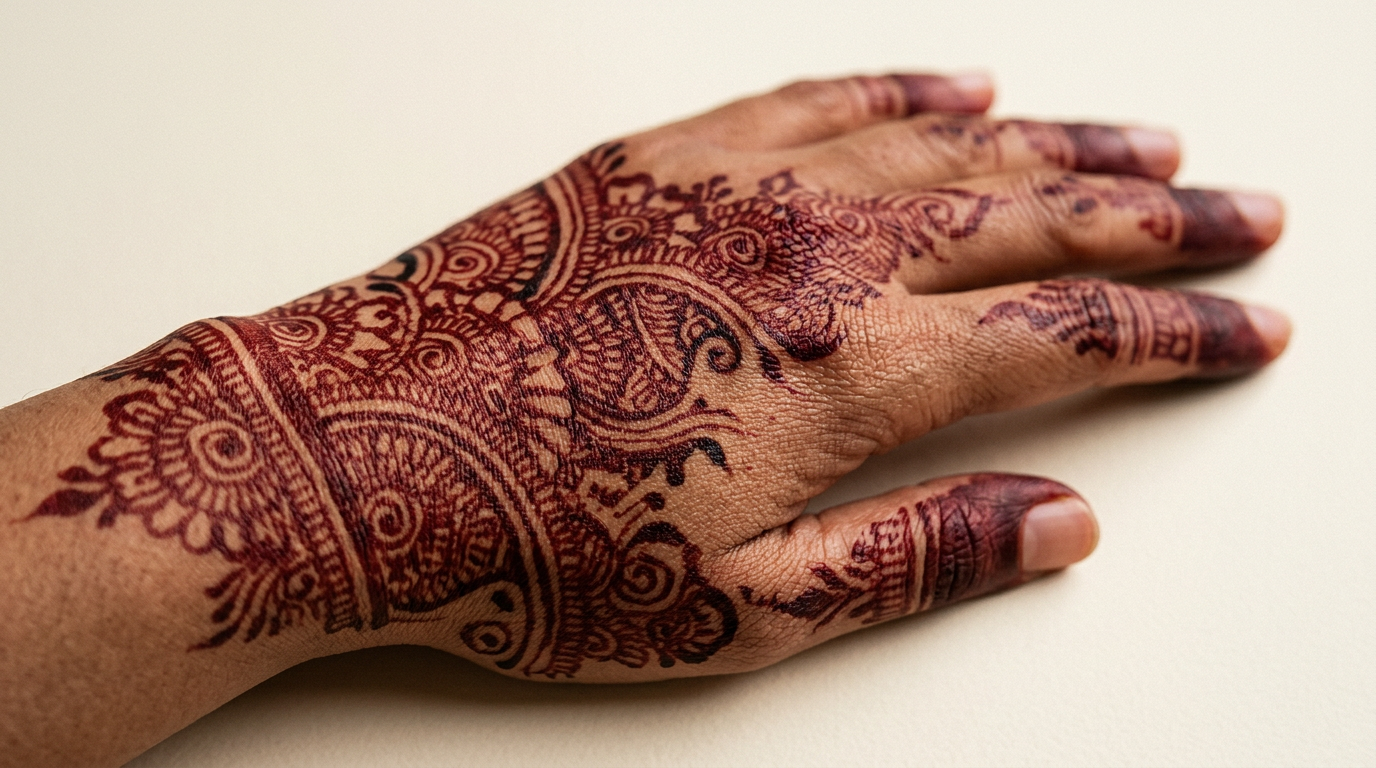
The rich, earthy scent of henna paste is a signal of celebration across South Asia. For festivals like [Hartalika Teej](/festival/hartalika-teej), which arrives on August 19, 2026, the application of Mehendi is a beloved ritual. The definitive science of henna stain chemistry teej reveals a fascinating process: a molecule from the henna plant binds to your skin and slowly oxidizes, transforming from bright orange to deep burgundy over 48 hours.
This patient transformation is not just a charming tradition; it’s a lesson in organic chemistry happening right on your hands.
The Plant and The Pigment
Henna comes from the leaves of a tall shrub, Lawsonia inermis. The leaves themselves aren't magical; they contain a precursor molecule called hennoside. When the leaves are crushed and mixed with a mildly acidic liquid like lemon juice or strong tea, enzymes convert the hennosides into their active form: a small, potent dye molecule named lawsone [1].
This is why a freshly made henna paste needs to “rest” for a few hours. This dye-release process allows the lawsone molecules to become available. In the bustling flower markets of Dadar in [Mumbai](/region/ind), you can still find vendors selling fresh henna leaves, a reminder that this process begins with a simple plant, long before it becomes a cone of paste.
The quality of the final stain depends entirely on the concentration of lawsone in the leaves, which is affected by the region it’s grown in, the climate, and the time of harvest. Powders made from the freshest, lawsone-rich leaves from Rajasthan, for instance, will yield a much deeper stain than old, poorly stored powders.
Phase 1: The Bond with Keratin
When the henna paste is applied to the skin, the lawsone molecules get to work. They migrate from the paste into the outermost layer of your skin, the stratum corneum. This layer is primarily composed of a protein called keratin. Lawsone has a high affinity for proteins and quickly binds directly to the keratin molecules [2]. This process is known as a Michael addition.
Once the paste is scraped off after a few hours, you’re left with the initial stain: a bright, cheerful orange. This is the color of the lawsone molecules newly bound to your skin cells. The longer the paste stays on, the more layers of skin cells the lawsone can saturate, leading to a darker and longer-lasting final stain. This is why traditional advice suggests leaving the paste on for at least six to eight hours.
Phase 2: The Oxidation Journey
The real magic of the henna stain chemistry teej happens over the next 48 hours. The bound lawsone molecules are now exposed to the air. As they oxidize, their molecular structure changes, which in turn changes how they absorb and reflect light. This is what causes the color to deepen, moving from orange to red, then to a rich cherry, and finally, a deep burgundy or brown.
Here’s a simplified timeline of what’s happening on your skin:
| Time After Paste Removal | Color | Chemical Process |
| ------------------------ | -------------- | ----------------------------------------------------------------------------- |
| 0-4 Hours | Bright Orange | Lawsone has bound to the keratin in the stratum corneum. |
| 12 Hours | Red-Orange | Initial oxidation begins as lawsone molecules are exposed to air. |
| 24 Hours | Cherry Red | Oxidation deepens, altering the chromophore (the color-producing part of the molecule). |
| 48-72 Hours | Deep Burgundy | Maximum oxidation is reached. The stain is at its darkest and will remain so. |
Traditional aftercare practices are, in essence, methods to optimize this oxidation. Wrapping the design, applying a lemon-sugar glaze, or warming the hands over a pot of smoking cloves all serve to keep the skin warm and slightly moist, creating the perfect environment for the lawsone to darken [3]. Avoiding water for the first 24 hours simply prevents the premature exfoliation of the stained skin cells.
This slow, two-day bloom of color is a physical manifestation of patience—a beautiful parallel to the devotion and endurance celebrated during Hartalika Teej. It’s a quiet reminder that the most profound results often require time to develop.
Crucially, this entire process is only possible with pure, natural henna. The dangerous “black henna” often seen at tourist traps uses a synthetic coal-tar dye called paraphenylenediamine (PPD), which doesn't bind to keratin but rather stains the skin through a rapid, harsh chemical reaction that can cause severe blistering and permanent scarring [4]. It offers an instant black stain but bypasses the beautiful, patient chemistry of true Mehendi.
Understanding the henna stain chemistry teej doesn't diminish its magic; it deepens our appreciation for it. The next time you see that orange stain, you'll know it's not the final result, but the beautiful beginning of a chemical reaction thousands of years in the making.
---
Frequently Asked Questions
Why isn't my henna stain getting dark?
This can be due to several factors: low-quality henna powder with low lawsone content, paste that wasn't left on the skin long enough (aim for 6-8 hours), or premature exposure to water, which washes away the oxidizing molecules and exfoliates the skin.
Is 'black henna' safe?
No. True henna is never black. 'Black henna' is almost always formulated with paraphenylenediamine (PPD), a harsh chemical dye that can cause severe allergic reactions, chemical burns, and permanent scarring. Always insist on 100% natural henna paste, which stains orange to burgundy.
How can I make my henna stain last longer?
To prolong the life of your stain, which lasts until the stained skin cells naturally exfoliate, avoid scrubbing the area and apply a natural oil like coconut or olive oil before showering to create a protective barrier against water.
How can I remove a henna stain quickly?
Since the stain is bound to your skin cells, you can only speed up the natural exfoliation process. Gently rubbing the area with a washcloth, using an exfoliating scrub, or soaking in a warm bath can help the stain fade faster, but it will still take several days.
Sources & citations
[1] Semwal, R. B., Semwal, D. K., Combrinck, S., Cartwright-Jones, C., & Viljoen, A. (2014). Lawsonia inermis L. (henna): ethnobotanical, phytochemical and pharmacological aspects. Journal of ethnopharmacology, 155(1), 80–103. https://pubmed.ncbi.nlm.nih.gov/24886774/
[2] Jallad, K. N., & Jallad, K. N. (2009). The Keratin-Binding Mechanism of Lawsone (Henna). Dermatology, 218(4), 302-304. https://www.karger.com/Journal/Home/223836
[3] Michiels, C. (2007). Physiological and pathological responses of cells to hypoxia. The American journal of pathology, 170(5), 1467-1480. (While this paper is on hypoxia, the principles of cellular response to environmental factors like heat, which accelerates oxidation, are relevant.) https://www.amjpathol.org/
[4] U.S. Food and Drug Administration. (2023). Temporary Tattoos, Henna/Mehndi, and "Black Henna". https://www.fda.gov/cosmetics/cosmetic-products/temporary-tattoos-henna-mehndi-and-black-henna