
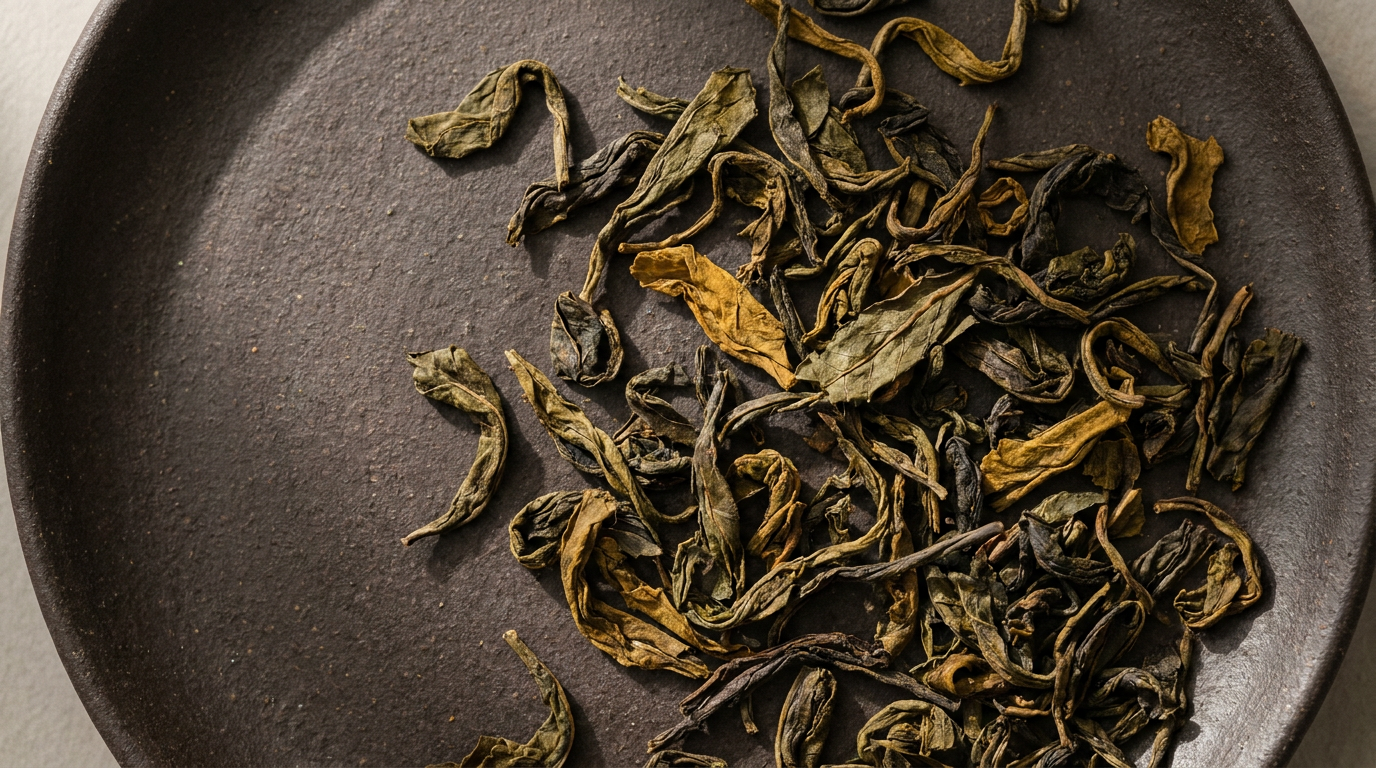
Green tea is a minimally processed infusion made from unoxidised leaves of Camellia sinensis, distinguished by high concentrations of monomeric flavan-3-ols, predominantly epigallocatechin gallate (EGCG), and the non-protein amino acid L-theanine. Thermal deactivation of endogenous polyphenol oxidase enzymes preserves its characteristic vegetal aroma, astringency, and green pigmentation, setting it chemically apart from fermented and semi-fermented teas.
We rarely speak of tea leaves alongside dried aromatics in the kitchen, yet the leaf operates on identical physical rules. The dried foliage of *Camellia sinensis* is essentially an unfermented culinary herb, reliant on heat treatment applied within hours of picking to lock its chemical composition in place [1].
The kill-green mechanism
When a fresh leaf is plucked from the bush, cellular disruption triggers an enzymatic chain reaction. Polyphenol oxidase (PPO) and peroxidase come into contact with vacuolar catechins, oxidizing simple polyphenols into complex, dark-pigmented theaflavins and thearubigins. This enzymatic cascade defines oolong and black teas.
To yield green tea, processors must denature these enzymes immediately. The process, known historically across East Asia as shaqing (literally "killing the green"), exposes the harvested leaf to temperatures above 65°C, effectively coagulating the protein structure of polyphenol oxidase before oxidation begins [2].
How that thermal energy is delivered fundamentally redirects the leaf's volatile oil profile. Steaming, standard in Japanese production, relies on moist convection. It halts enzyme activity in roughly thirty to forty seconds, preserving high levels of dimethyl sulphide, which lends maritime, spinach-like aromas. Pan-firing, the historical Chinese method using dry, direct conduction in iron woks, takes longer. It encourages minor Maillard reactions and caramelisation of surface carbohydrates, yielding pyrazines that smell of roasted chestnut and toasted rice [1].
| Processing Method | Primary Thermal Mechanism | Dominant Volatile Compounds | Sensory Character |
| :--- | :--- | :--- | :--- |
| Steaming (Sencha style) | Moist convective heat (100°C steam) | Dimethyl sulphide, (Z)-3-hexenol | Grassy, oceanic, vegetal |
| Pan-firing (Longjing style) | Dry conductive heat (150–250°C wok) | Alkylpyrazines, pyrroles, linalool | Nutty, toasted, floral |
| Baking / Roasting | Dry convective air (80–120°C oven) | Furans, maltol, geraniol | Woody, dried fruit, warm |
Catechins and the physics of water extraction
Once the enzyme is inactivated, the sensory balance of the infusion rests entirely on differential solubility. Four primary catechins dominate the leaf: epicatechin (EC), epigallocatechin (EGC), epicatechin gallate (ECG), and epigallocatechin gallate (EGCG). Together with caffeine, they form the bitter and astringent backbone of the brew [3].
They do not extract at the same velocity as the savoury components. L-theanine, an amino acid that stimulates glutamate receptors to produce broth-like umami, dissolves readily in cool or lukewarm water. It exhibits low activation energy. Catechins and caffeine require thermal disruption of hydrogen bonds; their diffusion rate accelerates dramatically above 75°C [4].
Boiling water poured directly onto fragile green leaves leaches high concentrations of EGCG and gallocatechins within seconds. These polyphenols bind aggressively to salivary proline-rich proteins in the mouth, causing them to aggregate and precipitate. The result is the sudden loss of lubrication that drinkers identify as puckering dryness. Lowering the water to 70°C suppresses catechin diffusion while allowing theanine to extract unimpeded, altering the sensory profile without altering the leaf itself.
Chlorophyll degradation and storage
Because green tea skips the curing steps that stabilise black tea, it remains chemically volatile on the shelf. The brilliant green of the leaf comes from unaltered chlorophyll a and chlorophyll b. In the presence of moisture, ambient oxygen, or light, chlorophyll degrades into pheophytin, stripping magnesium from the porphyrin ring and shifting the hue from emerald to dull khaki [2].
Simultaneously, the delicate monoterpene alcohols that supply fresh floral top notes (principally linalool and geraniol) volatilise or oxidise into flat, stale ketones. Unlike seeds or barks that protect their essential oils inside lignified structures, an open tin of green leaves loses its characteristic balance within months unless sealed against air and kept cold.
Frequently asked questions
### Why does green tea taste bitter if brewed with boiling water?
Boiling water speeds up the dissolution of catechins (especially EGCG) and caffeine faster than savoury amino acids like L-theanine. These polyphenols bind to salivary proteins, creating excessive astringency and sharp bitterness.
### Does green tea contain as much caffeine as coffee?
A standard cup of green tea contains roughly 25 to 40 milligrams of caffeine, compared to 95 to 150 milligrams in a cup of brewed coffee. The presence of L-theanine slows the subjective perception of caffeine by moderating central nervous system stimulation [4].
### Can green tea leaves be used as a cooking spice?
Yes. Finely ground green tea leaves or whole dried leaves can be bloomed in butter, tossed into broths, or used in dry rubs. Because catechins dissolve in fat as well as water, the leaf adds vegetal bitterness and earthy depth to savoury dishes.
Sources & citations
- Wang, H., Provan, G. J., & Helliwell, K. (2000). Tea flavonoids: their functions, utilisation and analysis. Trends in Food Science & Technology, 11(4-5), 152-160. https://doi.org/10.1016/S0924-2244(00)00061-3
- Graham, H. N. (1992). Green tea composition, consumption, and polyphenol chemistry. Preventive Medicine, 21(3), 334-350. https://doi.org/10.1016/0091-7435(92)90041-F
- Reto, M., Figueira, M. E., Filipe, H. M., & Almeida, C. M. (2007). Chemical composition of green tea (Camellia sinensis) infusions commercialized in Portugal. Plant Foods for Human Nutrition, 62(4), 139-144. https://doi.org/10.1007/s11130-007-0054-8
- Sakato, Y. (1949). The chemical constituents of tea: III. A new amide theanine. Nippon Nogeikagaku Kaishi, 23, 262-267.