
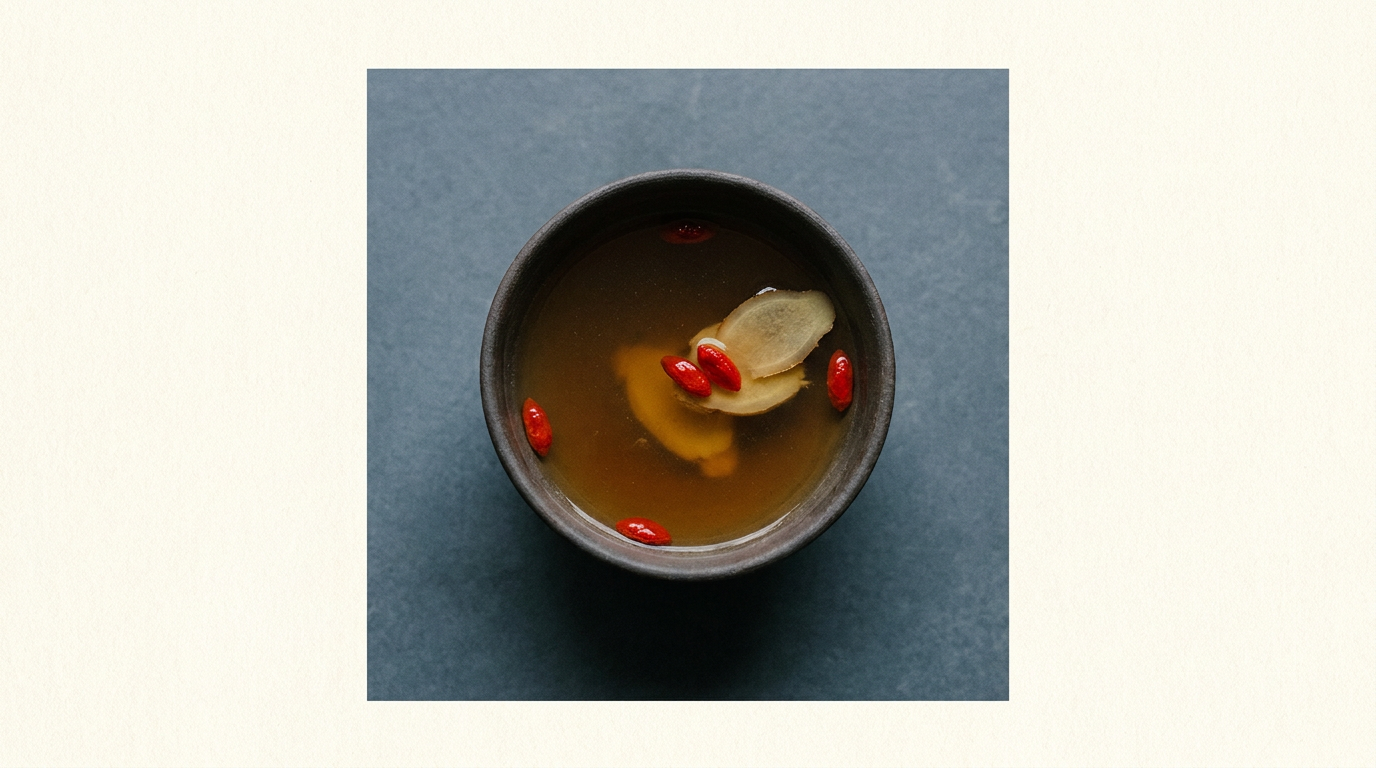
Goji berry soup is a traditional Chinese restorative broth made by simmering dried wolfberries (Lycium barbarum) alongside meats, roots, or mushrooms. Consumed across East Asia to support stamina and ocular health, the preparation leaches water-soluble polysaccharides into the broth while requiring dietary lipids from bone stock to effectively solubilise the berry's dense reserves of zeaxanthin carotenoids.
In Western supermarkets, the goji berry spent the early 2000s stranded in the raw food aisle, sold as an expensive dried chew tucked into granola. In Cantonese and Hakka kitchens, nobody eats them dry by the handful. They are dropped into simmering earthenware pots, soaked in tea, or ladled out of clear stocks. The culinary instinct behind goji berry soup is practical: drying collapses the cell walls of the fruit, but it takes heat and liquid to make its constituent chemistry usable.
The Solanaceae in the soup pot
Lycium barbarum and its close relative Lycium chinense are not mystical forest shrubs; they are nightshades. They share a family with tomatoes, aubergines, and chillies. Like tomatoes, their primary pigments are carotenoids. Unlike tomatoes, where lycopene dominates, the goji berry owes its vivid orange-red hue almost entirely to zeaxanthin, predominantly in the esterified form of zeaxanthin dipalmitate [1].
Dried wolfberries also contain a substantial fraction of water-soluble carbohydrates known as Lycium barbarum polysaccharides (LBPs). These are complex proteoglycans that make up between 5% and 8% of the dried fruit's mass [2]. When modern herbal monographs discuss the berry's immunomodulatory properties or historic claims regarding stamina, these polysaccharides are usually the compounds under laboratory scrutiny.
Yet the two primary chemical factions of the berry behave in opposite ways when cooked. Polysaccharides dissolve readily in hot water. Zeaxanthin, a hydrophobic tetraterpenoid, does not.
Why water needs fat
A herbal tea made solely of goji berries steeped in boiling water will yield a pale orange infusion rich in sugars, betaine, and polysaccharides. It will leave the bulk of the zeaxanthin trapped inside the rehydrated pulp. If you discard the berries, you discard the carotenoids.
Traditional soup bases solve this solubility divide through composite cooking. A classic broth pairs the dried fruit with chicken thighs, pork ribs, or carp head. The animal tissue renders free lipids and collagen into the simmering liquid. Zeaxanthin dissolves into these suspended droplets of fat, forming a micro-emulsion that dramatically increases its bioaccessibility in the human gut [3].
| Extraction Method | Primary Compounds Extracted | Absorption Limiting Factor |
| :--- | :--- | :--- |
| Raw dried snacking | Minor free sugars, unextracted pulp | Mechanical mastication; dense pectin wall |
| Clear water infusion (tea) | Water-soluble polysaccharides, betaine | Zero lipid phase; carotenoids remain in discarded berry |
| Slow simmer with fatty broth | Polysaccharides, betaine, and lipid-solubilised zeaxanthin | Thermal degradation if boiled vigorously for hours |
Centuries of domestic cooks did not require a chromatograph to observe that a chicken broth turned faintly golden when goji berries were simmered with it, whereas a sugar syrup did not. The fat acts as a vehicle for the pigment.
Retinal pigment and the liver-kidney axis
Traditional Chinese medicine classifies the wolfberry as sweet and neutral, traditionally directed toward the liver and kidney meridians to nourish blood and brighten the eyes (ming mu). It is one of the few instances where historical therapeutic vocabulary maps neatly onto contemporary ophthalmology.
Zeaxanthin, along with lutein, is one of only two carotenoids that selectively accumulate in the human macula lutea—the central region of the retina responsible for high-acuity vision [1]. The human body cannot synthesise zeaxanthin de novo; it must be ingested. Once absorbed, it acts as a passive blue-light filter and an antioxidant within retinal tissue, mitigating photo-oxidative damage.
Clinical trials have demonstrated that daily consumption of small amounts of Lycium barbarum significantly increases fasting serum zeaxanthin levels and macular pigment optical density in older adults [4]. It does not cure refractive errors or restore lost sight, but it does reliably supply the exact structural pigment the central retina uses to defend itself against oxidative stress.
The mechanics of the pot
Treating goji berries like bay leaves—tossing them into a pot at minute zero and letting them boil aggressively for three hours—is a culinary mistake. While the polysaccharides withstand extended heat, carotenoids isomerise and degrade under prolonged, vigorous aeration at high temperatures.
Beyond the chemistry, overcooked wolfberries burst, turning the flesh to acidulated mush and releasing astringent tannins from the internal seeds into the broth. The skin collapses into stringy fragments, and the clean sweetness of the soup curdles into a sour, metallic register.
In home kitchens, dried goji berries should be rinsed in cold water to clear surface dust, then added to the broth during the final fifteen to twenty minutes of gentle simmering. This window provides sufficient thermal energy to hydrate the pericarp, soften the pectin, and allow water-soluble compounds to migrate into the surrounding liquid. The berry stays plump, sweet, and intact. Crucially, the cook should expect the diner to eat the berries from the bottom of the bowl, not push them aside like spent peppercorns.
Frequently asked questions
### Should I soak goji berries before adding them to soup?
A brief rinse under cold running water is sufficient to remove surface impurities. Avoid soaking them in water for extended periods before cooking, as water-soluble polysaccharides and betaine will leach into the soaking water, which is often discarded.
### Can you make goji berry soup without meat?
Yes, but you must introduce an alternative lipid source. A vegetarian soup using dried mushrooms (such as shiitake or snow fungus) should include a splash of toasted sesame oil, camellia oil, or a handful of softened nuts to supply the dietary fat required to absorb the berry's fat-soluble zeaxanthin.
### Why does my goji berry soup taste sour?
Goji berries contain natural fruit acids, including citric acid. If they are boiled vigorously for too long, these acids concentrate and dominate the broth. Sourness can also indicate old berries that have oxidised in storage, or berries treated with excessive sulphur dioxide during the drying process.
Sources & citations
- Bucheli, P., et al. (2011). Goji berry effects on macular characteristics and plasma antioxidant levels. Investigative Ophthalmology & Visual Science, 52(10), 7274–7281.
- Potterat, O. (2010). Goji (Lycium barbarum and L. chinense): Phytochemistry, pharmacology and safety in the perspective of traditional uses and recent popularity. Planta Medica, 76(1), 7–19.
- Borel, P. (2003). Factors affecting intestinal absorption of highly lipophilic food microconstituents (fat-soluble vitamins and carotenoids). Current Opinion in Clinical Nutrition & Metabolic Care, 6(5), 519–524.
- Cheng, C. Y., et al. (2005). Fasting plasma zeaxanthin response to Fructus barbarum L. (wolfberry; kei tze) in a food-based human supplementation study. British Journal of Nutrition, 93(1), 123–130.