
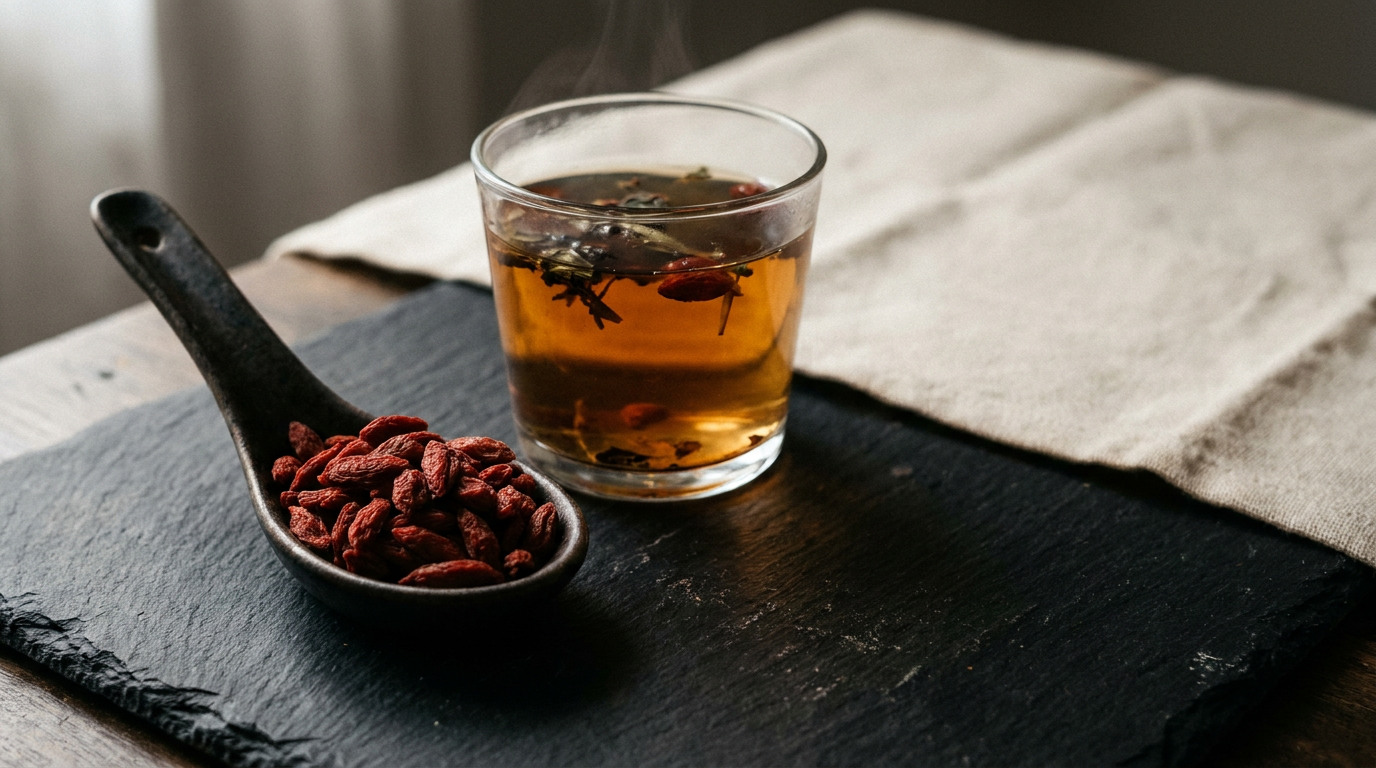
Goji berries (Lycium barbarum) offer genuine clinical value for ocular health, driven by exceptionally high concentrations of zeaxanthin dipalmitate, a macular pigment precursor. However, broader claims attributing longevity, metabolic renewal, and daily tonic vitality to their specific polysaccharides rest almost entirely on rodent models and small, short-term trials rather than established human physiology [1].
For two decades, dried goji berries have occupied a strange double life. In North American and European health food aisles, marketers renamed gouqizi an exotic superfood, charging steep markups to scatter it over breakfast porridge. In China, where the plant has grown along the yellow silt banks of Ningxia for centuries, cooks drop a tablespoon into slow-simmered chicken soup or steep them alongside chrysanthemum flowers. It was never an isolated therapeutic silver bullet. It was a sweet, slightly astringent dried fruit that belonged to the kitchen as much as the pharmacy.
Stripping away the lifestyle branding leaves two distinct chemical complexes: zeaxanthin and Lycium barbarum polysaccharides. One holds up remarkably well under clinical scrutiny. The other has been asked to carry far more weight than the data supports.
The macular argument holds
The clearest clinical case for eating goji berries centres on the retina. The human eye concentrates two specific dietary carotenoids in the macula lutea: lutein and zeaxanthin. These pigments absorb damaging high-energy blue light and scavenge local reactive oxygen species. Without them, the risk of age-related macular degeneration rises sharply.
Most plant foods rich in zeaxanthin, such as sweet corn or orange peppers, contain the carotenoid in its free form. Goji berries package zeaxanthin primarily as a dipalmitate ester. While esterified carotenoids require enzymatic cleavage during digestion, the lipid matrix of the dried berry appears to assist absorption rather than hinder it.
In a randomised trial conducted at the University of California, Davis, healthy adults aged 45 to 65 consumed 28 grams of dried goji berries five times per week for 90 days [2]. The control group took a commercial lutein and zeaxanthin supplement. The researchers measured macular pigment optical density (MPOD) and skin carotenoids. In the goji group, macular pigment optical density increased significantly over the trial period, whereas the supplement group showed no statistically significant change. A modest portion of whole, dried berries demonstrably fed the tissue it was supposed to reach.
| Source | Zeaxanthin form | Primary carotenoid profile | Practical cooking role |
| :--- | :--- | :--- | :--- |
| Goji berry | Zeaxanthin dipalmitate | Zeaxanthin (predominant) | Infused in broths, teas, stews |
| Egg yolk | Free zeaxanthin | Balanced lutein and zeaxanthin | Emulsions, whole cooked eggs |
| Sweet corn | Free zeaxanthin | Zeaxanthin and cryptoxanthin | Grain dishes, roasted vegetables |
| Kale | Free carotenoids | Lutein (minimal zeaxanthin) | Braised greens, sautés |
The polysaccharide problem
Where the narrative unravels is in the claim of systemic tonic vitality. Wellness literature attributes energy, immune resilience, and metabolic balance to Lycium barbarum polysaccharides (LBPs). These are complex, highly branched glycoconjugates containing arabinose, galactose, glucose, and rhamnose.
In cell cultures, isolated LBPs exhibit neat biological activities. They stimulate murine splenocytes, reduce oxidative markers in isolated liver tissue, and prompt glucose uptake in diabetic rat models [3]. But a petri dish is not a person. When a human eats dried goji berries, complex polysaccharides do not pass intact into the bloodstream to instruct immune cells. They encounter human digestive enzymes, which cannot break down many of these beta-glycosidic bonds, and arrive in the colon.
There, LBPs act like any other fermentable dietary fiber: they feed gut microbes, which ferment them into short-chain fatty acids such as acetate and butyrate. That is a useful metabolic process, but it is not unique to goji berries. Leeks, oats, and chicory root achieve identical microbial outcomes at a fraction of the cost. The clinical trials claiming that goji juice enhances general well-being or athletic endurance in humans rely almost entirely on subjective questionnaires, small cohorts, and commercial funding [4].
The practical pharmacology of the berry
Goji berries belong to the Solanaceae family, sitting alongside tomatoes, aubergines, and chillies. They are not inert confections. Their pharmacological activity is sufficient to cause documented herb-drug interactions.
Multiple published case reports document significant interactions between Lycium barbarum and warfarin, a common anticoagulant [5]. Compounds within the berry appear to inhibit the cytochrome P450 enzyme CYP2C9, which metabolises warfarin. The result is an unexpected elevation of international normalised ratio (INR) values and an increased risk of bleeding. Anyone using blood-thinning medication should treat daily goji berry consumption with the same caution they would give to grapefruit.
For everyone else, the dried berry is best treated as food rather than medicine. Eating them dry out of a plastic pouch offers a leathery, jaw-tiring chew. Rehydrating them in boiling water or simmering them in a savoury broth softens the tough skin, releases the natural sugars, and allows the fat-soluble carotenoids to dissolve into whatever cooking oil or animal fat is present in the pot. It turns out that traditional Chinese culinary technique was already solving the bioavailability question long before anyone ran a clinical trial.
Frequently asked questions
### How many goji berries are required to see an effect on eye health?
Clinical trials demonstrating measurable improvements in macular pigment optical density generally use roughly 28 grams per day, eaten four to five times weekly over two to three months [2]. This equates to approximately one standard small handful.
### Are goji berries better for vision than carrots?
Carrots provide beta-carotene, which the human body converts into vitamin A. Goji berries provide zeaxanthin, which concentrates directly in the central macula to filter blue light. They serve different physiological functions in ocular health, meaning one does not replace the other.
### Do goji berries lose their nutrients when boiled in soup?
Zeaxanthin is relatively heat-stable, and because carotenoids are fat-soluble, simmering dried goji berries in a broth that contains culinary fats actually improves the absorption of the pigment compared to chewing dry berries raw.
### Can goji berries interact with prescription medications?
Yes. Goji berries can inhibit the liver enzyme CYP2C9, significantly amplifying the anticoagulant effect of warfarin. Individuals taking prescription blood thinners or certain diabetic medications should consult a physician before consuming them daily.
Sources & citations
- Potterat, O. (2010). Goji (Lycium barbarum and L. chinense): Phytochemistry, pharmacology and safety in the perspective of traditional uses and recent popularity. Planta Medica, 76(1), 7–19. https://doi.org/10.1055/s-0029-1186218
- Li, X., Holt, R. R., Keen, C. L., Morse, L. S., Yiu, G., & Hackman, R. M. (2021). Goji Berry Intake Increases Macular Pigment Optical Density in Healthy Adults: A Randomized Pilot Trial. Nutrients, 13(12), 4409. https://doi.org/10.3390/nu13124409
- Cheng, J., Zhou, Z. W., Sheng, H. P., He, L. J., Fan, X. W., He, Z. X., Sun, T., Shan, X. C., & Zhou, S. F. (2015). An evidence-based update on the pharmacological activities and possible molecular targets of Lycium barbarum polysaccharides. Drug Design, Development and Therapy, 9, 33–78. https://doi.org/10.2147/DDDT.S72892
- Amagase, H., & Nance, D. M. (2008). A randomized, double-blind, placebo-controlled, clinical study of the general effects of a standardized Lycium barbarum (Goji) juice, GoChi. Journal of Alternative and Complementary Medicine, 14(4), 403–412. https://doi.org/10.1089/acm.2008.0004
- Rivera, C. A., Ferro, C. L., Bursua, A. J., & Gerber, B. S. (2012). Probable interaction between Lycium barbarum (goji berry) and warfarin. Pharmacotherapy, 32(3), e50–e53. https://doi.org/10.1002/j.1875-9114.2012.01018.x