
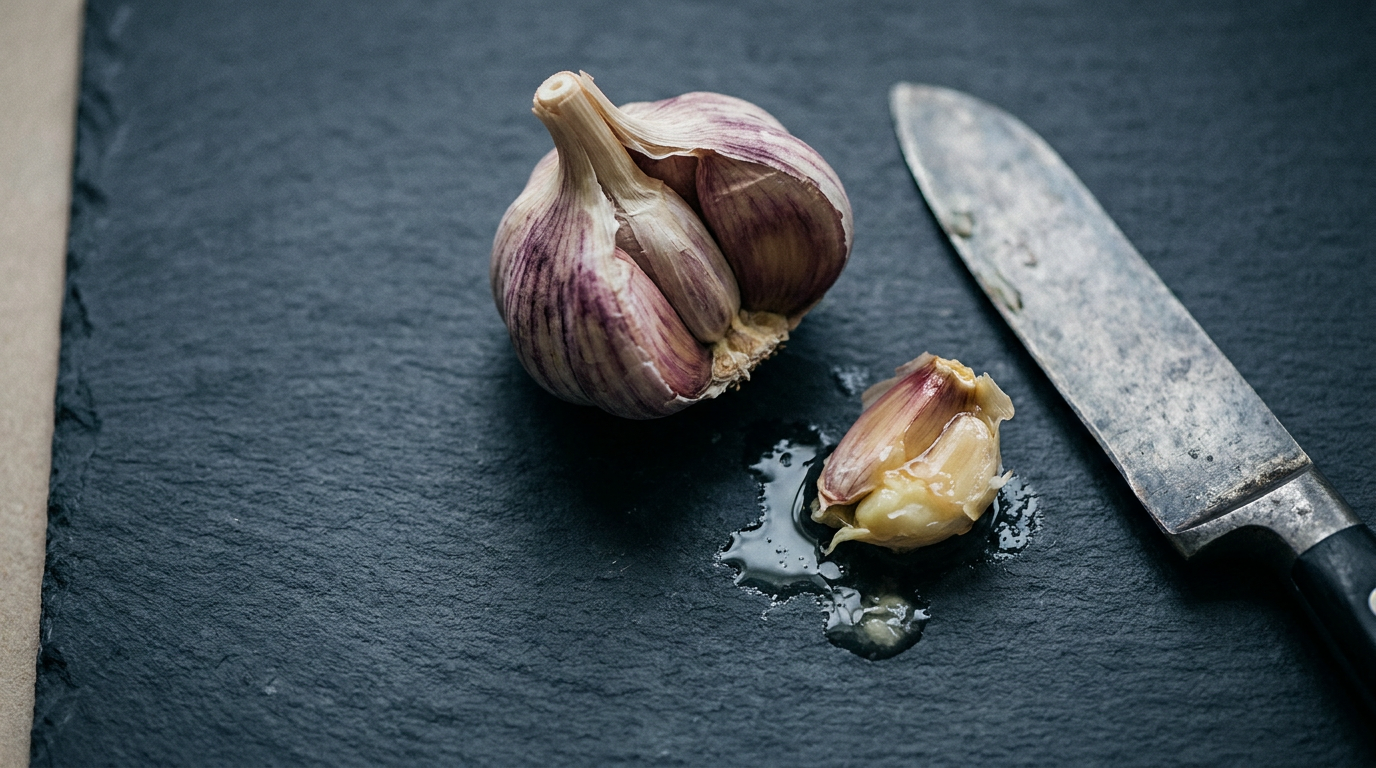
Garlic (Allium sativum) is a bulbous perennial of the amaryllis family whose culinary pungency and defensive chemistry depend entirely on mechanical rupture. Intact cloves contain alliin and the enzyme alliinase in separate cellular compartments. When crushed or sliced, these mix to synthesise allicin, an unstable sulfur compound that breaks down into the volatile sulfides responsible for garlic's characteristic bite and aroma [1].
The cellular tripwire
An uncut clove of garlic smells of very little. You can hold a peeled clove to your nose and register nothing more aggressive than damp earth and mild vegetation. This is deliberate. For the plant, the pungent sulfur compounds we prize in the kitchen are not standing perfume; they are a rapid-response chemical defence system against subterranean herbivores, nematodes, and fungal pathogens [1].
Inside an intact clove, the non-protein amino acid (+)-S-allyl-L-cysteine sulfoxide (known commonly as alliin) sits quietly in the cytoplasm of storage cells. In adjacent vascular sheath cells, vacuum-sealed away in vacuoles, resides alliinase, a pyridoxal-phosphate-dependent glycoprotein enzyme [2]. As long as the clove remains undamaged, the two never meet.
Cut, crush, or chew the tissue, however, and the cellular walls collapse. Alliinase binds to alliin almost instantaneously. Within seconds, it cleaves alliin into allylsulfenic acid, which spontaneously condenses into diallyl thiosulfinate—allicin [2]. Allicin is what gives freshly crushed raw garlic its sharp, tear-inducing heat. It is also remarkably volatile and chemically restless. It begins degrading the moment it forms, transforming through ambient temperature into a cascade of secondary polysulfides, including diallyl disulfide and diallyl trisulfide [3].
How you mechanically damage the clove dictates the exact balance of these compounds. Microplane grating causes catastrophic cellular shearing, bringing nearly every unit of alliin into contact with alliinase. The result is maximum allicin production and an aggressive, biting heat. Slicing with a sharp knife severs far fewer cells, yielding a milder, cleaner profile. Leaving a clove whole and crushing it lightly with the flat of a blade releases just enough volatile chemistry to infuse warm oil without overwhelming it.
The ten-minute rest and the thermal trap
In standard kitchen practice, cooks frequently undermine garlic's biochemistry within thirty seconds of peeling it. Alliinase is an enzyme, which means it is a protein, and proteins denature under heat. At temperatures above 60°C, alliinase rapidly unfolds and loses its catalytic function [2].
If you drop freshly sliced garlic immediately into sizzling fat, heat reaches the interior of the slivers before alliinase has completed its reaction with alliin. The enzyme dies prematurely. The alliin that has not yet converted remains inert, and the potential yield of allicin collapses [1].
To preserve the full aromatic and physiological profile of garlic, culinary chemists recommend letting chopped or crushed garlic sit on the board for ten minutes before introducing it to heat. This rest window gives alliinase sufficient time to convert the available alliin into allicin. Once allicin is formed, it is relatively heat-tolerant; cooking will break it down into complex, savoury polysulfides rather than silencing it altogether [3].
There is a second hazard in the pan: scorching. Garlic is not an onion. While both are alliums, garlic bulbs contain up to 80% dry matter composed of non-structural carbohydrates, predominantly fructans (fructose polymers) [4]. These long chains of sugars caramelise and then burn at comparatively low temperatures. When garlic turns dark brown in oil, those sugars char, producing bitter, acrid pyrazines that overpower any remaining sulfur aromatics. Garlic needs gentle, moderated fat, not a smoking skillet.
Four states of sulfur
Thermal treatment reorganises garlic's volatile profile entirely. What begins as a reactive antimicrobial shield becomes something rounded, sweet, or fermented depending on the vector of heat and water.
| Preparation | Enzyme State | Dominant Sulfur Compounds | Sensory Profile |
| :--- | :--- | :--- | :--- |
| Raw, finely grated | Peak alliinase activity; complete conversion | Allicin, diallyl sulfide, diallyl disulfide | Sharp, pungent, lingering burn; direct lachrymatory heat |
| Sweated in oil | Alliinase denatured; allicin degraded | Diallyl disulfide, diallyl trisulfide, vinyldithiins | Savoury, warm, rounded allium notes; diminished sharpness |
| Roasted whole bulb | Alliinase deactivated internally before rupture | Trace allicin; intact alliin; degraded fructans | Sweet, mellow, nutty; Maillard derivatives and free fructose |
| Black garlic (aged) | Inactive; prolonged low-heat Maillard reaction | S-allyl-cysteine (SAC), 5-hydroxymethylfurfural | Molasses, tamarind, balsam; zero pungency; high water-soluble antioxidants |
Whole roasted garlic bypasses allicin synthesis almost completely. Because the clove cooks inside its skin before its cells are crushed, heat denatures the alliinase while alliin remains sequestered. Simultaneously, prolonged moderate heat hydrolyses the complex fructan chains into free fructose [4]. The bulb transforms into a soft, spreadable paste characterised by caramelised sweetness rather than sulfurous heat.
Black garlic takes this structural reorganisation further. It is not fermented by microbes, despite common assertion; it is aged under controlled humidity (70–90%) and constant low heat (60–85°C) over several weeks [4]. The enzymatic pathways are silent. Instead, slow, non-enzymatic browning (the Maillard reaction) breaks down the sugars and amino acids, converting volatile, pungent sulfides into stable, water-soluble organosulfur molecules such as S-allyl-cysteine [4].
Understanding garlic means respecting this mechanical boundary. If you want pungency, smash the cell walls and wait. If you want depth without the sting, keep the clove intact until heat has quietly defused the tripwire.
Frequently asked questions
### Why does garlic sometimes turn bright green or blue in acidic liquids?
When garlic is chopped and exposed to mild acid (such as vinegar or lemon juice), cell rupture allows amino acids to react with sulfur compounds in the presence of trace copper or iron, producing pyrrole pigments. Multipyrrole complexes form blue and green colours. It is completely safe to eat and does not indicate spoilage.
### Does garlic powder contain allicin?
Garlic powder contains alliin and preserved, dehydrated alliinase, but no active allicin until moisture is introduced. When rehydrated in cold or lukewarm water, the enzyme activates and allicin forms. If added directly to a boiling pot or hot oil, the heat deactivates the enzyme before it can synthesise allicin, producing a much flatter, cooked-garlic flavour.
### Is the green germ inside an older garlic clove toxic or bitter?
The green sprout (germ) inside stored garlic is not toxic. As the clove expends stored energy to grow, the sprout develops higher concentrations of certain volatile compounds, which can taste astringent and grassy when raw. For slow-cooked dishes, leaving the germ in makes little difference, but for raw preparations like aioli or pesto, removing it yields a cleaner flavour.
Sources & citations
- Block, E. (1985). The chemistry of garlic and onions. Scientific American, 252(3), 114–119. https://doi.org/10.1038/scientificamerican0385-114
- Borlinghaus, J., Albrecht, F., Gruhlke, M. C., Nwachukwu, I. D., & Slusarenko, A. J. (2014). The versatile chemistry of allicin: a natural anti-microbial substance from garlic. Molecules, 19(8), 12591–12618. https://doi.org/10.3390/molecules190812591
- Cavallito, C. J., & Bailey, J. H. (1944). Allicin, the antibacterial principle of Allium sativum. I. Isolation, physical properties and antibacterial action. Journal of the American Chemical Society, 66(11), 1950–1951. https://doi.org/10.1021/ja01239a048
- Kimura, S., Tung, Y. C., Pan, M. H., Su, N. W., Lai, Y. J., & Cheng, K. C. (2017). Black garlic: A critical review of its production, bioactivity, and application. Journal of Food and Drug Analysis, 25(1), 62–70. https://doi.org/10.1016/j.jfda.2016.11.003