
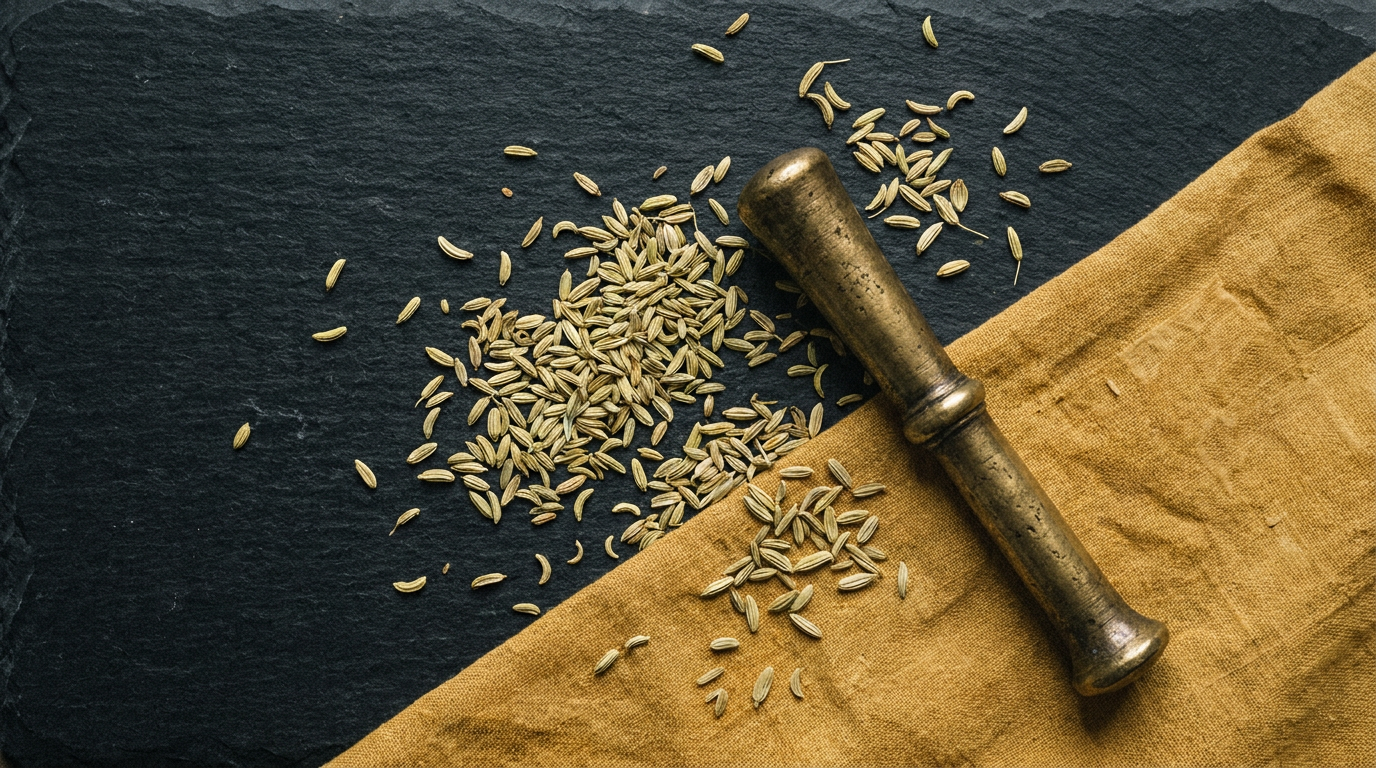
Fennel (Foeniculum vulgare) is an aromatic flowering herb in the carrot family (Apiaceae) whose dried schizocarp fruits, commonly called seeds, provide a sweet, liquorice-like flavour. This distinctive sensory profile is driven primarily by trans-anethole, balanced by the herbal sharpness of estragole and the cooling, bitter camphor of fenchone, distinguishing it from related botanicals like anise and caraway.
Most cooks know fennel as the botanical behind Italian pork sausages, Bengali panch phoron, and the sugar-crusted mukhwas offered at the door of South Asian restaurants. Yet fennel seed frequently gets collapsed into a generic "anise" category, as if star anise, aniseed, and fennel were simply different containers for the same compound. They are not. If you swap star anise for fennel gram-for-gram in a dry rub, you end up with an unpleasantly cloying medicine chest. The difference lies in a single ketone.
The compound that divides sweet from bitter
Like aniseed and star anise, fennel relies heavily on trans-anethole for its characteristic sweetness [1]. Trans-anethole is roughly thirteen times sweeter than sucrose by weight, which explains why chewing a raw seed produces an immediate, sugary impression without any free sugars coating your tongue.
Where fennel departs from its chemical cousins is the presence of fenchone. Fenchone is a bicyclic monoterpene ketone with a pungent, camphorous, distinctly bitter aroma. In star anise, fenchone is virtually absent. In fennel, it provides a medicinal backbone that cuts through richness. It acts as an olfactory counterbalance: without fenchone, fennel would taste like boiled sweets; with it, the seed holds up against roast pork shoulder, oily mackerel, and hot mustard oil.
Botanists classify the plant into distinct botanical varieties based largely on this chemical divide [2]. Foeniculum vulgare var. dulce (sweet fennel) contains very little fenchone, often under ten percent of its volatile oil fraction, leaving trans-anethole to dominate. Foeniculum vulgare var. vulgare (bitter fennel), which grows wild across the Mediterranean basin and is cultivated extensively across Central Europe, can carry fenchone levels exceeding twenty percent of its essential oil. The dried seed documented in our fennel catalog entry typically sits between these poles depending on geographic origin, with Indian and Turkish cultivations prized for higher anethole concentrations and greener, sweeter finishes.
Apiaceae seeds compared
Because the Apiaceae family shares a basic anatomical plan—producing tiny, ridged dry fruits called schizocarps—confusion among their seeds is common. Their volatile chemistry, however, shows clear territorial lines:
| Spice | Botanical Name | Dominant Volatile | Secondary Volatiles | Flavour Characteristics |
| :--- | :--- | :--- | :--- | :--- |
| Fennel seed | Foeniculum vulgare | trans-Anethole (50–70%) | Fenchone, Estragole, Limonene | Sweet, herbaceous, cooling, mildly bitter |
| Aniseed | Pimpinella anisum | trans-Anethole (80–95%) | Pseudoisoeugenyl 2-methylbutyrate | Pure sweet liquorice, warm, floral |
| Caraway | Carum carvi | S-(+)-Carvone (50–60%) | Limonene, Myrcene | Rye-like, earthy, sharp, citrus-woody |
| Cumin | Cuminum cyminum | Cuminaldehyde (30–40%) | p-Cymene, Terpenes | Earthy, warm, pungent, heavy |
Aniseed delivers a singular note of pure liquorice because trans-anethole makes up nearly its entire volatile fraction. Fennel is messier and more interesting. Limonene gives raw fennel seeds a brisk citrus edge, while estragole (an isomer of anethole) introduces a green, tarragon-like quality.
How heat alters the seed
Chewing a raw fennel seed gives a crisp, green, punchy sweetness. Toasting that same seed in a dry skillet transforms it into something mellow, nutty, and warm. This change is not purely browning from the Maillard reaction, as dried seeds have minimal available sugars and surface proteins to brown.
Instead, dry heat selectively volatilises the lowest-boiling-point monoterpenes [3]. Compounds like alpha-pinene and limonene, which boil below 175°C, flash off quickly during dry roasting. What remains in the seed matrix are the heavier phenylpropanoids: anethole and estragole. Heat also softens the tough cellulosic seed coat, allowing these volatile oils to diffuse more freely when crushed or masticated.
Because trans-anethole is lipophilic—readily soluble in fats but poorly soluble in water—fennel behaves differently depending on the cooking medium. Simmered in water, as in a stock or infusion, the seed releases its glycosidically bound flavours slowly, yielding an herbal, faint sweetness. Bloomed in hot lard, ghee, or olive oil, the seed coats burst and anethole dissolves directly into the cooking medium, distributing sweet, liquorice-tinged notes across the entire dish.
Why chew fennel after dining?
The South Asian tradition of offering raw or toasted fennel seeds after meals is usually framed through digestive folklore. Laboratory analysis offers a physiological rationale that requires no mysticism.
Trans-anethole has been shown in isolated tissue assays to exert an antispasmodic effect on intestinal smooth muscle [4]. By modulating calcium ion transport in smooth muscle cells, anethole reduces intestinal contractility and spasms, which explains the historical use of fennel infusions to ease abdominal cramping and gas. Chewing the seeds also mechanically stimulates salivation; salivary amylase begins carbohydrate breakdown immediately, while the antimicrobial terpenes in the volatile oil provide a mild breath-freshening effect.
Fennel succeeds across savoury, sweet, and post-meal contexts precisely because it refuses to be just a sweet seed. It is the medicinal edge of fenchone working against the confectionery pull of anethole that makes it indispensable in the kitchen.
Frequently asked questions
### Are fennel seeds and anise seeds interchangeable?
Not in equal measures. Aniseed (Pimpinella anisum) contains a much higher concentration of pure trans-anethole and lacks the bitter monoterpene fenchone. If substituting aniseed for fennel seed, reduce the quantity by roughly one third to prevent the dish from tasting overly sweet and confection-like.
### What is the difference between herb fennel and bulb fennel?
Both belong to the species Foeniculum vulgare, but bulb fennel (Foeniculum vulgare var. azoricum, or Florence fennel) is bred specifically for its swollen, crisp, overlapping leaf bases eaten as a vegetable. Herb and spice fennel (Foeniculum vulgare var. vulgare or dulce) are cultivated for their feathery fronds and seed yield; they do not form an edible bulb.
### Does toasting fennel seeds destroy their active volatile oils?
Gentle dry toasting drives off lighter, piney monoterpenes like pinene and limonene, concentrating the heavier phenylpropanoids like trans-anethole. However, excessive heat or prolonged smoking will oxidise anethole into bitter degradation products, stripping the seed of its characteristic sweetness.
Sources & citations
- European Medicines Agency. (2007). Assessment Report on Foeniculum vulgare Miller. Committee on Herbal Medicinal Products (HMPC). EMA/HMPC/137428/2006.
- Piccaglia, R., & Marotti, M. (2001). Characterization of some Italian types of wild fennel (Foeniculum vulgare Mill.). Journal of Agricultural and Food Chemistry, 49(1), 239–244. https://doi.org/10.1021/jf0006764
- Badgujar, S. B., Patel, V. V., & Bandivdekar, A. H. (2014). Foeniculum vulgare Mill: A review of its botany, phytochemistry, pharmacology, contemporary application, and toxicology. BioMed Research International, 2014, 842674. https://doi.org/10.1155/2014/842674
- Alexandrovich, I., Rakovitskaya, O., Kolmo, E., Sidorova, T., & Shushunov, S. (2003). The effect of fennel seed oil emulsion on infantile colic: a randomized, placebo-controlled study. Alternative Therapies in Health and Medicine, 9(4), 58–61.