
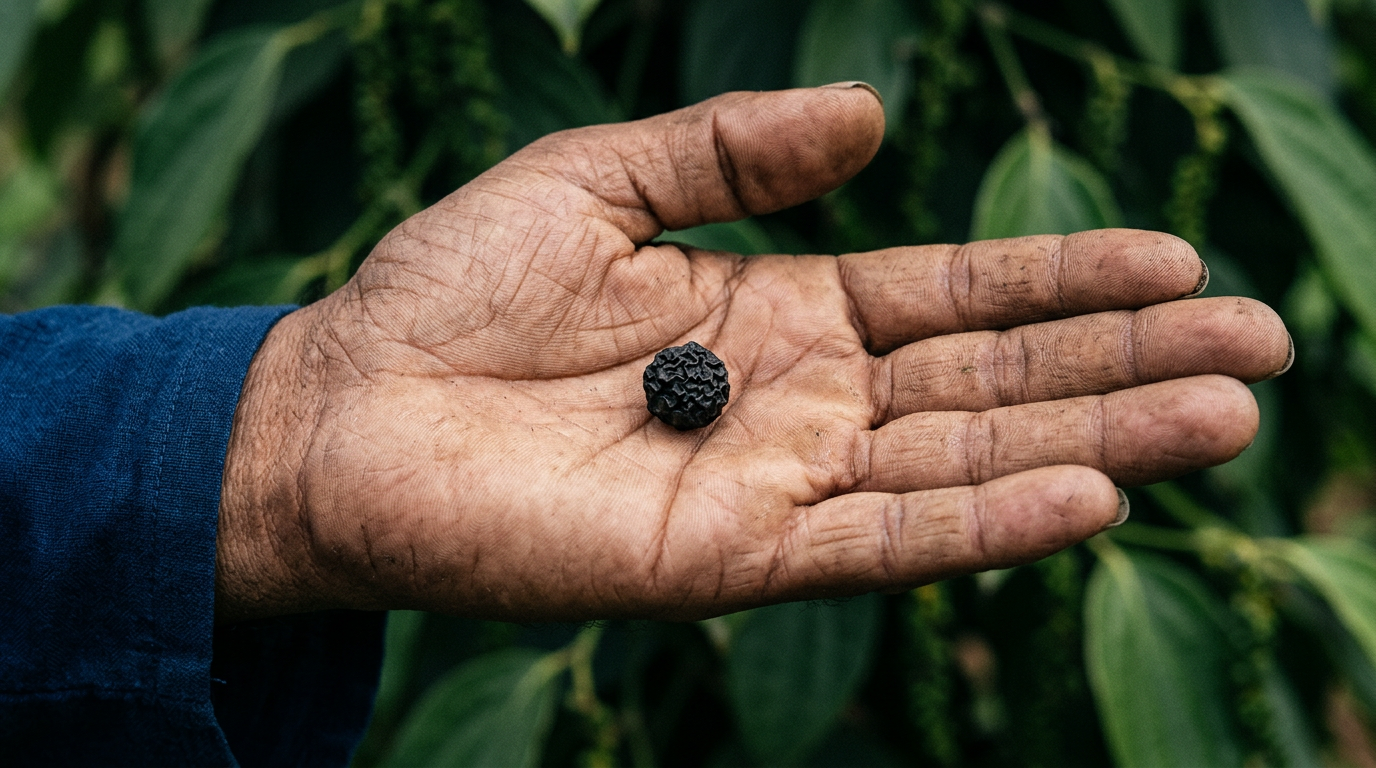
The conversation around single origin spices India is about more than just taste; it’s about truth. As we approach India's Independence Day on August 15, it's a fitting moment to consider a different kind of sovereignty: the sovereignty of a seed, a farmer, and a place. The fine print on the back of a spice jar tells a story, but too often, it’s a work of fiction that obscures the real journey from farm to your kitchen.
That jar of black pepper in your pantry? It might say “Product of Germany” or “Packed in the Netherlands.” This is rarely where the pepper was grown. Instead, it’s where the spice had its last “substantial transformation.” A peppercorn grown on a family farm on the Malabar Coast can be shipped to Vietnam for sterilization, then to a European port for grinding and bottling. In that moment, its identity is legally rewritten. The farmer in Kerala vanishes from the story, along with the unique character of their land.
The Great Spice Detour
This global shuffle isn’t an accident; it’s a feature of a commoditized system designed to prioritize cost and consistency over character and equity. For centuries, the spice trade was about controlling routes and sources. Today, it’s about controlling processing and packaging, which is where a large portion of the final value is added [1].
Take the famed Tellicherry peppercorns from Kerala’s Malabar coast, a region that gives pepper its very name in many languages. A farmer might sell their high-grade raw peppercorns for a fraction of the final retail price. The spice then enters a complex global supply chain. It’s aggregated, blended with peppers from other regions or even other countries, and standardized. The goal is to produce a uniform product, year after year. The result is that the nuance—the very soul of the spice—is blended into oblivion.
This isn't just an issue in the UK or US. Walk through the Dubai Spice Souk, and you'll see merchants scooping pepper by the kilogram from large open sacks. While visually stunning, it’s often impossible to know the precise origin of what’s in that bag. It could be a mix from India, Indonesia, and Brazil, optimized for a specific price point rather than a singular expression of terroir.
Reading Between the Labels
Food labeling laws, like the FDA’s regulations in the US, often define the “country of origin” as the last place a product was significantly altered [2]. Grinding bulk peppercorns and putting them in a jar counts. This is how a spice grown in Asia can legally become a “Product of Europe.”
| Label Term | What It Often Means | What It Obscures |
| :--- | :--- | :--- |
| Packed in Country X | The spice was put into its final container in Country X. | The country where it was grown, harvested, and dried. |
| Product of Country Y | The spice was ground, blended, or significantly processed in Country Y. | The entire agricultural journey and the farmers who enabled it. |
| Single Origin | The spice comes from a single known geographical region, sometimes a single estate. | This is the gold standard, but requires a transparent supply chain to be meaningful. |
We demand provenance from our 12-ounce bag of coffee beans at a high-end US grocer. We celebrate the winemaker's estate. Yet the 100g jar of generic ground pepper on a major UK supermarket shelf is granted anonymity. Why the double standard? It’s a colonial hangover, a habit of viewing these ingredients as bulk commodities rather than artisanal agricultural products.
Terroir, Piperine, and Economic Justice
Spices have terroir. Black pepper grown in the highlands of the Western Ghats in [India](/region/india) has a different aromatic profile and heat intensity than one grown in the flatlands of Vietnam. The concentration of piperine, the alkaloid that gives pepper its signature heat and many of its health benefits, varies significantly based on soil, climate, and harvesting practices [3]. When we accept blended, anonymous spices, we lose this library of flavours and properties.
Choosing true single origin spices India is an act of defiance against this system. It ensures the value generated by a unique agricultural heritage flows back to the communities that are its stewards. It is a recognition that the farmer’s name and the land’s character are as important as the final brand on the package.
This is a central part of [our philosophy](/why). Decolonizing our spice racks doesn't just mean learning the history; it means changing the economics. It starts with demanding to know the real story behind the label.
This [India Independence Day](/festival/india-independence-day), let's celebrate not just political freedom, but the right of a farmer’s product to retain its identity from soil to shelf. The most powerful choice we can make is to ask, “Where does this really come from?” and to support those who can give a clear answer. By doing so, we help restore the narrative and the value to the true origin of single origin spices India.
***
### Frequently Asked Questions
1. What does “single origin spice” actually mean?
Single origin means the spice is sourced from a single known geographical location. This can be a specific country, a region (like the Malabar Coast), or even a single farm or estate. It’s the opposite of a blend from multiple, undisclosed locations.
2. Is single origin always better quality?
Generally, yes. Traceability to a single origin incentivizes farmers to produce higher-quality crops because their product isn't being blended into an anonymous commodity. It allows for the preservation of unique flavour profiles tied to that specific region’s terroir.
3. Why are single origin spices more expensive?
They reflect a more equitable and transparent supply chain. The price includes paying farmers a premium for their quality and craft, maintaining the integrity of the spice through direct and careful processing, and the costs of third-party lab testing to verify purity and origin.
4. How can I verify the origin of my spices?
Look for brands that offer radical transparency. This includes naming the specific region or even the farming cooperative, providing batch numbers, and sharing third-party lab reports on purity, potency, and contaminants. A vague “Product of” label is a red flag.
Sources & citations
- Food and Agriculture Organization of the United Nations (FAO). "Value chains for sustainable food systems." https://www.fao.org/sustainable-food-value-chains/en/
- U.S. Customs and Border Protection. "Country of Origin Marking." https://www.cbp.gov/trade/rulings/informed-compliance-publications/country-origin-marking
- Gorgani, L., Mohammadi, M., Najafpour, G. D., & Nikzad, M. (2017). "Piperine—The Bioactive Compound of Black Pepper: From Isolation to Medical Formulations." Comprehensive Reviews in Food Science and Food Safety, 16(1), 124-140. https://pubmed.ncbi.nlm.nih.gov/33371583/
- Encyclopaedia Britannica. "Spice trade." https://www.britannica.com/topic/spice-trade