
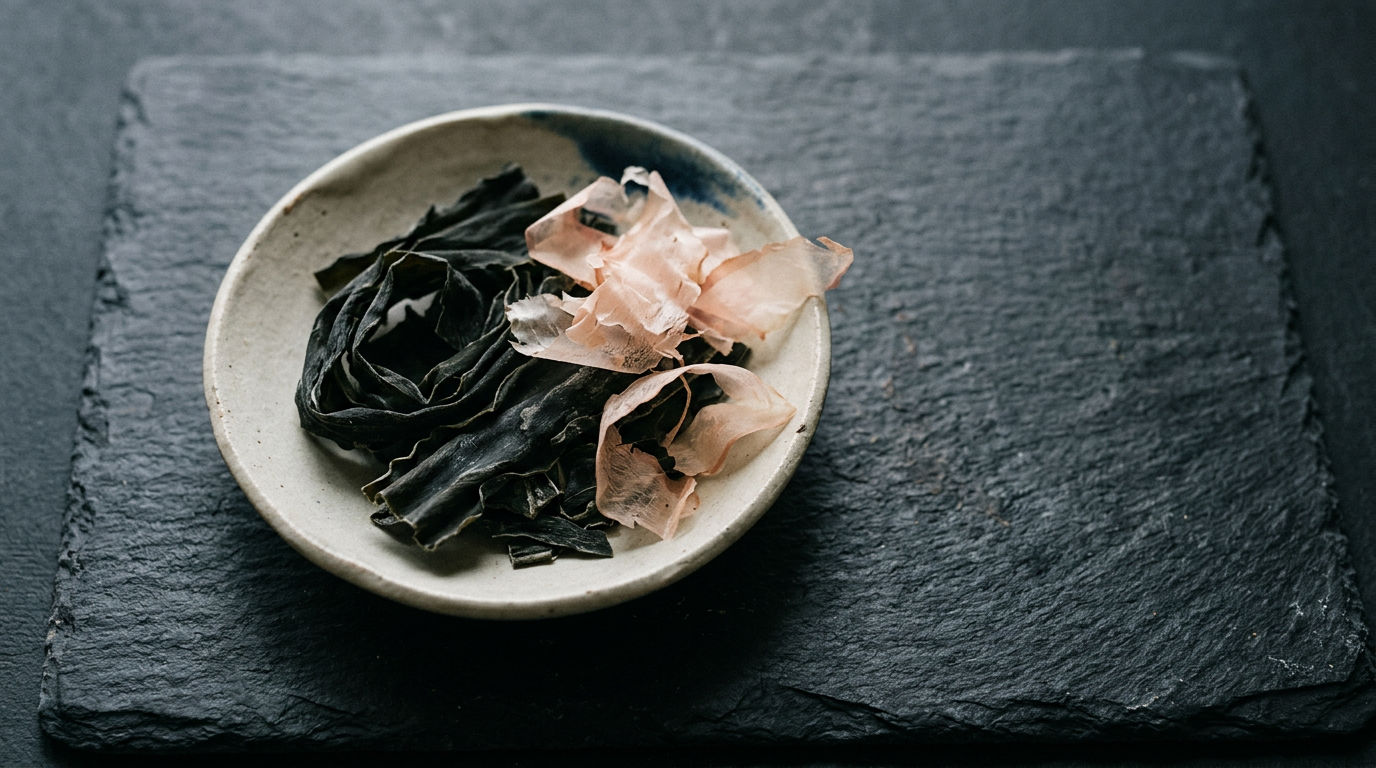
My weekend started with a simple goal: make a foundational dashi, the clear Japanese soup stock. I had the two key ingredients: a sheet of dark, sea-dusted kombu and a bag of feathery, smoke-scented katsuobushi. What I ended up with was a lesson in chemistry that rewrites how we should think about flavour. The foundation of Japanese cuisine, the best dashi recipe umami science isn't about extraction, but synergy. It relies on the precise, low-temperature combination of glutamate from kombu and inosinate from bonito flakes, creating a flavour far greater than the sum of its parts—a principle with lessons for kitchens everywhere.
The Umami Duet
Most of us think of flavour as a list of ingredients. A little of this, a dash of that. Dashi teaches us to think in chords. The deep, savory satisfaction of a well-made dashi comes from a chemical phenomenon known as umami synergy [1].
Kombu, a type of kelp, is rich in glutamic acid, an amino acid that provides the baseline umami taste. Katsuobushi—dried, fermented, and smoked bonito tuna—is packed with inosinic acid, a nucleotide. On their own, each is pleasant. But when they meet in warm water, the effect isn't additive; it's multiplicative. The inosinate amplifies the glutamate signal to our taste receptors by an order of magnitude, creating a round, mouth-filling savouriness that lingers long after the sip is gone.
Crafting this synergy is an act of precision. Boiling kombu makes it bitter and slimy. The ideal temperature for drawing out its glutamate is a gentle 60°C (140°F). After removing the kombu, the water is heated to just below a simmer, around 85°C (185°F), before the katsuobushi is added for a brief steep. This temperature dance isn't fussy ritual; it's chemistry. It's the knowledge that separates a flat broth from a profound one.
A Flavour ‘Discovered’ a Century Late
In 1908, Japanese chemist Professor Kikunae Ikeda identified glutamate as the source of kombu's distinct taste, which he named umami (うま味), or “essence of deliciousness” [2]. But to call this a “discovery” is to view it through a narrow, Western lens. It was the naming and isolation of a principle that chefs and home cooks across the world had understood intuitively for millennia. It’s a core principle of our work in the /region/us.
Yet for decades, Western food science, built on the four-taste model (sweet, sour, salty, bitter), was skeptical. This skepticism hardened into suspicion with the popular vilification of MSG (monosodium glutamate), the salt form of glutamic acid. In the US and UK, fears of “Chinese Restaurant Syndrome” created a cloud of racially-tinged anxiety around an ingredient that is chemically indistinguishable from the glutamate found in Parmesan cheese, ripe tomatoes, and cured ham [3]. This is a classic story of colonised-food: a non-Western ingredient or concept is misunderstood, feared, and commercially sidelined, while its underlying components are celebrated in European contexts.
The Synergy Matrix
What Ikeda named, global food cultures have always practiced. The dashi principle is a universal template for creating depth. It's almost always a partnership between a plant-based glutamate and an animal- or fungi-based nucleotide.
| Glutamate Source (Plant) | Inosinate/Guanylate Source (Animal/Fungi) | Culinary Example |
| :--- | :--- | :--- |
| Kombu (Seaweed) | Katsuobushi (Bonito) | Japanese Dashi |
| Tomato | Anchovy / Parmesan | Italian Sugo |
| Cabbage | Cured Pork | French Choucroute Garnie |
| Soybeans (Soy Sauce) | Shiitake Mushroom | Chinese Braises |
Thinking this way changes how you stock your pantry. I now source my ma-kombu from a specialist importer in Brooklyn who can tell me its harvest date. For a simple stock, I use about 10g of kombu and 20g of katsuobushi (or about 0.75 ounces of flakes) per litre of water. Understanding the dashi recipe umami science turns a shopping list into a strategy for building flavour.
This principle—that the most powerful effects come from thoughtful combination—is what animates our own work. It’s not just about finding one powerful spice. It's about understanding the ancient pairings and chemical synergies that create something new. For a full, step-by-step method, see our foundational /recipe here.
FAQ
1. What exactly is umami?
Umami is considered the fifth basic taste, alongside sweet, sour, salty, and bitter. It is a savory, brothy, and rich flavor imparted by glutamates and nucleotides present in many foods like aged cheeses, meats, and mushrooms.
2. Can I make a vegan or vegetarian dashi?
Absolutely. A classic vegetarian dashi is made by pairing kombu with dried shiitake mushrooms. The shiitake contain guanylic acid, a nucleotide that works synergistically with kombu's glutamic acid, similar to how bonito flakes work.
3. Why shouldn't I boil the kombu?
Boiling kombu causes it to release alginates, which result in a bitter taste and a slimy texture in your dashi. A gentle, sub-simmer steep is crucial for a clean, pure flavour.
4. What's the difference between ichiban dashi and niban dashi?
Ichiban dashi (first dashi) is made from the initial steep of fresh kombu and katsuobushi. It has the most refined, delicate flavour and is used for clear soups. Niban dashi (second dashi) is made by re-steeping the same ingredients, resulting in a less intense but still flavourful stock perfect for miso soup or noodle dishes.
Sources & citations
- Yamaguchi, S., & Ninomiya, K. (2000). Umami and Food Palatability. The Journal of Nutrition, 130(4), 921S-926S. https://academic.oup.com/jn
- “Kikunae Ikeda.” Britannica. https://www.britannica.com/biography/Kikunae-Ikeda
- LeMesurier, T. (2017). 'Chinese Restaurant Syndrome', a Racist Myth? Not So Fast. Colgate University. https://www.colgate.edu/news/stories
- Mouritsen, O. G., et al. (2012). Seaweeds for umami flavour in the New Nordic Cuisine. Flavour, 1(1), 4. https://flavourjournal.biomedcentral.com/