
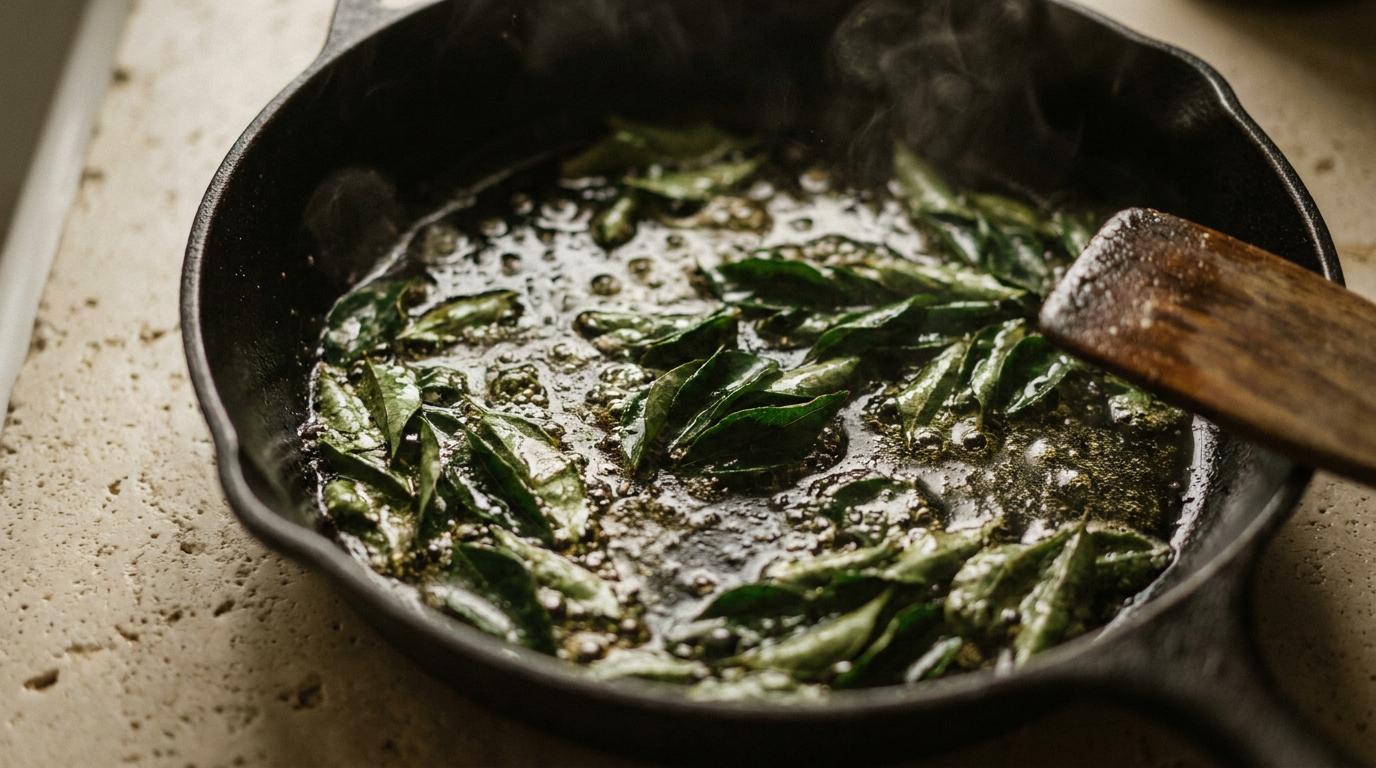
Curry leaves are the aromatic foliage of Murraya koenigii, a subtropical tree belonging to the citrus family, Rutaceae. Native to the Indian subcontinent, they impart a pungent, nutty, and distinctly citrus-herbaceous flavour driven by volatile monoterpenes and sesquiterpenes such as beta-caryophyllene and alpha-pinene. They differ entirely from commercial curry powder, relying on hot fat extraction to release their aroma.
The confusion around curry leaves begins with taxonomy and colonial record-keeping. British colonial administrators encountered dishes called kari in southern India—derived from the Tamil word kari, meaning a spiced sauce or relish—and subsequently borrowed the word to describe both the finished dish and a blended spice powder that rarely contains the actual leaf. In Tamil, the plant is kariveppilai, which translates literally as "black neem leaf" due to its visual resemblance to the neem tree (Azadirachta indica), although the two species are entirely unrelated botanically. While neem is notoriously bitter and belongs to the mahogany family, Murraya koenigii belongs to the citrus family. Its scent profile reflects that lineage: sharp, sulfurous, resinous, and green.
The physics of the tadka
Curry leaves behave poorly when handled like Western soft herbs. If you chop them finely and scatter them across a finished soup like parsley, you get a leathery, slightly astringent mouthful. The leaf requires thermal rupture in a lipid medium.
When a sprig of fresh leaves hits hot ghee, mustard oil, or coconut oil during a temper (variously termed tadka, chhonk, or thalithal), two immediate physical events occur. First, residual moisture on the glossy cuticle vaporises explosively, creating the characteristic crackle. Second, the heat destabilises the glandular trichomes on the leaf surface, releasing essential oils that are almost entirely hydrophobic [1].
These aromatic compounds do not dissolve into water. They require lipids to migrate. The volatile profile of fresh Murraya koenigii leaves is dominated by beta-caryophyllene, alpha-pinene, sabinene, and beta-phellandrene [2]. By infusing the hot oil, the volatile aromatics become suspended throughout the cooking fat. When that fat is poured over a dal or tossed with warm rice, it evenly disperses compounds across the entire dish rather than leaving them isolated in the foliage.
Why dried curry leaves fail
Supermarket spice aisles frequently sell dried curry leaves in clear plastic tubs. They are, for practical culinary purposes, useless.
| Quality Indicator | Fresh Murraya koenigii | Commercially Dried Murraya koenigii | Helichrysum italicum ("Curry Plant") |
| :--- | :--- | :--- | :--- |
| Primary Aroma Drivers | Beta-caryophyllene, sabinene, alpha-pinene | Residual lignins, degraded polyphenols | Neryl acetate, italidiones |
| Flavour Profile | Sharp citrus-resin, savoury-nutty, sulfurous | Cardboard, faint tea bitterness, dust | Sweet maple, herbal, bitter resin |
| Culinary Usability | High; oil extraction releases oils in 5–10 seconds | Minimal; volatile terpenes have evaporated | Ornamental; generally not used in Indian cookery |
| Botany | Tree in the Rutaceae (citrus) family | Dried leaves of Murraya koenigii | Asteraceae (daisy) family shrub |
Monoterpenes like pinene and sabinene have low boiling points and degrade rapidly under ambient heat and air exposure. When curry leaves are dried industrially, these delicate top notes volatilise into the atmosphere, leaving behind brittle cellulose and oxidised tannins [3]. If fresh leaves are unavailable, freezing whole fresh sprigs inside an airtight container preserves the integrity of the essential oils far better than dehydration. The leaf may darken slightly on thawing, but the cellular oil reserves remain intact.
Carbazole alkaloids and physiological claims
Beyond culinary chemistry, Murraya koenigii produces a rare class of secondary metabolites called carbazole alkaloids, most notably mahanimbine, girinimbine, and koenimbine [4]. These compounds have attracted sustained laboratory interest for their antioxidant and enzyme-inhibitory activities.
Rodent models and in vitro assays demonstrate that mahanimbine exhibits alpha-glucosidase and alpha-amylase inhibitory potential, suggesting a theoretical mechanism for slowing carbohydrate breakdown in the gut [4]. Similarly, isolated extracts show protective capacity against lipid peroxidation in cellular models [1].
However, there is a gulf between a petri dish treated with pure methanolic extract and an individual eating four leaves in a bowl of sambar. The concentration of carbazole alkaloids consumed in an ordinary culinary portion is modest, and rigorous human clinical trials evaluating standardized curry leaf preparations remain sparse. The leaves are nutritious—supplying modest levels of dietary iron, calcium, and carotenoids—and their long-standing use in Ayurvedic formulations for digestive complaints is well documented. But consuming them as a targeted therapeutic intervention overstates the available clinical evidence.
Enjoy them for their genuine function: a citrus-adjacent botanical that solves the structural problem of how to carry resinous, nutty top notes through hot fat.
Frequently asked questions
Can I eat the curry leaves left in my dish, or should I discard them?
You can eat them. Unlike bay leaves (Laurus nobilis), which have rigid, woody veins that pose a mild choking risk, cooked curry leaves soften in oil and are completely digestible. Many diners chew them for their concentrated savoury bitterness.
Can I substitute curry powder for curry leaves?
No. Curry powder is a ground mixture typically built around turmeric, coriander, cumin, and fenugreek. It shares neither botanical origin nor flavour profile with Murraya koenigii. If you cannot find fresh or frozen curry leaves, it is better to omit them rather than alter the dish with blended ground spices.
How should fresh curry leaves be stored to prevent spoiling?
Strip the leaves from their thick stems and discard any discoloured foliage. Ensure the leaves are completely dry, then seal them in an airtight container lined with a paper towel and store them in the refrigerator for up to two weeks, or freeze them directly for several months.
Sources & citations
- Ningappa, S. S., Dinesha, R., & Srinivas, L. (2008). Antioxidant and free radical scavenging activities of polyphenol-enriched curry leaf (Murraya koenigii L. Spreng.) extracts. Food Chemistry, 106(2), 720–728. https://doi.org/10.1016/j.foodchem.2007.06.057
- Rao, B. R., Rajput, D. K., & Mallavarapu, G. R. (2011). Chemical diversity in curry leaf (Murraya koenigii) essential oils. Industrial Crops and Products, 34(1), 1147–1152. https://doi.org/10.1016/j.indcrop.2011.04.004
- Ghasemzadeh, A., et al. (2014). Optimization of extraction conditions for the recovery of phenolic compounds and evaluation of antioxidant activities of Murraya koenigii leaves. Molecules, 19(11), 17743–17757. https://doi.org/10.3390/molecules191117743
- Tachibana, Y., et al. (2001). Antioxidative activity of carbazoles from Murraya koenigii leaves. Journal of Agricultural and Food Chemistry, 49(11), 5589–5594. https://doi.org/10.1021/jf010621r