
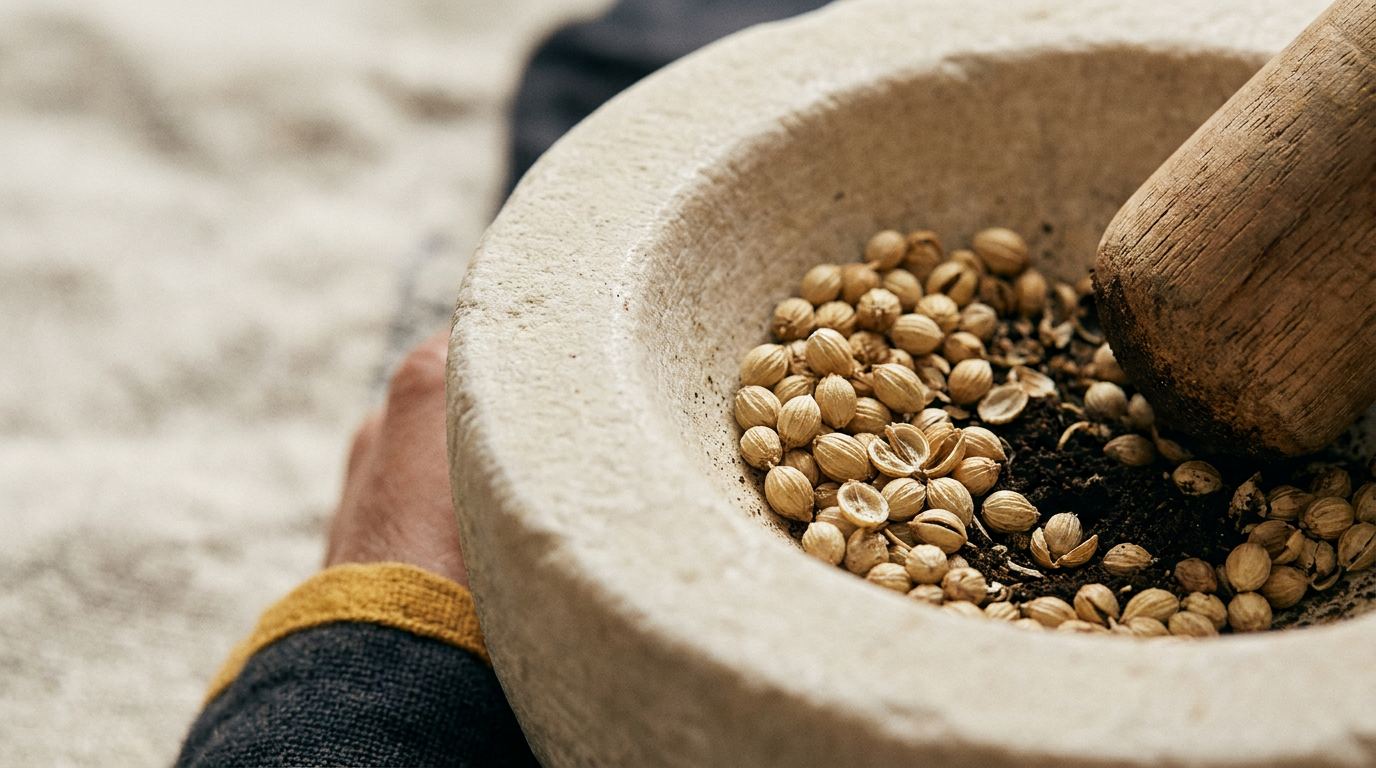
Coriander refers to the dried fruits of the Coriandrum sativum plant, yielding a warm, citrusy, floral, and slightly peppery flavour profile foundational to spice blends across South Asia, North Africa, and the Mediterranean. Botanically classified as schizocarps rather than true seeds, their chemistry is dominated by linalool rather than the pungent aldehydes found in the plant's fresh leaves.
Few botanical transitions in the kitchen are as sharp as the one between cilantro leaves and coriander seeds. People who register the fresh green herb as a mouthful of bath soap can usually eat the ground spice without distress. That difference is not an illusion, and it is not down to personal tolerance. It is a documented metabolic shift that occurs as the plant matures from vegetative growth into seed development.
For a broader look at culinary profiles, see our entry on coriander.
The shift from leaf aldehydes to fruit monoterpenes
The divisive flavour of coriander leaf belongs to a cluster of unsaturated aliphatic aldehydes, primarily (2E)-decenal and (2E)-dodecenal [1]. These are volatile molecules with structures chemically analogous to the by-products of soap-making and the defensive sprays of shield bugs. Humans with specific polymorphisms in the OR6A2 olfactory receptor gene perceive these aldehydes with acute sensitivity, registering them as pungent, soapy, and unpleasant [2].
As Coriandrum sativum flowers and sets fruit, this volatile factory shuts down. The plant stops accumulating long-chain aldehydes and turns its enzymatic machinery towards monoterpene synthesis. By the time the spherical fruit dries from green to pale tan, the volatile oil profile is radically different. Upwards of 60 to 70 percent of the essential oil in mature coriander fruit is (S)-(+)-linalool, an acyclic monoterpene alcohol that carries a sweet, woody, and distinctly citrusy aroma [3]. The secondary components are monoterpene hydrocarbons: alpha-pinene, gamma-terpinene, camphor, and geraniol.
In practical terms, the spice in the jar has almost nothing chemically in common with the herb in the crisper drawer.
Morphology and the two varieties
What cooks call a coriander seed is technically a schizocarp: a small, ribbed, globular fruit consisting of two single-seeded halves (mericarps) fused together. These two halves enclose a central hollow cavity where volatile oils collect in tiny longitudinal channels called vittae.
Commercial coriander splits into two primary botanical varieties, which behave differently in the pan and in the mill:
| Attribute | Coriandrum sativum var. vulgare | Coriandrum sativum var. microcarpum |
| :--- | :--- | :--- |
| Common names | Large-fruited, Mediterranean, Indian | Small-fruited, Russian, Central European |
| Fruit diameter | 3.0 to 5.5 mm | 1.5 to 3.0 mm |
| Shape | Ellipsoidal to slightly oval | Strictly spherical |
| Essential oil yield | 0.1 to 0.4 percent | 0.8 to 1.5 percent |
| Primary culinary role | Thickening curries, spice rubs, mild sweetness | Distillation, gin botanicals, pungent spice blends |
| Husks to oil ratio | High woody husk content | Lower husk volume, higher essential oil density |
The larger Indian varieties are often favoured in cooking because their husks are softer and shatter easily when roasted. They contribute considerable soluble fibre and pectin when ground, which helps thicken sauces and gravies in South Asian cookery without throwing off bitter off-notes [4]. The smaller European varieties contain far more concentrated linalool by weight, making them sharper and far more aromatic.
Heat, crushing, and the fate of linalool
Linalool is volatile and comparatively delicate. When whole coriander fruits sit in a sealed jar, their intact outer pericarp forms an effective barrier against oxidation. Once cracked, the volatile oil in the vittae meets atmospheric oxygen, and the bright citrus notes begin to degrade into dull, terpene-heavy staleness.
Toasting introduces another layer of chemical change. When whole coriander is heated gently in a dry skillet, moisture departs and thermal degradation begins. Mild heat drives off the more volatile, pine-like hydrocarbons like alpha-pinene. At the same time, the carbohydrates and trace proteins in the fruit wall participate in non-enzymatic browning, producing pyrazines and alkylpyrazines that add nutty, toasty aromatics.
Overheating, however, evaporates the linalool entirely, leaving behind the woody fibre of the pericarp and bitter degradation products. A light toast until the seeds become fragrant and fragile under a pestle is enough. If the fruit turns dark brown, its citrus character is gone.
Frequently asked questions
### Why does coriander seed taste like citrus while the leaf tastes like soap?
Coriander leaves owe their aroma to (2E)-decenal and other long-chain aldehydes, which activate specific olfactory receptors associated with soap. In contrast, mature seeds contain virtually no aldehydes; their flavour is driven by linalool, a monoterpene alcohol that imparts sweet, floral, and citrus-rind notes.
### Is it better to buy ground coriander or whole seed?
The volatile monoterpenes in coriander seed are stored in internal channels protected by a woody shell. Grinding ruptures these pockets and exposes linalool to oxidation. Whole seed retains its aroma for years in an airtight container, whereas ground coriander loses its bright, citrusy character within weeks.
### Can you substitute ground coriander for fresh coriander leaves?
No. Despite coming from the same plant, their chemical profiles and culinary uses do not overlap. Ground coriander cannot provide the sharp, herbaceous lift of the fresh leaves, and the fresh leaves cannot provide the warm, sweet citrus structure of the ground fruit.
Sources & citations
- Eyres, G., et al. (2005). Identification of volatile flavour-active compounds in fresh coriander leaves (Coriandrum sativum L.). Journal of Agricultural and Food Chemistry, 53(16), 6419-6423. https://doi.org/10.1021/jf050512c
- Eriksson, N., et al. (2012). A genetic variant near olfactory receptor genes influences cilantro preference. Flavour, 1(22). https://doi.org/10.1186/2044-7248-1-22
- Bhuiyan, M. N. I., et al. (2009). Chemical composition of the essential oils obtained from Coriandrum sativum L. parts. Bangladesh Journal of Pharmacology, 4(2), 150-153. https://doi.org/10.3329/bjp.v4i2.2741
- Diederichsen, A. (1996). Coriander: Coriandrum sativum L. Promoting the conservation and use of underutilized and neglected crops. 3. Institute of Plant Genetics and Crop Plant Research, Gatersleben / International Plant Genetic Resources Institute, Rome. https://www.bioversityinternational.org/e-library/publications/detail/coriander-coriandrum-sativum-l/