
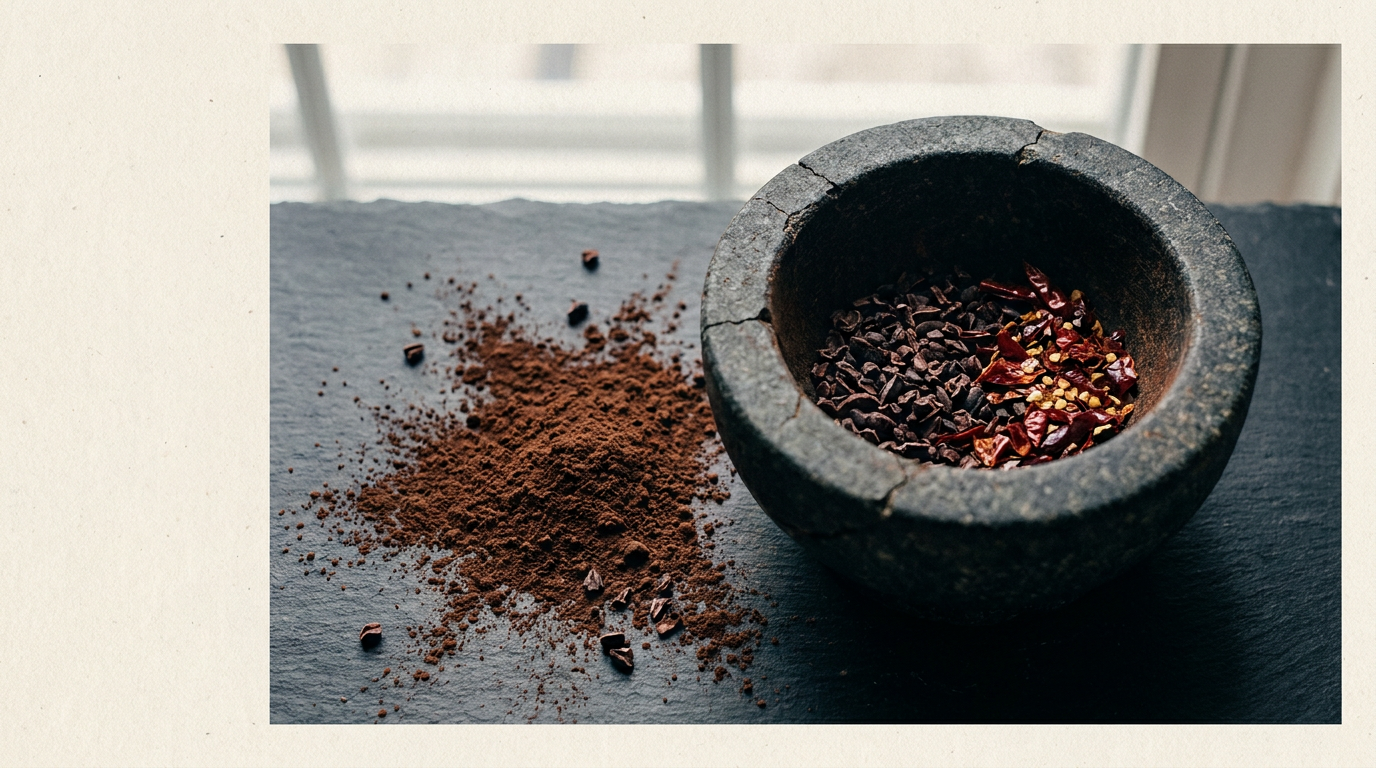
Cocoa is the fermented, dried, and roasted seed of the Theobroma cacao tree, ground into a powder after the extraction of cocoa butter. Functioning chemically as a bittering and aromatic spice, it contributes pyrazines, astringent polyphenols, and methylxanthines to savoury braises and sweet preparations alike, bridging Mesoamerican culinary foundations with modern high-heat pastry chemistry.
To treat cocoa purely as a dessert ingredient is a relatively modern European quirk. For roughly three millennia across Mesoamerica, the cacao seed operated as a pungent, bitter base for water-based suspensions, seasoned with dried capsicums, maize, and aromatic seeds [1]. The seed requires substantial chemical intervention before it resembles anything edible. Raw cacao straight from the pod is astringent, aggressively bitter, and enveloped in a mucilaginous white pulp rich in citric acid and sucrose.
### The sweatbox: fermentation as flavour architect
The flavour of cocoa does not exist inside the raw seed. It is manufactured on the forest floor or in slatted wooden sweatboxes. When the pods are split, workers heap the seeds and their sugary pulp together, initiating a spontaneous succession of micro-organisms [2].
First, wild yeasts consume the pulp sugars under anaerobic conditions, producing ethanol and carbon dioxide while dropping the pulp's viscosity. As the pulp drains away, air enters the heap. This allows aerobic acetic acid bacteria to oxidise the ethanol into acetic acid, a reaction that releases considerable heat, raising the mass temperature to nearly 50°C.
This heat and acid kill the seed embryo. Cell walls rupture inside the cotyledons, mixing previously compartmentalised enzymes with substrates. Endogenous proteases break storage proteins down into small peptides and free amino acids. At the same time, invertase cleaves sucrose into glucose and fructose. These fragments are the critical precursors. Without this specific biological rotting, subsequent roasting produces the aroma of burnt beans rather than cocoa.
### Maillard reactions and pyrazine development
Once dried, the cured seeds are roasted. Here, the peptides and reducing sugars generated during fermentation undergo Maillard reactions. The signature aroma profiles of cocoa stem largely from heterocyclic volatiles, particularly alkylpyrazines, which provide nutty, roasted, and earthy base notes [2].
Simultaneously, the seed's high polyphenol content undergoes thermal transformation. Native monomers such as epicatechin and catechin, alongside polymeric proanthocyanidins, oxidise and condense. This reaction dampens the raw, mouth-puckering astringency of the bean while preserving enough structural bitterness to balance rich fats.
### The chemistry of the Dutch process
In 1828, Dutch chemist Coenraad van Houten introduced two innovations that altered cocoa handling. He devised a mechanical hydraulic press to squeeze out the triglyceride-dense cocoa butter, leaving behind a hard press cake that could be milled into powder. He also developed alkalisation, treating the nibs or liquor with an alkaline solution, typically potassium carbonate [3].
| Attribute | Natural Cocoa Powder | Dutch-Processed Cocoa |
| :--- | :--- | :--- |
| pH Range | 5.3 – 5.8 (acidic) | 6.8 – 8.1 (neutral to slightly alkaline) |
| Flavour Profile | Sharp, fruity, astringent, tart | Mellow, earthy, deep roasted, woody |
| Flavanol Retention | High (native antioxidant structure) | Significantly degraded by alkaline heat |
| Colour | Pale reddish-brown | Dark brown to charcoal black |
| Leavening Action | Reacts immediately with baking soda | Requires baking powder for leavening |
Alkalisation neutralises the natural acetic and citric acids remaining from fermentation. This shifts the pH upward, darkens the pigments, and modifies the bitterness, muting the sharper botanical top notes. In European baking, this neutrality prevents early leavening failure, but it also strips away the bright, acidic fruitiness inherent to well-fermented beans.
### The savoury pot: beyond confectionery
Because Western kitchens spent two centuries pairing cocoa powder with equal measures of sucrose and dairy fat, its behaviour in savoury cookery is frequently misunderstood. Cocoa is not naturally sweet. It contains negligible free sugars, roughly 10 to 12 percent lipid content in standard retail powder, and a high concentration of the methylxanthine theobromine, a milder homologue of caffeine that produces persistent bitterness on the rear of the tongue [1].
In a Mexican mole poblano or an Oaxacan mole negro, cocoa is used as a finishing spice and structural emulsifier rather than a confection. Cooked into an unctuous sauce of charred dried chilies (such as ancho, pasilla, and mulato), toasted seeds, and stock, cocoa powder contributes insoluble dietary fibres and starch that assist in sauce thickening. More importantly, its pyrazines link directly to the roasted aromas of charred chili skins, while its bitterness counters the heavy capsaisin heat and rich lard.
Using cocoa as a spice requires treating it with the same caution as ground fenugreek or mustard. Added too early to a dry, hot pan, its residual proteins and carbohydrates burn readily, turning bitterness into acridity. Whisked into a simmering liquid toward the final phase of cooking, it dissolves into an earthy, savoury bass note that deepens meat braises, stews, and roasted root vegetables without depositing sweetness.
Frequently asked questions
### Is cocoa powder chemically classified as a spice?
Yes. While commercial trade categorises cacao as a bulk agricultural commodity due to chocolate manufacturing, culinarily and botanically cocoa powder functions as a ground seed spice. It provides aroma, pigment, bitterness, and flavour complexity to dishes rather than caloric bulk.
### Why does natural cocoa curdle dairy faster than Dutch cocoa?
Natural cocoa retains organic acids formed during fermentation, giving it a pH between 5.3 and 5.8. When stirred into hot milk without sufficient buffering sugars or stabilisers, this acidity can lower the pH of the milk toward the isoelectric point of casein (pH 4.6), causing the proteins to aggregate and curdle.
### Can I substitute natural cocoa for Dutch-processed cocoa interchangeably?
Not in baked goods reliant on chemical leaveners. Natural cocoa is acidic and requires sodium bicarbonate (baking soda) to neutralise it and produce carbon dioxide. Dutch-processed cocoa has had its acidity neutralised, meaning it will not react with baking soda; recipes using it rely instead on baking powder for lift.
### Does raw cacao retain more nutrients than roasted cocoa?
Unroasted cacao seeds retain higher concentrations of heat-sensitive flavan-3-ols. However, raw seeds lack the complex pyrazines created through the Maillard reaction during roasting, resulting in a bitter, astringent powder that lacks the characteristic cocoa aroma.
Sources & citations
- Coe, S.D. and Coe, M.D. (2013) The True History of Chocolate. Thames & Hudson.
- Afoakwa, E.O., Paterson, A., Fowler, M. and Ryan, A. (2008) 'Flavor formation and character in cocoa and chocolate: a review', Critical Reviews in Food Science and Nutrition, 48(9), pp. 840–857.
- Miller, K.B. et al. (2008) 'Impact of alkalization on the antioxidant and flavanol content of commercial cocoa powders', Journal of Agricultural and Food Chemistry, 56(18), pp. 8527–8533.