
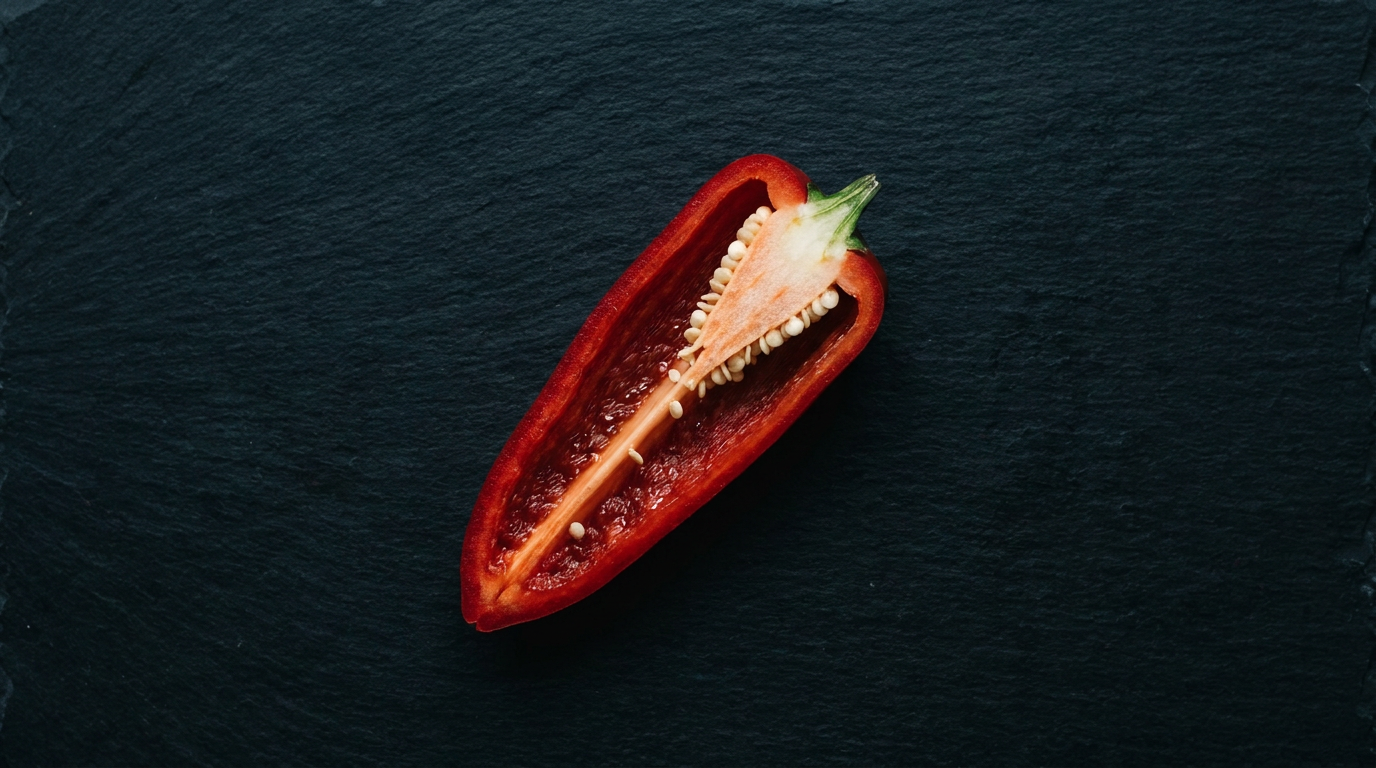
Chilli, derived from the fruit of plants in the Capsicum genus, is a pungent spice known for imparting a characteristic heat and vibrant flavour to dishes globally. Its heat originates in capsaicinoids synthesised primarily in the fruit's internal placental tissue. These compounds trigger human thermal pain receptors, producing a sensation of burning heat without causing actual tissue combustion.
To understand chilli, one must first discard the common kitchen assumption that the seeds hold the heat. They do not. If you dissect a fresh pod of Capsicum annuum or Capsicum chinense, the pale spongy ridge running down the interior cavity—the placenta—is where the glandular epidermal cells concentrate capsaicin and dihydrocapsaicin [1]. Seeds possess no capsaicinoid-producing glands of their own. They taste hot purely through proximity, coated in chemical exudates when the fruit is sliced, shaken, or dried.
The Receptor That Senses Boiling Water
Capsaicin does not burn skin or mucous membranes in the manner of an acid or an open flame. It manipulates a specific ion channel: transient receptor potential vanilloid 1, or TRPV1 [2].
Under normal physiological conditions, TRPV1 sits on peripheral sensory neurons, waiting to protect the body from thermal trauma. When ambient temperature crosses roughly 43°C, the receptor opens its pore, allowing calcium and sodium ions to flood the neuron. This depolarises the membrane and fires a signal directly to the central nervous system: you are touching something scalded.
Capsaicin binds directly to a hydrophobic pocket within TRPV1, lowering its activation threshold from 43°C down to normal body temperature (37°C) [2]. The receptor opens spontaneously at resting biological warmth. The brain receives unambiguous data that the tongue is on fire, even though a digital thermometer placed in the mouth registers normal body heat. The secondary physiological responses—sweating, facial flushing, vasodilation, rhinorrhoea—are automated systemic efforts to dump non-existent heat.
Birds possess an orthologous TRPV1 channel, but subtle variations in its amino acid sequence prevent capsaicin from binding to it [3]. A thrush or finch can eat a ripe bird's eye pepper without discomfort, digest the sugary pericarp, and defecate viable seeds miles away. Mammalian molars grind seeds to paste, destroying the embryo; avian digestive systems pass them intact. The molecule is an evolutionary filter designed to discourage grinding jaws while recruiting wings.
Capsaicinoid Profiles Across Cultivated Species
The genus Capsicum spans dozens of wild species, but global cooking relies predominantly on five domesticates. They differ substantially in capsaicinoid concentration, aromatic volatile profiles, and tissue density.
| Species | Common Cultivars | Heat Range (SHU) | Dominant Volatiles | Distinctive Culinary Behaviour |
| :--- | :--- | :--- | :--- | :--- |
| *Capsicum annuum* | Jalapeño, Poblano, Cayenne, Paprika | 0 – 50,000 | Alkylpyrazines, hexanal (grassy, vegetal) | Versatile; fleshy pericarp suits drying into powders or roasting. |
| *Capsicum frutescens* | Tabasco, Bird's eye (Piri piri) | 30,000 – 150,000 | Hexenyl esters, β-ionone (sharp, punchy) | Soft, deciduous fruit; rapidly releases capsaicinoids into ferments and vinegars. |
| *Capsicum chinense* | Habanero, Scotch bonnet, Bhut jolokia | 100,000 – 1,500,000+ | Long-chain esters, ionones (fruity, floral) | Slow heat onset with lingering throat burn; highly concentrated placental glands. |
| *Capsicum baccatum* | Aji amarillo, Aji limon | 5,000 – 50,000 | Terpenes, limonene (citrus, mineral) | High acidity balance; predominantly used raw, paste-ground, or lightly cooked. |
| *Capsicum pubescens* | Rocoto, Manzano | 30,000 – 100,000 | Phenolic derivatives (apple, resinous) | Thick, juicy flesh with black seeds; resistant to cold-climate drying. |
Within Capsicum annuum, centuries of selective breeding produced cultivars like bell peppers that carry a recessive mutation in the Pun1 locus, knocking out capsaicin synthase entirely [4]. At the opposite end, Capsicum chinense varieties ramp up glandular coverage across the entire inner wall of the fruit, explaining why a habanero feels significantly more aggressive than a serrano.
Lipid Partitioning in the Pan
Capsaicin is a lipophilic alkaloid, virtually insoluble in cold water (roughly 0.0013 g per 100 mL). It dissolves readily in fats, oils, and high-proof ethanol [1].
This basic chemical property dictates how chilli operates across culinary traditions. When crushed chilli flakes hit warm vegetable oil or ghee, capsaicinoids elute out of the placental tissues and distribute uniformly through the liquid lipid phase. Fat coats the tongue, extending the physical area over which the molecules reach lingual papillae. Conversely, adding water-based liquids like vinegar or stock leaves the capsaicin suspended in unground particulate form or bound within insoluble droplets.
Drinking cold water after eating a fiery curry offers momentary thermodynamic cooling against oral tissues, but as soon as the water is swallowed, the water-insoluble capsaicin molecules remain anchored in the hydrophobic membranes of your mucosal cells. Casein, the major phosphoprotein in mammalian milk, acts as a biological detergent. Its lipophilic domains envelope the capsaicin molecule, dislodging it from TRPV1 and carrying it down the oesophagus.
Cooking also does not destroy capsaicin. The molecule is remarkably heat-stable, with a decomposition threshold well above 200°C. Long-simmered stews do not dilute chilli heat through thermal breakdown; they merely redistribute the alkaloid into the surrounding fat globules and dispersed starches.
Frequently Asked Questions
### Do chilli seeds contain any capsaicin?
Chilli seeds contain negligible capsaicin inside their own tissues. They taste hot purely because they are in direct contact with the placenta, which secretes capsaicin-rich oils onto the seed coat during development and processing.
### Why does drinking milk relieve chilli heat better than water?
Milk contains casein, a hydrophobic protein that binds to capsaicin molecules, pulling them away from the lingual TRPV1 nerve receptors. Water is polar and repels capsaicin, simply moving the lipid-soluble compounds around the mouth without clearing them.
### Does cooking chilli longer make a dish less spicy?
No. Capsaicinoids are chemically stable at normal cooking temperatures and do not degrade through boiling, braising, or roasting. Prolonged cooking distributes the compound more evenly across fats and liquids, which may alter the onset of heat but does not diminish the chemical payload.
### What is the Scoville Heat Unit (SHU) measurement based on?
Originally, the Scoville organoleptic test measured how many times a chilli extract had to be diluted in sugar water before a trained panel of five testers could no longer detect any heat. Today, high-performance liquid chromatography (HPLC) measures capsaicinoid concentrations directly in parts per million, which are then converted to Scoville units [1].
Sources & citations
- Govindarajan, V.S. (1986). Capsicum — production, technology, chemistry, and quality. Part III: Chemistry of the pungent principles. CRC Critical Reviews in Food Science and Nutrition, 24(3), 245–355.
- Caterina, M.J., Schumacher, M.A., Tominaga, M., Rosen, T.A., Levine, J.D., & Julius, D. (1997). The capsaicin receptor: a heat-activated ion channel in the pain pathway. Nature, 389(6653), 816–824. https://doi.org/10.1038/39807
- Jordt, S.E., & Julius, D. (2002). Molecular basis for species-specific sensitivity to “hot” chili peppers. Cell, 108(3), 421–430. https://doi.org/10.1016/S0092-8674(02)00637-2
- Stewart, C., Kang, B.C., Liu, K., Mazourek, M., Moore, S.L., Yoo, E.Y., Kim, B.D., Paran, I., & Jahn, M.M. (2005). The Pun1 gene for pungency in pepper encodes a putative acyltransferase. The Plant Journal, 42(5), 675–688. https://doi.org/10.1111/j.1365-313X.2005.02410.x