
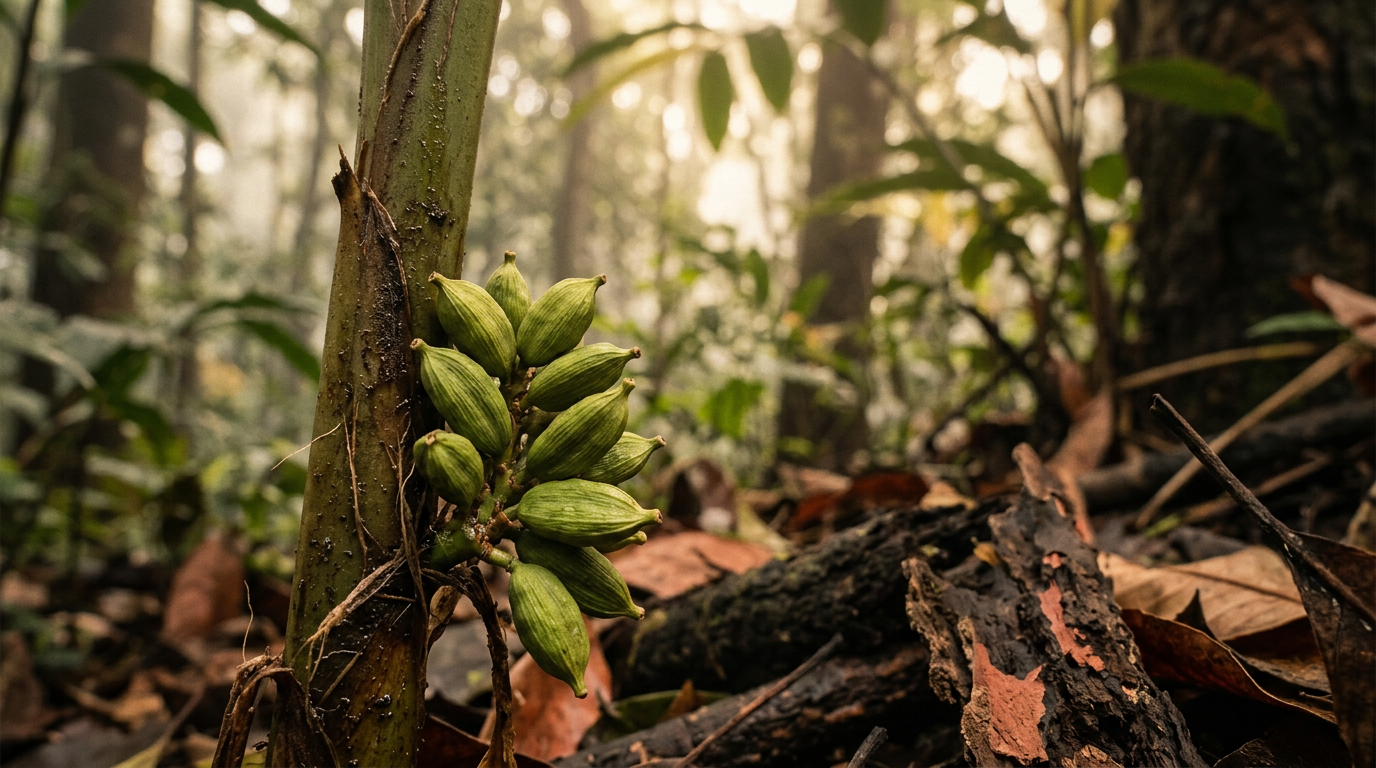
The story of cardamom, climate change, and Kerala is a critical, unfolding narrative of agricultural adaptation. Erratic rainfall and rising temperatures in the Western Ghats threaten the delicate ecosystem required for premium cardamom, forcing farmers to innovate decades ahead of policy. This isn't a theoretical risk model; it's a present-day reality for one of the world's most prized spices, impacting everything from a pot of chai in Mumbai to a spiced bun in a boutique London bakery.
The Rain-Fed Queen
Known as the ‘Queen of Spices,’ green cardamom (Elettaria cardamomum) is a notoriously fussy crop. It thrives in a very narrow band of conditions: the cool, humid, shaded understory of evergreen forests, with well-distributed rainfall and loamy, nutrient-rich soil. For centuries, the ideal incubator for this spice has been the Cardamom Hills of the Western Ghats, a UNESCO World Heritage site in [/region/india](India).
Here, in its native habitat, [cardamom](/spice/cardamom) grows not in monoculture fields but as part of a complex agroforestry system called shola, characterized by patches of forest interspersed with grasslands. The massive, old-growth trees provide the perfect dappled sunlight, and the thick layer of forest humus keeps the soil moist and fertile. This terroir is what gives Alleppey Green Extra Bold (AGEB) cardamom its high content of volatile oils, its intensely aromatic, eucalyptus-like notes, and its vibrant green hue [1]. It's a flavour profile that simply cannot be replicated in drier, hotter climates.
A Climate in Crisis
The climate that made the Cardamom Hills famous is becoming unstable. The predictable rhythm of the southwest and northeast monsoons, which once guaranteed the 1,500-2,500 mm of annual rain the plants need, has been replaced by volatility. Today, farmers face long, scorching droughts punctuated by sudden, destructive downpours that cause landslides and wash away topsoil [2].
Temperatures are also creeping up. Cardamom is sensitive to heat stress, which affects flowering and fruit set. Pollination, traditionally carried out by wild bees, is also in decline as the changing climate disrupts bee populations and flowering schedules. The combination of these factors is creating a perfect storm. The challenge of cardamom climate change in Kerala is not just about lower yields; it's an existential threat to the quality and unique character of the spice itself.
Innovation Born of Necessity
While governments and international bodies draft climate strategies, the farmers of Idukki and Wayanad are already deploying their own. Their work is a masterclass in resilience, blending generational knowledge with modern science.
They're becoming masters of water. Instead of relying solely on the monsoon, many are building check dams, digging rainwater harvesting pits, and installing low-cost drip irrigation systems to provide consistent moisture during dry spells. This isn't high-tech wizardry; it's practical, small-scale engineering that respects the local water table.
They're re-architecting the forest canopy. Recognizing that the old shade trees are also suffering from climate stress, farmers are actively planting a diverse mix of native, climate-resilient species. This multi-story canopy not only provides optimal shade but also enhances biodiversity, improves soil health by fixing nitrogen, and provides a secondary income source through fruits and timber.
They're collaborating with science. The Indian Cardamom Research Institute (ICRI), part of the Spices Board of India, has been working for years to develop new cultivars that are more tolerant of drought and pests [3]. Farmers are the crucial last-mile partners, test-driving these new varieties on their land and providing real-world feedback, creating a powerful loop between the lab and the land. These efforts collectively address the core issues of cardamom climate change in Kerala.
The Taste of Resilience
Why does this matter for someone buying spices in the UK or across the globe? Because this on-the-ground adaptation is the only reason you can still find truly exceptional cardamom. The fragrant elaichi you find at a Kochi spice market, sold by the tola, and the pod you might crack into a gin and tonic in Norwich share a common guardian: a farmer in the Western Ghats who has figured out how to keep their plants alive and thriving against the odds.
This isn't about simply maintaining supply. It's about protecting flavour, complexity, and a cultural legacy that is inextricably tied to a specific place. The work these farmers are doing is a quiet, powerful form of assurance. It represents a deeper, more resilient understanding of quality—one that begins not with a spec sheet, but with the health of an entire ecosystem. When you choose spices from growers who are actively engaged in this work, you are supporting a model of agriculture that is not waiting for the future, but actively building it.
---
### Frequently Asked Questions
1. What makes Kerala's cardamom special?
Kerala's location in the Western Ghats provides a unique microclimate—cool, humid, and shaded—that is ideal for growing high-quality cardamom. This results in pods with a higher concentration of aromatic oils, a vibrant green colour, and a complex flavour profile that is prized worldwide.
2. How exactly is climate change affecting cardamom?
Climate change is causing more erratic rainfall (leading to both droughts and floods), rising temperatures that stress the plants, and a decline in natural pollinators like bees. This combination reduces yield, can damage the quality of the pods, and makes farming more unpredictable and difficult [4].
3. Are there sustainable cardamom options?
Yes. Look for brands that practice direct sourcing and can tell you about their farmers' agricultural practices. Sustainable cardamom often comes from agroforestry systems that promote biodiversity, conserve water, and focus on soil health, rather than from intensive monoculture farms.
4. Why can premium cardamom be expensive?
Cardamom is a labour-intensive crop. It is harvested by hand in difficult, hilly terrain, and the drying process requires significant skill to preserve colour and aroma. When you add the increasing costs of climate adaptation—like installing irrigation or managing new pests—the price reflects the immense effort required to produce a high-quality spice.
Sources & citations
- Encyclopedia Britannica. (n.d.). Cardamom. Retrieved from https://www.britannica.com/plant/cardamom
- C.K., S., & C.S., V. (2021). Impact of Climate Change on Agro-ecosystems of Western Ghats. In Research and Developments in Agricultural Sciences Vol. 3. B P International. Retrieved from https://www.bookpi.org/
- Spices Board of India. (n.d.). Indian Cardamom Research Institute (ICRI). Retrieved from http://www.indianspices.com/spices-board/indian-cardamom-research.html
- Food and Agriculture Organization of the United Nations (FAO). (n.d.). Elettaria cardamomum (L.) Maton. Retrieved from https://www.fao.org/