
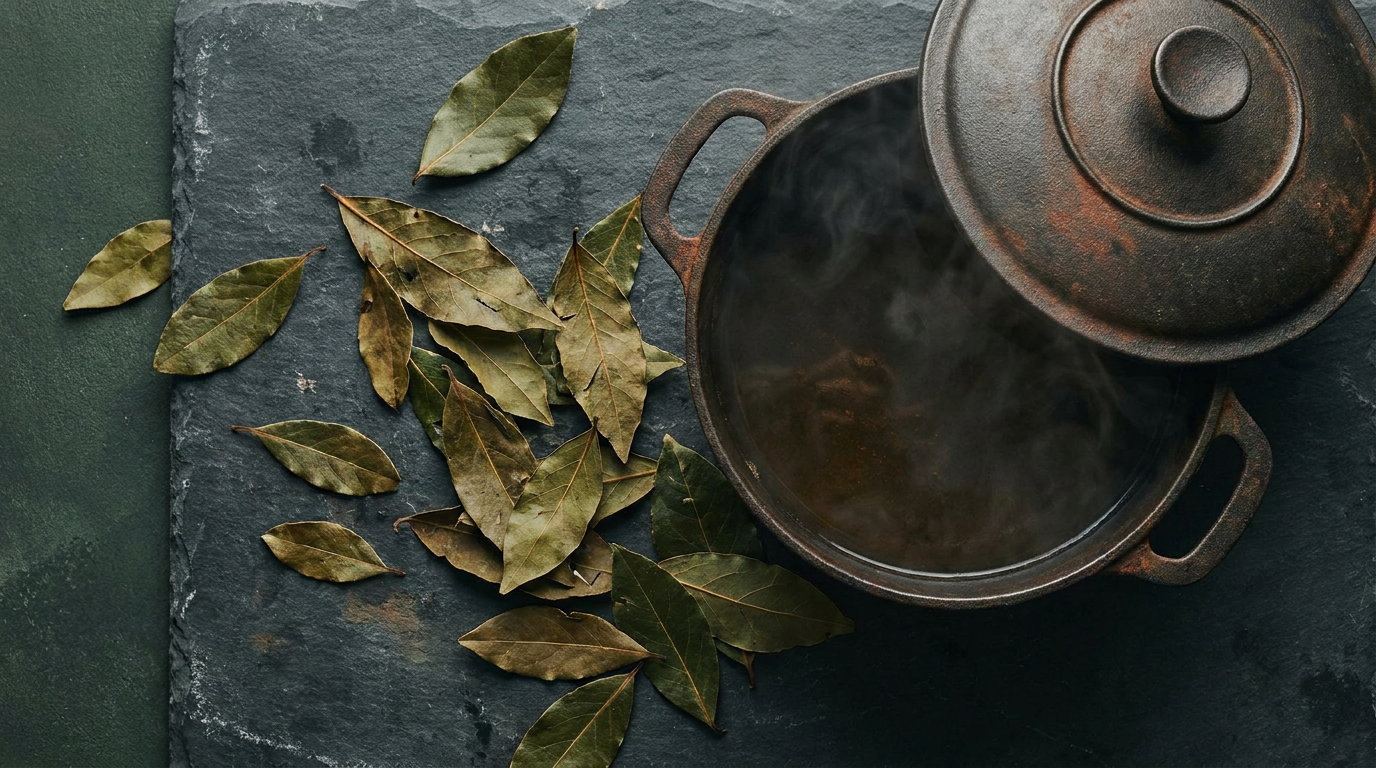
Bay leaf (Laurus nobilis) is an aromatic dried leaf harvested from the Mediterranean bay laurel tree, prized across global cookery for lending woody, herbal depth to slow-simmered dishes. Driven by essential oil compounds such as 1,8-cineole, eugenol, and linalool, its chemistry requires sustained heat and liquid to extract, transforming harsh medicinal aromatics into subtle, savoury complexity.
Every few months, an internet debate resurfaces asking whether the bay leaf is an elaborate practical joke. Cooks pull a leathery, intact oval from a pot of beef stew, discard it onto the rim of a bowl, and wonder aloud what would have happened had they simply omitted it. To bite into one directly is unpleasant: bitter, astringent, and reminiscent of eucalyptus vapour rub. Yet omitting it leaves stocks, braises, and bean broths curiously flat.
The confusion stems from how bay leaf works in a pot. It is not an herb intended to dissolve, nor is it a finishing note. It is an extraction problem.
The volatile profile: why time matters
The dried foliage of Laurus nobilis contains between 1 and 3 percent essential oil by weight [1]. The primary driver of its aroma is 1,8-cineole (also known as eucalyptol), which often accounts for more than 40 percent of the volatile fraction [2]. On its own, cineole is pungent, camphoraceous, and sharp. If you drop a fresh bay leaf into a quick pan sauce for five minutes, cineole dominates, lending the liquid an astringent, medicinal edge.
When simmered over forty minutes or several hours, however, the volatile landscape shifts. Secondary compounds—primarily eugenol (which provides a warm, clove-like phenolic foundation), linalool (floral and citrus-adjacent), and various terpenes such as alpha-pinene and sabinene—migrate into the surrounding water and fat. Simultaneously, a proportion of the more volatile monoterpenes evaporates away, muting the raw menthol-like top notes. What remains is a rounded, woody resinous baseline that binds other savoury elements together.
Because these compounds are largely lipophilic, they do not dissolve readily in plain water. A bay leaf boiled in salted water extracts poorly compared to one simmered in a stock containing gelatin, rendered lipids, or milk solids. The fats hold onto the eugenol and linalool, acting as a reservoir that slowly releases aroma across the palate.
Not all leaves sold as 'bay' are the same plant
Part of the reason recipes fail or taste unexpectedly medicinal is commercial substitution. Market shelves feature three distinct botanicals under the generic label "bay leaf". They are not interchangeable.
| Common Name | Botanical Species | Native Region | Dominant Chemistry | Flavour Profile |
| :--- | :--- | :--- | :--- | :--- |
| Mediterranean Bay | Laurus nobilis | Mediterranean basin | 1,8-cineole, eugenol, linalool | Herbal, woody, subtle clove undertone |
| Indian Bay (Tejpatta) | Cinnamomum tamala | Himalayan foothills, India | Cinnamaldehyde, eugenol, linalool | Warm cinnamon, sweet wood, cassia-like |
| California Bay | Umbellularia californica | Pacific Northwest, US | Umbellulone, 1,8-cineole | Intensely pungent, camphoraceous, cooling |
Cinnamomum tamala, used throughout northern Indian cookery for biryanis and kormas, belongs to the Lauraceae family but shares more chemical kinship with cassia bark than Mediterranean laurel. Its leaves have three prominent lengthwise veins and smell distinctly of sweet spice. Substituting Laurus nobilis into a dish formulated around tejpatta robs it of warm bark aromatics.
Conversely, California bay (Umbellularia californica) contains umbellulone, a volatile compound that irritates the mucous membranes and can trigger headaches if used carelessly [3]. It is roughly three to four times more potent than Laurus nobilis. One whole California leaf in a domestic pot of soup will steamroller every other flavour present.
The swallowing problem
The instruction to "remove the bay leaf before serving" has led generations of diners to believe the plant is poisonous. It is not toxic in culinary amounts. Its hazard is purely mechanical.
The leaf tissue of Laurus nobilis is reinforced with dense, lignified veins and thick cellulose intended to protect the evergreen plant through dry Mediterranean summers. Long boiling softens the flesh slightly, but the vascular skeleton does not break down at standard kitchen temperatures. Biting into a fragment yields sharp edges that resist mastication.
Emergency room literature regularly records cases of intact bay leaves lodged in the oesophagus or causing mucosal abrasions further down the digestive tract [4]. We fish the leaf out not because it harms the chemistry of the broth, but because human teeth cannot comfortably grind its structural fibres into safety.
How to handle the leaf
Fresh leaves are not automatically superior to dried ones. Fresh Laurus nobilis is packed with bitter sesquiterpene lactones and raw cineole. Air-drying over several weeks allows enzymes and gentle oxidation to mellow these astringent compounds, concentrating eugenol's warming contribution [2].
If you want extraction without hunting for intact leaves at dinner, crack the dried leaf once across its spine to rupture the oil glands before adding it to your braise, or tie several leaves into a cheesecloth sachet. What matters is patience: give it at least forty-five minutes in the presence of liquid and fat, or save the leaf for another night.
Frequently asked questions
Can I substitute fresh bay leaves for dried bay leaves directly?
Use fresh leaves sparingly. Fresh Mediterranean bay has a sharper, more mentholated aroma. Use half the quantity of fresh leaf that a recipe requests in dried form, and avoid prolonged boiling, which can introduce bitter, resinous notes.
Is bay leaf tea safe to drink?
Yes. Infusions made from Laurus nobilis leaves steeped in hot water for five to ten minutes are traditional in Mediterranean herbal practice. The extraction releases cineole and eugenol without the fibrous hazards of eating the leaf whole.
Why don't recipes just call for ground bay leaf?
Ground bay leaf exists and is often included in commercial spice blends like Old Bay. However, ground bay leaf oxidises rapidly on the shelf, losing its linalool while retaining harsh cineole. Whole leaves protect their volatile oils within the internal cells until cracked and simmered.
Sources & citations
- Flamini, G., et al. (2002). Composition of the essential oils of Laurus nobilis leaves from different regions. Journal of Agricultural and Food Chemistry, 50(12), 3510–3512. https://doi.org/10.1021/jf0115049
- Sellami, I. H., et al. (2011). Effect of drying on the essential oil composition and antioxidant activity of Laurus nobilis L. leaves. Industrial Crops and Products, 33(3), 677–682. https://doi.org/10.1016/j.indcrop.2011.01.005
- MacGregor, J. T., et al. (1974). Umbellulone: head-ache producing volatile component of Umbellularia californica. Toxicology and Applied Pharmacology, 27(1), 194–198.
- Fater, M. C., & Holmes, E. C. (1985). Perforation of the terminal ileum by an ingested bay leaf. The American Journal of Surgery, 149(3), 419–420. https://doi.org/10.1016/-0002-9610(85)90124-7