
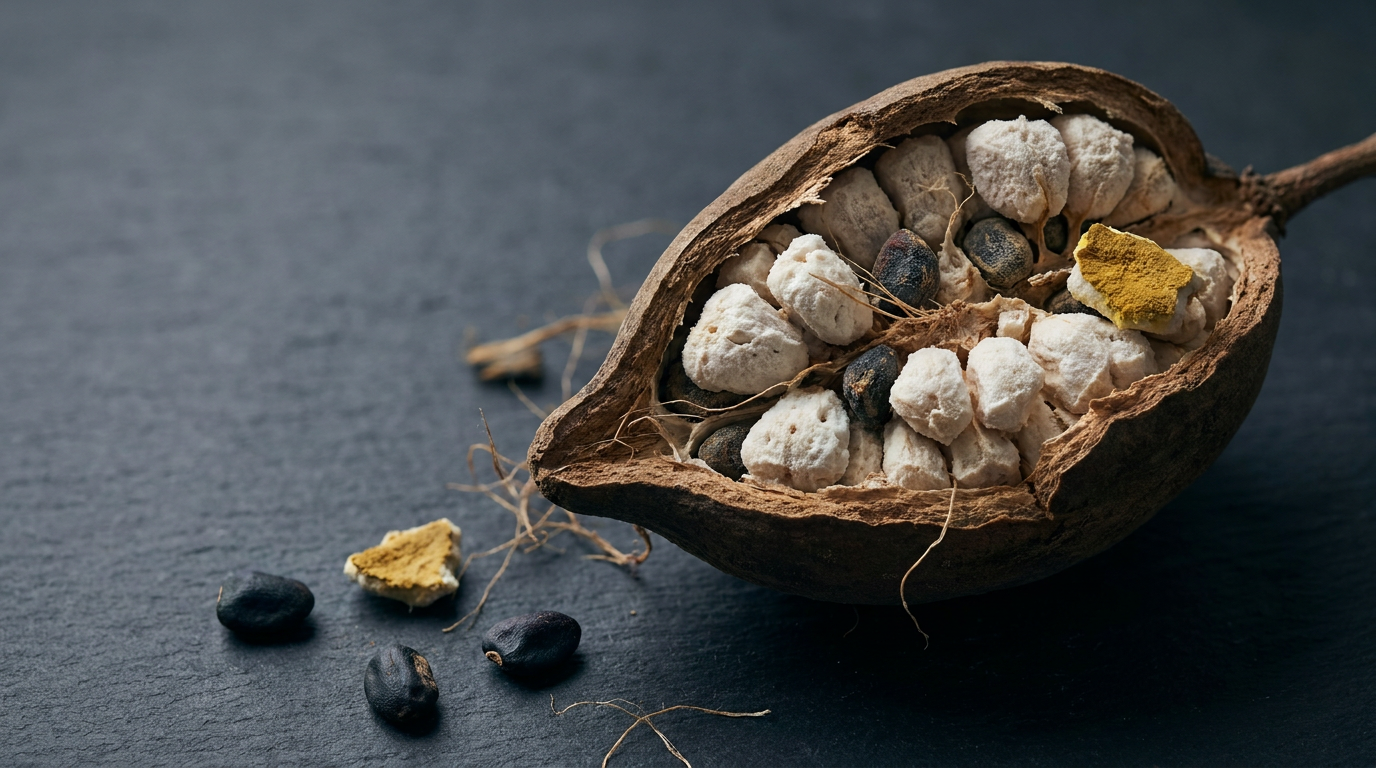
Baobab refers to the fruit, leaves, and bark of the iconic Adansonia digitata tree, native to arid African savannahs, known for its nutrient-dense dry pulp and culinary versatility. Uniquely among edible fruits, its woody pods dehydrate naturally on the branch, producing an acidic, chalky powder exceptionally rich in pectin, vitamin C, calcium, and bioactive polyphenols [1].
Most fruit must be plucked, chilled, preserved, or dried artificially before it spoils. The African baobab (Adansonia digitata) bypasses that entire post-harvest headache by drying completely inside its own woody shell while still suspended on the branch [1]. By the time the pod drops to the dry soil, the inner pulp is not wet tissue at all, but a chalk-white, crumbly matrix encasing brown seeds and reddish fibres.
For communities across the Sahel, southern Africa, and Madagascar, the baobab has never been an exotic novelty or a marketing buzzword. It is an everyday acidifier, thickener, and thirst-quencher. In cooking, it does the work of lemon juice, cream of tartar, and gelatin simultaneously. As explored in our baobab profile, treating it strictly as a wellness powder misses its true value: an extraordinary botanical acid and culinary hydrocolloid.
The chemistry of natural desiccation
Why does baobab pulp dehydrate on the branch without rotting? The process is tied directly to the physiology of the Adansonia tree, an extreme succulent adapted to severe seasonal drought. The trunk stores tens of thousands of litres of water, but during the fruiting period, the tree actively mobilises moisture away from the maturing fruit, dropping its leaves to halt transpiration [2].
Inside the hard, velvety woody pericarp, the water content drops below 12 percent. This low water activity suppresses fungal and microbial growth entirely, yielding a shelf-stable powder inside a natural hermetic seal. When cracked open, the white pulp reveals an intensely tart flavour driven by organic acids: predominantly citric, tartaric, malic, and succinic acids [1].
Alongside this acidity sits a massive concentration of L-ascorbic acid (vitamin C), typically ranging from 150 to nearly 500 milligrams per 100 grams of pulp, significantly higher than fresh oranges or lemons on equivalent dry matter [3]. Because the fruit dries without artificial heat, the heat-sensitive ascorbic acid and its associated polyphenols remain largely undamaged until extracted.
Soluble fibre and structural behaviour
Taste baobab powder raw and the first impression is sharp, dry citrus, followed rapidly by a coat-your-tongue thickness. That viscosity comes from its pectin content. Roughly 50 percent of the dried pulp consists of total dietary fibre, with soluble pectin making up a substantial share [3].
| Attribute | Raw Baobab Pulp | Commercial Spray-Dried Lemon Juice | Tamarind Pulp |
| :--- | :--- | :--- | :--- |
| Moisture Content | < 12% (natural) | ~ 3–5% (industrial) | 15–30% |
| Predominant Acid | Citric, Tartaric, Malic | Citric | Tartaric |
| Pectin / Soluble Fibre | Very high (~25–30%) | Low to none | Moderate |
| Primary Function | Acidifier, binder, thickener | Pure acidulant | Acidifier, colour, body |
| Processing Required | Cracking pod, sieving | Mechanical juicing, spray drying | Shelling, boiling/steeping |
In food systems, this pectin makes baobab behave unlike standard powdered acids. Whisk citric acid into liquid, and the viscosity stays close to water. Whisk baobab into water, milk, or broth, and the high-methoxyl and low-methoxyl pectins hydrate, trapping free water and producing a smooth, glossy emulsion. In Senegalese bouye, the pulp is massaged into water or milk and sweetened, creating a drink that resembles thin yoghurt without any fermentation involved.
Starch interaction and the glycemic response
There is also compelling carbohydrate chemistry in how baobab interacts with cooked grains. When baobab extract is incorporated into high-starch foods, such as wheat bread or millet porridge, it measurably slows down starch digestion [4].
This is not a mystical mechanism. The combination of high polyphenol concentrations (especially proanthocyanidins and soluble tannins) and rich soluble fibre acts as a physical and chemical brake on digestive enzymes. Laboratory and human crossover trials show that baobab polyphenols directly inhibit salivary and pancreatic alpha-amylase and intestinal alpha-glucosidase, while the viscous pectin network physically retards the rate at which amylases can access gelatinised starch granules [4]. Adding baobab to a simmered grain sauce is not just a flavouring choice; it alters the physical architecture of the meal.
Using baobab in the kitchen
Because the fruit contains native pectins and delicate vitamin C, high, sustained heat is its enemy. Prolonged boiling dulls the bright, malic-citric sharpness into a flat, muted sourness and breaks down the pectin chains, leading to a thin, watery consistency instead of a velvet body.
Treat it as you would cold-churned sumac, tamarind water, or late-stage citrus zest:
- In dressings and emulsions: Whisk baobab powder directly with olive oil, a splash of water, and salt. The pectin acts as a natural emulsifier, producing a stable vinaigrette without needing prepared mustard or egg yolk.
- In broths and stews: Stir a slurry of baobab powder and warm water into braises or groundnut sauces just after removing the pot from the heat. It provides the acidic balance required to cut through heavy, lipid-dense dishes.
- In macerations: Dust it over sliced stone fruit or berries with a small pinch of sugar; the powder draws out moisture and forms a bright, tart glaze within ten minutes.
Frequently asked questions
Does baobab powder dissolve completely in water?
No. Because it contains both soluble pectin and insoluble plant fibres, it does not dissolve clear like refined citric acid. It creates a cloudy suspension with significant body. Whisking or blending produces the smoothest suspension.
Can baobab replace cream of tartar in baking?
Yes, in many cases. The high natural tartaric and citric acid content allows baobab powder to activate baking soda (sodium bicarbonate) effectively. However, it will lend a pale fawn colour and a faint citrus flavour to the crumb.
How should raw baobab powder be stored?
Because it has an inherently low moisture content, baobab is remarkably stable. Kept in an airtight jar away from ambient humidity and direct sunlight, it retains its acidity and volatile profile for upwards of two years.
Sources & citations
- National Research Council. (2008). Lost Crops of Africa: Volume III: Fruits. The National Academies Press. https://doi.org/10.17226/11879
- Wickens, G. E., & Lowe, P. (2008). The Baobabs: Pachycauls of Africa, Madagascar and Australia. Springer Science & Business Media.
- Chadare, F. J., et al. (2009). Baobab food products: a review on their composition and nutritional value. Critical Reviews in Food Science and Nutrition, 49(3), 254–274. https://doi.org/10.1080/10408390701856330
- Coe, S. A., et al. (2013). The polyphenol-rich baobab fruit (Adansonia digitata L.) reduces starch digestion and glycemic response in humans. Nutrition Research, 33(11), 888–896. https://doi.org/10.1016/j.nutres.2013.08.002